The fact is that the air moving along the upper surface of the wing does move faster than the lower surface, but it’s not because it’s trying to get to the back at the same time, as was first assumed. The air particles above the wing have no idea what speed the air particles below the wing are going, nor do they care! The reason the air on top flows faster has to do with how it is compressed and deflected upward as it approaches the plane. This creates a low pressure area towards the back of the wing, which pulls the air quickly downward and over the surface. The air curves around the surface for this reason, and the pressure there is lower. The air that goes around the bottom of the wing is compressed and deflected downward. This creates a higher pressure area. So the strict Bernoulli explanation was close, but not the whole picture.
The amount of lift a plane (or bird) gets depends on other things: the angle of attack and the speed that the air is moving.
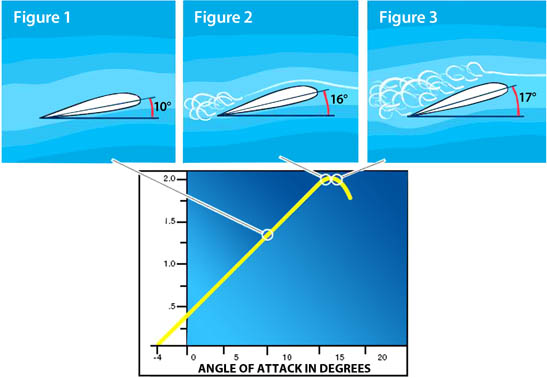
The angle of attack is simply the angle at which the wing meets the air. If the wing is fairly flat, there is very little lift, as seen in Figure 1. If the angle is greater, the lift is greater, both because the air from below pushes up on the wing more, and because the pressure difference is greater. This can be seen in Figure 2. The lift increases until the angle becomes too great, at which point the air cannot curve downward properly over the top of the wing. The air flow separates from the top of the wing, which actually reduces the curve of the airflow, resulting in very little pressure difference (see Figure 3). This causes "stall", and there will be no lift until the pilot reduces the angle of attack.
All planes have stall warning sirens if this happens, so the pilot can correct the problem. This is why planes need to go up at a gradual angle, and can’t just climb straight into the sky.
Angle of Attack
What is the angle of attack?
The angle that the wing meets the air.
