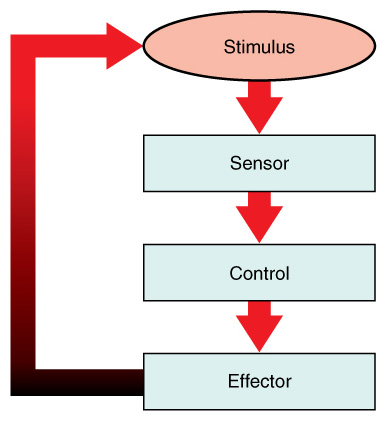
 A negative feedback loop can be visualized in a simple flow chart. |
How do sensors, effectors, and the integration center work together to help the body's environment stay around its set point values? The most common way is through a negative feedback loop. A negative feedback loop is a closed path that tends to reduce the activity of a body system. It occurs when a stimulus causes a change in a particular set point and the body activates processes that reverse, or negate, the change.
A negative feedback loop occurs when a stimulus causes a change in a particular set point. This change is picked up by the sensor. The sensor sends a message to the integration center, which is sometimes called the integrator. The integrator sends a signal to effectors, which can be muscles, organs, or other structures. When the sensor receives a signal from the body system that the set point has been reached, it sends a signal for the loop to stop.
A thermostat works on a negative feedback loop. For example, when your house is at 62 degrees F and you feel chilly, you might increase the thermostat setting to 68 degrees F. The sensor in the thermostat then recognizes the difference between the current temperature (62 degrees) and what it's supposed to be (68 degrees), and directs the furnace to produce heat. Once the output of the furnace (heat) increases the temperature of the house, the thermostat's sensor signals the furnace to shut off. Simply stated, the output of a negative feedback pathway signals the pathway to stop.
What vocabulary term from the last page describes the temperature value of 68 degrees F in the example above? First, write down or think about the answer to this question. Then click the Answer button to check your answer.
The temperatures in the above example function as the set point. If the temperature drops below 68 degrees, the sensor signals the system to operate. Once the set point is reached, the sensor signals the system to stop.
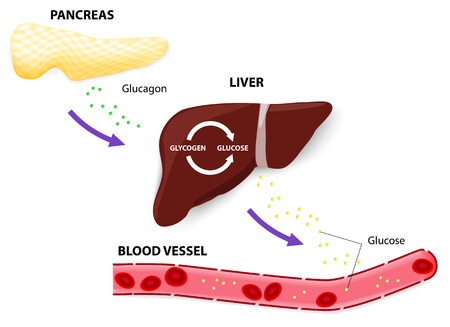 A negative feedback loop keeps blood glucose levels close to a set point. |
Negative feedback loops are one of the most common ways that the body maintains homeostasis. Let's look at an example. All the cells in the body need a sugar called glucose. Glucose comes from the food we eat, and is transformed in cells into energy. When blood glucose levels get below a set point, certain cells in an organ called the pancreas sense this drop. They send an effector chemical called glucagon to the liver, which triggers the release of glucose into the bloodstream. The cells in the pancreas then sense the increase in blood glucose, and stop releasing glucagon.
Question
What do you think happens when blood glucose levels get too high?
