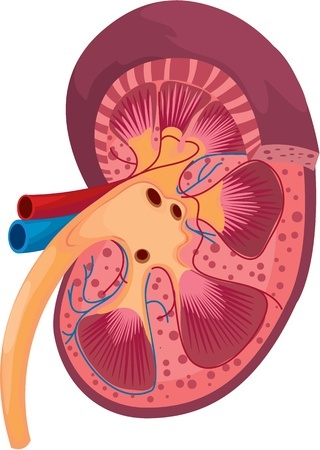
 The kidney is an extremely important organ in osmoregulation. |
In this lesson you've learned about some important examples of homeostasis, as well as how negative feedback loops are used by the body to help maintain homeostasis. The balance between water and salt is also very important in the animal body. Watch the video to learn about osmoregulation, which is the way in which animals keep a consistent water balance.
 Have you ever eaten a large bowl of salty snacks? If so, you probably got pretty thirsty—so thirsty that you had to get a drink of water, and could hardly wait to do so. You can thank a process called osmoregulation for your thirst.
Osmoregulation is all the processes used to keep a consistent water balance. Osmoregulation operates, like thermoregulation, on a negative feedback loop. There are lots of structures and chemical reactions that make up osmoregulation, but they can be demonstrated by a flow chart.
And it's all based on one major principle: that water flows from an area of high concentration to low concentration; if there is more salt in an area of the body, water will go to that area.
Let's go back to our salty snack example. After you eat a lot of salt, the salt concentration in your bloodstream rises. If there was no osmoregulation, then, when this blood got to the kidney, the kidney would pass a lot of salt into the urine. Water would leave the body tissues to get to this salt, and leave you dehydrated, which is not good.
However, if you have a lot of salt in your blood, this higher concentration tells the hypothalamus to release a chemical effector hormone that signals the cells in the kidney to absorb more water. This prevents dehydration.
The opposite occurs if you drink a lot of water. The hypothalamus sends an effector hormone to the kidney to tell it to release more water, making you urinate more. In both cases, when salt concentrations return to normal in the blood, the hypothalamus stops sending out the effector hormone, closing the negative feedback loop.
This negative feedback loop is essential in the animal body to maintain homeostasis in terms of the water balance within the body.
Question
How do you think osmoregulation might differ between marine animals and land animals?
