Keeping a fairly consistent level of blood glucose is just one example of a negative feedback loop. The body also completes thermoregulation, which is the regulation of body temperature through a negative feedback loop. Although this example might seem like it should be very different from keeping a consistent level of blood glucose, it actually is quite similar.
Thermoregulation involves many parts of the body, but still follows the form of a negative feedback loop. Click each tab to see which parts of the body form this loop and how they work together to help keep a consistent body temperature in both hot and cold environments.
Increased Body Temperature
Decreased Body Temperature
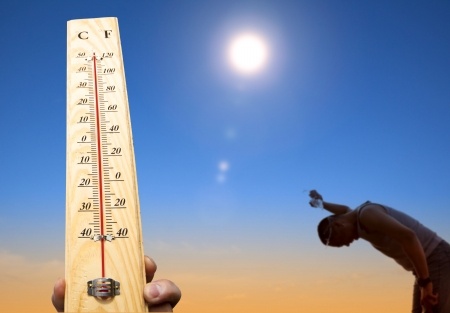
Recall that most people have a temperature set point of about 37 degrees C. During exercise, or when we're in a hot room, our body temperature starts to rise. If it weren't for homeostasis, this increase could cause cell death. What happens instead? A structure in the brain called the hypothalamus receives information from the nervous system that the body's temperature is too high. The hypothalamus then sends signals to:
- the sweat glands, telling them to produce sweat; the evaporation of sweat causes cooling.
- the blood vessels near the skin, telling them to widen; the increase of blood flow to the skin releases heat to the air.
- the tiny muscles in the skin, instructing the hair on our bodies to lie flat. When the hair lies flat against the skin, there is no layer of air next to the skin to act as an insulator--this lack of insulation encourages the release of heat.
- stop these actions when the temperature decreases to about the set point.
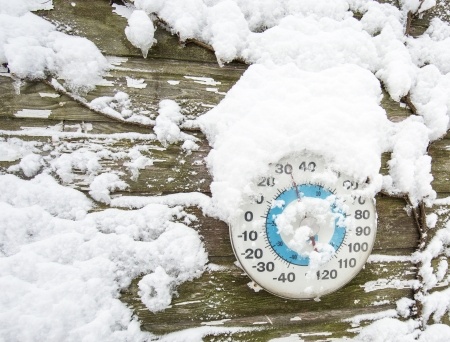
Our bodies must also maintain our temperature set point of 37 degrees C in cold conditions. In the cold, our body temperature starts to fall. If it weren't for homeostasis, this decrease would cause damage to tissues and organs. What happens instead? The hypothalamus receives information from the nervous system that the body's temperature is too low. The hypothalamus then sends signals to:
- the sweat glands, turning them "off"; this action prevents cooling by evaporation.
- the blood vessels near the skin, telling them to tighten; the decrease of blood flow to the skin keeps heat inside the body.
- the tiny muscles in the skin, instructing the hair on our bodies to stand up (resulting in "goosebumps"). When the hair stands up, a cushion of air is trapped next to the skin, creating a layer of insulation. This layer of insulation encourages the retention of heat.
- skeletal muscle to contract and relax rapidly; this action makes us shiver, and the friction during shivering produces heat.
What roles in the negative feedback loop do the body structures above play? See if you can answer the questions.
Which is the integrator in this type of negative feedback loop?
- the sweat glands
- the muscles beneath the skin
- the nerves within the body
- the hypothalamus
The integrator is the part of the loop that receives information from the sensors and sends directions to the effectors.
The integrator is the part of the loop that receives information from the sensors and sends directions to the effectors.
The integrator is the part of the loop that receives information from the sensors and sends directions to the effectors.
The integrator is the part of the loop that receives information from the sensors and sends directions to the effectors.
What role do the muscles and blood vessels play in this negative feedback loop?
- integration centers
- effectors
- sensors
- stimuli
Both of these structures carry out commands to retain heat or release heat.
Both of these structures carry out commands to retain heat or release heat.
Both of these structures carry out commands to retain heat or release heat.
Both of these structures carry out commands to retain heat or release heat.
Which of these is not an effector in the negative feedback loop that helps to release heat?
- the blood vessels under the skin
- the sweat glands
- the muscles beneath the skin
- the hair on top of the skin
When the body's temperature is higher than its set point, the body must release heat in order to maintain homeostasis.
When the body's temperature is higher than its set point, the body must release heat in order to maintain homeostasis.
When the body's temperature is higher than its set point, the body must release heat in order to maintain homeostasis.
When the body's temperature is higher than its set point, the body must release heat in order to maintain homeostasis.
Summary
 Questions answered correctly:
 Questions answered incorrectly:
