From about 2000 B.C.E. to about 1000 B.C.E., the Bantu and other migrants move through sub‐Saharan Africa, herding and spreading agriculture. These migrants either displaced or absorbed the native peoples and eventually discovered iron metallurgy to make better tools. They brought yams, millet, and bananas, and the availability of these new foods, along with the new technology, caused a surge in population. The political organization of African tribes was generally based on kin, or extended family, rather than bureaucracy. Families, especially male family leaders, governed villages through councils. The chief was usually the head of the most prominent family. Villages were grouped into districts, and the chiefs dealt with inter‐village affairs. About 1000 C.E., this system began to fall apart as population pressures forced conflicts over resources. Some communities organized military forces and began conquering surrounding communities. The best examples of this were Benin, Ife, and the Kingdom of the Kongo.
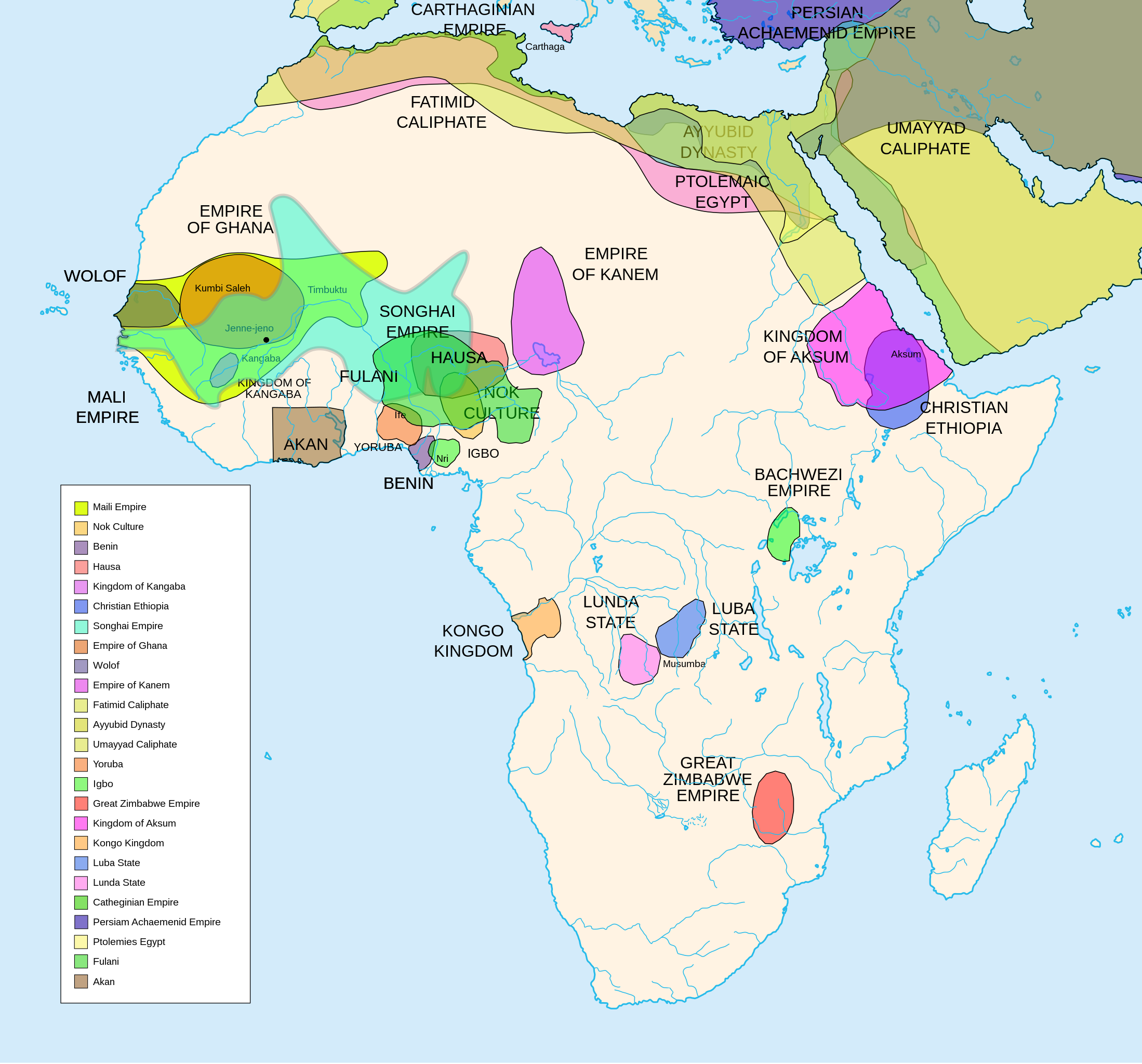
Jeff Israel (ZyMOS) [CC BY-SA 3.0 (https://creativecommons.org/licenses/by-sa/3.0)]
Native African religions had a creator god with lesser gods and spirits, who often were associated with natural features and intervened in people’s lives. Diviners mediated between humans and the spirits and used both rituals and medicine to solve problems. Christianity came to Africa in the first century and Islam in the 700s‐800s. Each influenced Africa in different ways. Christianity was especially strong in Ethiopia, where the kings claimed descent from the Israelite kings.
Exposed to Islam through trade, the kings of Ghana in West Africa became Muslim but did not force conversion on their people. The kingdom declined in the early thirteenth century due to nomadic raiders. The great kingdom in the region was Mali, built by Sundiata in about 1230 C.E. and gaining influence in part by controlling and taxing the trade through Mali. Mansa Musa, who ruled from 1312‐1337, expanded Mali. He also helped advance Islam by participating in the hajj, hiring Islamic scholars, and establishing Islamic schools in Mali. Internal factions and military pressure from its neighbors caused the Mali empire to collapse. It was replaced in the late fifteenth century by the Songhay empire. Further east, the Swahili states developed.
In this lesson, you will learn about the development of African states before the arrival of Islam. Additionally, you will learn about the growth of empire in the Islamic era.
