A. Davey from Where I Live Now: Pacific Northwest [CC BY 2.0 (https://creativecommons.org/licenses/by/2.0)]
Even though Islam would later have a tremendous effect on large portions of the African continent, earlier religious beliefs systems existed among the Bantu peoples of sub-Saharan Africa. The earliest religions were monotheistic among most of the regional tribes, who tended to believe in a single creator god. However, beliefs quickly evolved, and they came to include other lesser gods and spirits that were associated with various natural features. These lesser deities intervened in the workings of the world. As well, the Bantu peoples believed in ancestors' souls and had many rituals. Diviners mediated between humanity and supernatural beings, interpreting the cause of people's misfortune and using medicine or rituals to eliminate problems. Primitive African religion was not theological but practical.
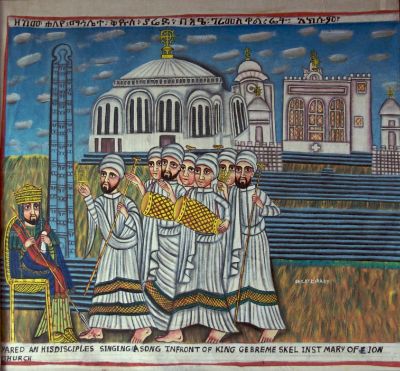
Later, more advanced and well-established religions evangelized into Africa. There was a Jewish presence in northeastern Africa from the 500s B.C.E., and early Christianity reached North Africa during the first century C.E. The Church at Alexandria evolved into the modern Coptic sects of Christianity. The Christian kingdom of Axum in Ethiopia was founded in the fourth century C.E., establishing Ethiopian Christianity. Missionaries translated the Bible into native languages, such as Ge’ez, and popularized Christianity there. Early believers even carved churches out of solid rock. This form of Christianity has deeps roots in Judaism. In fact, the Solomonic dynasty of the thirteenth century C.E. claimed descent from Israelite kings. Moreover, many Ethiopians believe that the Ark of the Covenant, missing since the Babylonian Captivity, is guarded in a church in Axum. The Solomonic dynasty used the Kebra Negast, a fictionalized account of lineage, to prove their Israelite descent. This belief would eventually become popular with another religion, Rastafarianism.
Textbook Reading
Select the tab for the version of the textbook that you have available.
6th edition
7th edition
In your textbook, read Chapter 18, focusing on the following sections:
-
Effects of Early African Migrations
-
Agriculture and Population Growth
-
Political Organization
-
-
Africa Society and Cultural Development
-
Social Classes
-
African Religion
-
The Arrival of Christianity and Islam
-
-
Islamic Kingdoms and Empires
-
Trans-Saharan Trade and Islamic States in West Africa
-
Indian Ocean Trade and Islamic States in East Africa
-
In your textbook, read Chapter 18, focusing on the following sections:
-
Effects of Early African Migrations
- Agriculture and Population Growth
- Political Organization
-
Africa Society and Cultural Development
- Social Classes
- African Religions
- The Arrival of Christianity
-
Islamic Kingdoms and Empires
- Trans-Saharan Trade and Islamic States in West Africa
- Indian Ocean Trade and Islamic States in East Africa
Be sure to take notes on key concepts, vocabulary, and questions you might have for your instructor. Upon finishing the reading and note-taking, test your understanding of the material with the activity provided below.
Cards remaining:
Question
What religious heritage was claimed by the Solomonic dynasty of Ethiopia?
The kings and emperors of Axum and Ethiopia claimed they were descendants of the ancient kings of Israel. There was a Jewish presence in the region, especially after the Jewish Diaspora in 70 C.E., and the dynasty claimed to have possession of the Ark of the Covenant. However, the dynasty was Christian, pointing to a continuation of Jewish royal and theological heritage through Christianity.
