As this lesson has demonstrated, there are certain characteristics, or properties, that must be present before you can state truthfully that any two triangles are similar. Try saying those properties to yourself—to see how well you have learned them—before clicking the button below.

| In order for two triangles to be congruent the following must be true: a) The corresponding angles must be congruent. b) The corresponding sides must have a common ratio. |
While proving these characteristics are present is one way to claim that two triangles are similar, it's not the only way. There are certain similarity properties that, if you can show that they exist, allow you to use just two or three pieces of information about the triangles to show that they're similar.
Similarity properties are generally identified by name and are often abbreviated. Let's take a closer look at each of these properties.
| Property | Description |
| Angle-Angle or AA | If the two corresponding angles of two triangles are congruent, then the triangles are similar. |
| Side-Angle-Side or SAS | If two pairs of sides of two triangles are in the same ratio and the included angles are congruent, then the two triangles are similar. |
| Side-Side-Side or SSS | If all three pairs of corresponding sides have a common ratio, then the two triangles are similar. |
Which property could you use to show that the following two triangles are similar?
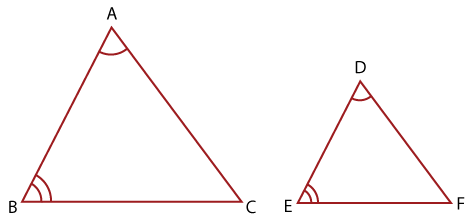
Since \(\small\mathsf{ \angle{A} }\) is congruent to \(\small\mathsf{ \angle{D} }\) and \(\small\mathsf{ \angle{B} }\) is congruent to \(\small\mathsf{ \angle{E} }\), the two triangles ABC and DEF are similar by AA.
