As you may have learned earlier in this course, rhetoric is the use of emotional appeals as well as reasoning to inspire people to change the way they think or act. What you may not realize is that rhetoric is an essentially American activity. To understand how, just recall the style of the foundational documents that created the United States; they used powerfully nuanced language, provocative questions, and carefully structured sentences to make the case for a new country unlike any that had come before.
In contrast to most of the written texts, the foundational speeches, such as the ones delivered by Patrick Henry, were tailored to specific audiences. Speakers like Henry used their relationships with listeners and their listeners' knowledge of that relationship to make their speeches even more effective. They also selected language that listeners were most likely to remember, even after hearing those words just once.
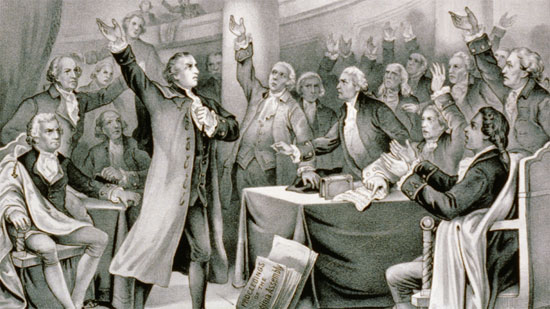
The illustration above depicts Patrick Henry's speech to the Virginia Assembly in 1775, when the Assembly met to consider sending troops to help form a Continental Army, which would essentially begin the war for independence from England. What famous line from this speech—very short and simple in structure—became the rallying cry for the American Revolution?
"Give me liberty, or give me death!"
Patrick Henry's approach is especially useful when delivering rhetoric aloud instead of publishing or passing around copies of a document. The audience for a speech will hear your words just once, as you speak them. Unlike readers, listeners cannot "reread" a sentence that wasn't quite clear or see how ideas are organized on a page.
Question
The Revolution-era politician George Mason said this of Patrick Henry's "liberty or death" speech:
"Every word he says not only engages but commands the attention, and your passions are no longer your own when he addresses them."
What does Mason's statement suggest about the purpose of rhetorical speech?
