|
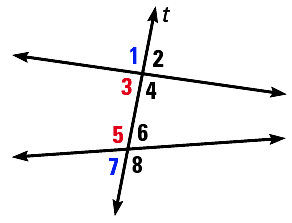
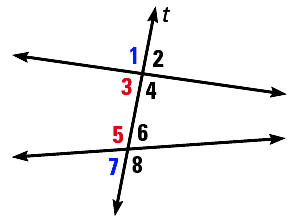
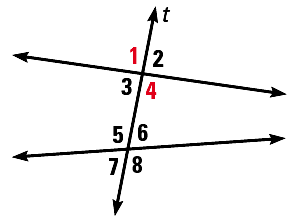
Interior and Exterior AnglesAngles 3 and 5 are interior because they are inside of the two lines crossed by the transversal. Angles 4 and 6 are also interior. Angles 1 and 7 are exterior because they lie outside of the two lines. What are the other exterior angles in the image above?
Angles 2 and 8 are also exterior angles.
Consecutive Interior and Consecutive Exterior AnglesAngles 3 and 5 are called consecutive interior angles because 1) they lie inside of the two lines, and 2) they appear on the same side of the transversal in sequential order. Angles 4 and 6 also appear this way and are consecutive interior. Similarly, angles 1 and 7 are called consecutive exterior angles because 1) they lie outside of the two lines, and 2) they appear on the same side of the transversal in sequential order. Angles 2 and 8 also appear this way and are consecutive exterior.
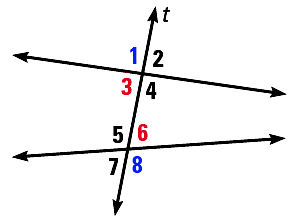
Alternate Interior and Alternate Exterior AnglesAngles 3 and 6 are called alternate interior angles because 1) they lie inside of the two lines, and 2) they appear on opposite sides of the transversal line. Angles 4 and 5 also appear this way and are alternate interior. Similarly, angles 1 and 8 are called alternate exterior angles because 1) they lie outside of the two lines, and 2) they appear on opposite sides of the transversal line. What other angles are alternate exterior angles?
angles 2 and 7
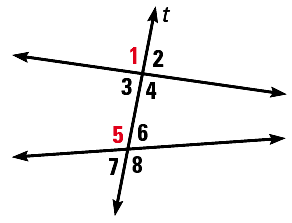
Corresponding AnglesAngles 1 and 5 are called corresponding because they appear in the same position in relation to the transversal and the two lines. For example, angle 1 appears on the exterior side of the transversal and the first line, while angle 5 appears in the same exterior side of the transversal but on the second line.
3 and 7
Vertical AnglesAngles 1 and 4 are called vertical because they lie around the shape of an X and are on opposite sides. The main characteristic of these angles is that they do not lie next to each other, which means they are nonadjacent.
2 and 3 |
 |