
Let's Break it Down
In a previous lesson, you learned about the triangle sum theorem.

Triangle Sum Theorem
The triangle sum theorem states the sum of all three interior angles in a triangle must equal \(180^\circ\).
For a triangle with angle measurements \(x,\ y,\ z,\) as seen here:
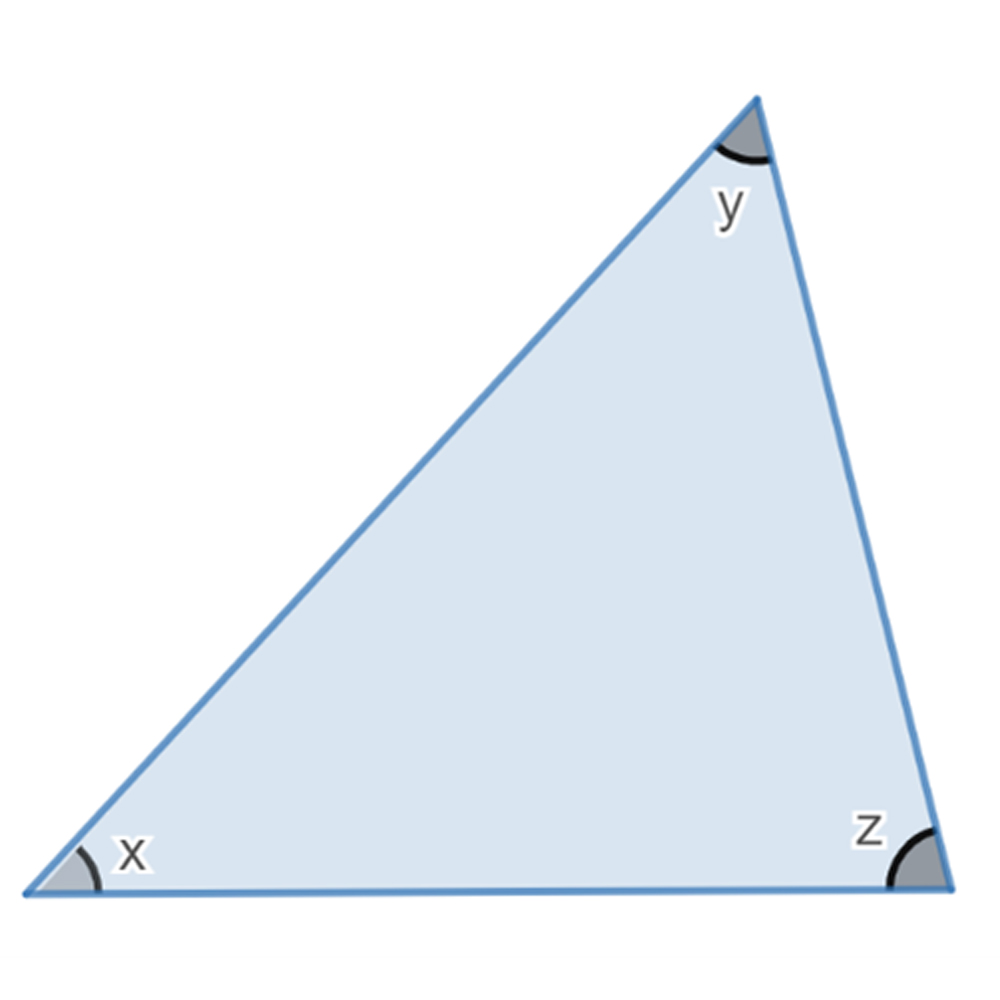
\(x+y+z=180^\circ\)
You also learned how to use the triangle sum theorem to identify when a triangle does not exist due to its angle measurements. For example:

Mathalio wants to construct the next tortilla chip, and it must be in the shape of a triangle. His team has proposed two designs that have the interior angle measurements shown below.
Chip A: \(90^\circ, 80^\circ, 70^\circ\)
Chip B: \(67^\circ, 104^\circ, 9^\circ\)
Which interior angle measurements form a triangle?
Chip B forms a triangle because a triangle can only be formed when all three of its interior angles add up to \(180^\circ\).
Chip A: \(90^\circ+80^\circ+70^\circ=240^\circ\)
Chip B: \(67^\circ+104^\circ+9^\circ=180^\circ\)
The triangle sum theorem can also be used to find missing angles in a triangle. For example:
Mathalio was shown designs with these four triangles that all have either one or two missing interior angle measurements:
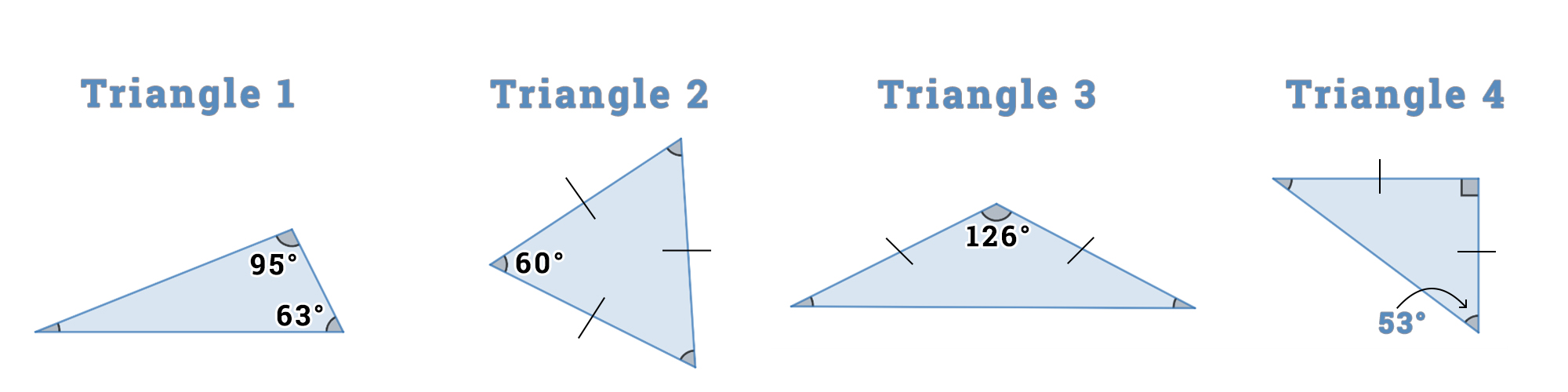
Triangle 1 is a scalene triangle with one angle labeled 95 degrees and another angle labelled 63 degrees. Triangle 2 is an equilateral triangle with one angle labeled 60 degrees. Triangle 3 is an isosceles triangle with the non-base angle labelled 126 degrees. Triangle 4 is a right triangle with one angle labeled 53 degrees.
After some calculations, Mathalio was able to solve for every missing measurement. How did he do it?
Mathalio used the triangle sum theorem and his knowledge of right, equilateral, and isosceles triangles to solve for the missing angles in each triangle. Click each one to learn how.
Label the missing angle measurement. (You can use any letter you like.) |
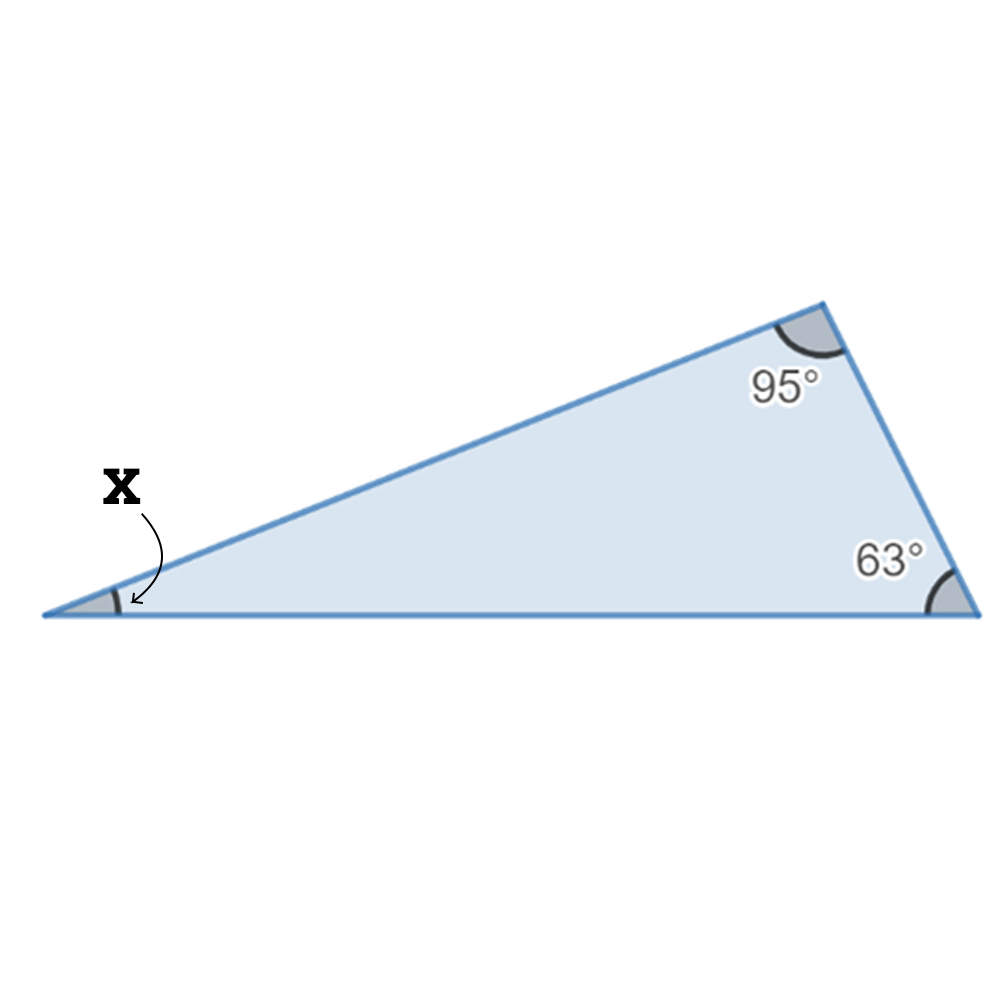 |
Since the triangle sum theorem states that all three interior angles, when added, must equal \(180^\circ\), set up an equation to solve for the missing angle measurement, \(x\). |
\(x+95^\circ+63^\circ=180^\circ\) |
Solve the equation for the unknown variable. |
\(x+95^\circ+63^\circ=180^\circ\) Add the two known angles together: \(x+158^\circ=180^\circ\) Subtract both sides of the equal sign by \(158^\circ\): \(x=22^\circ\) The missing angle measurement is \(22^\circ\). |
Check your solution by adding all three angle measurements together: |
\(22^\circ+95^\circ+63^\circ=180^\circ\) \(180^\circ=180^\circ\) Since this is true, the angle measurement of \(22^\circ\) is correct. 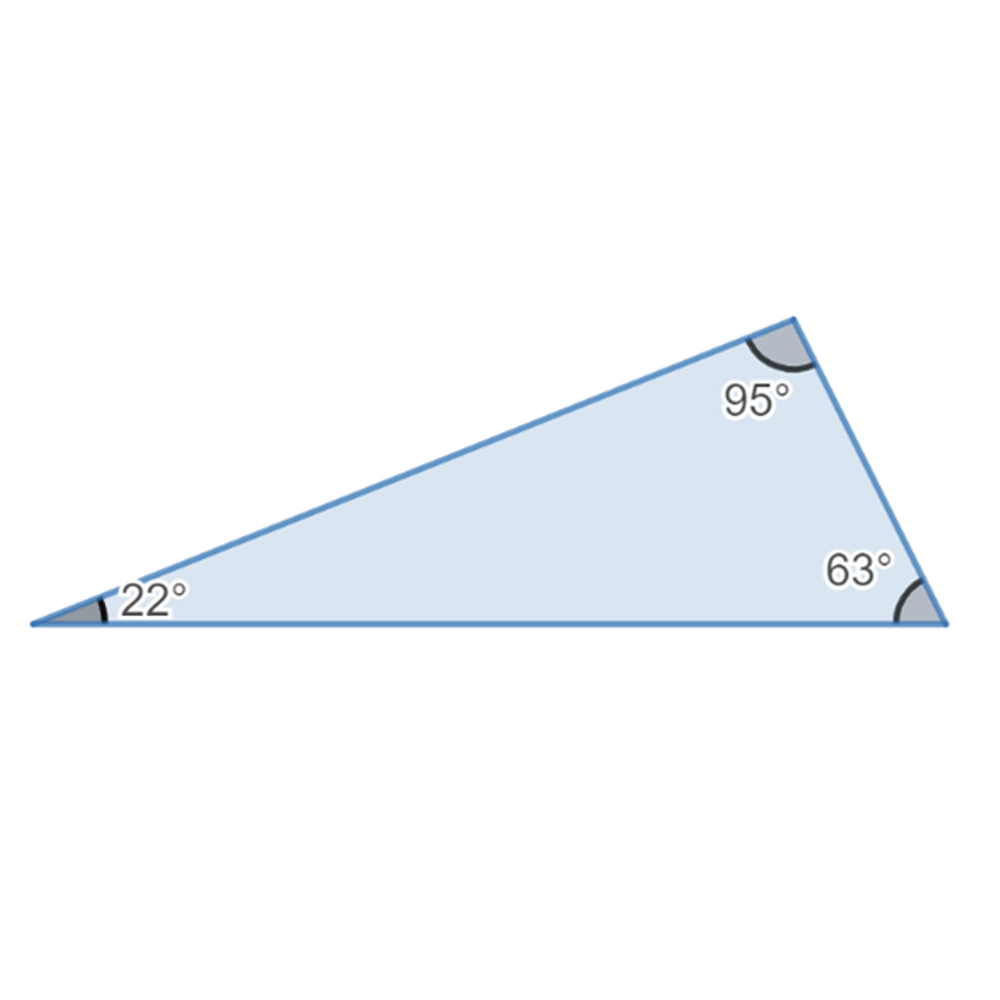 |
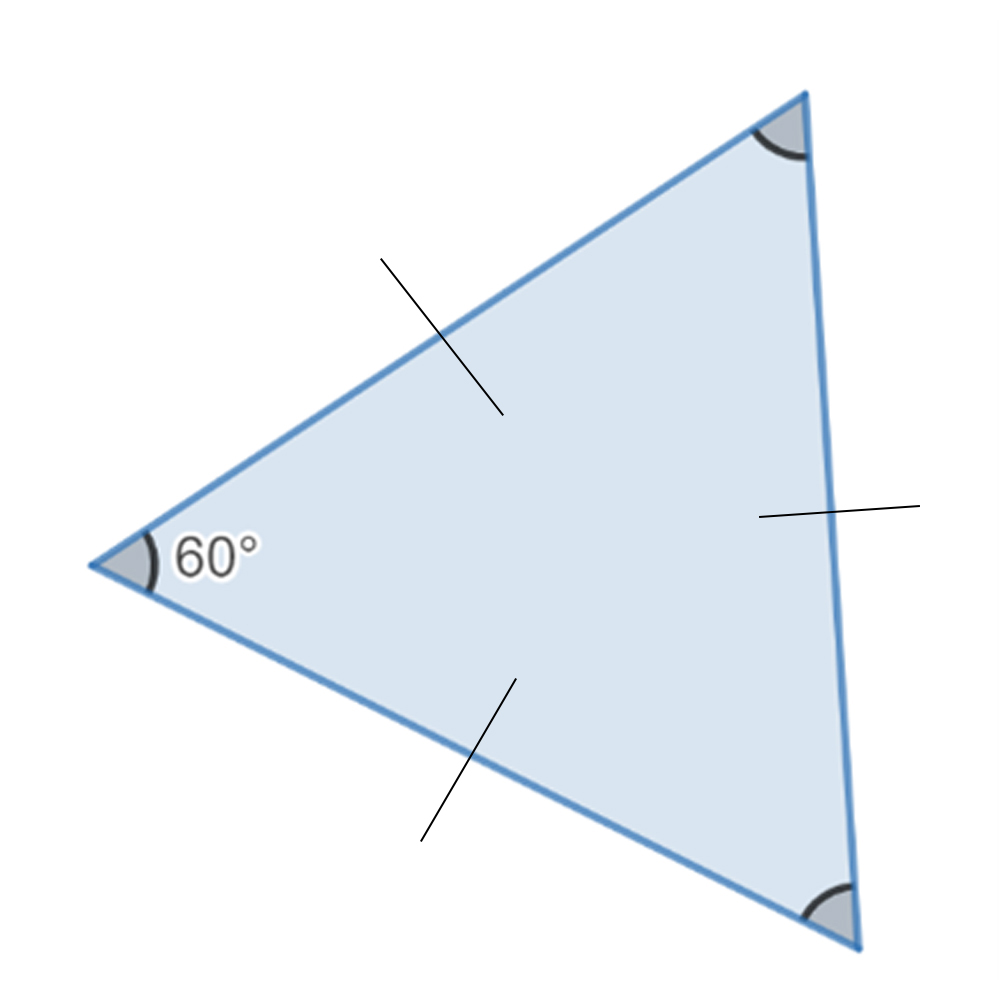
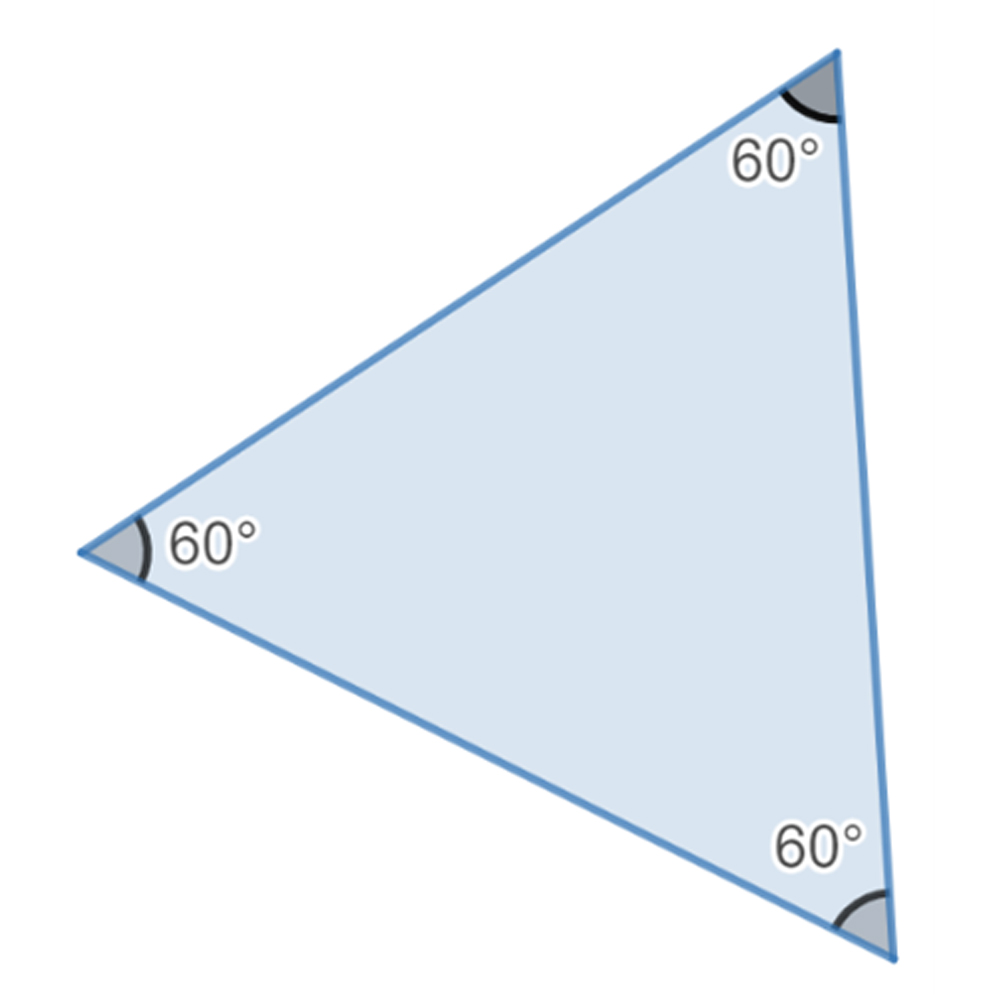
This is an equilateral triangle. This means that all three interior angle measurements are congruent. So, since the one angle measurement is \(60^\circ\), the other two angle measurements will also be \(60^\circ\). In fact, the interior angles of all equilateral triangles are always congruent to \(60^\circ\).
This is an obtuse isosceles triangle, which means that two interior angle measurements will be acute and congruent.
Label the missing angle measurements. Since this is an isosceles triangle both of the unknown angle measures will be equal. |
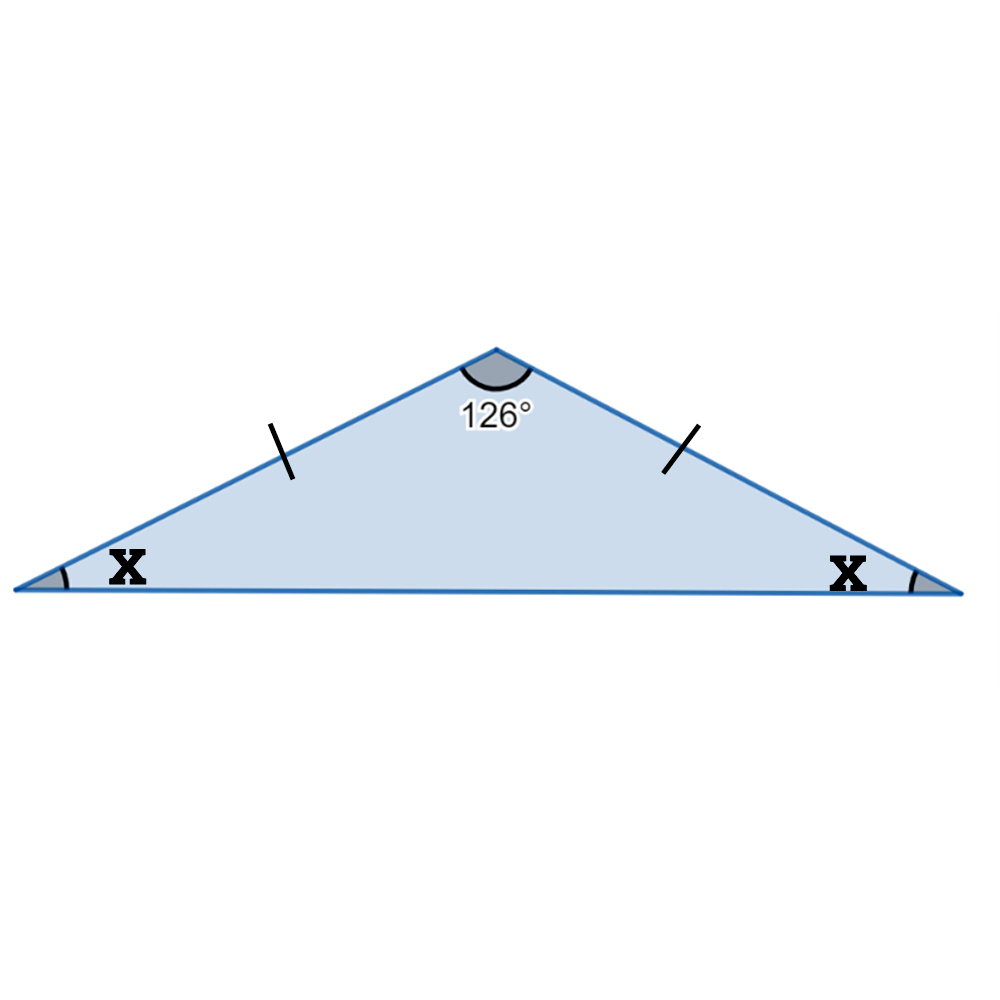 |
Since the triangle sum theorem states that all three interior angles, when added, must equal \(180°\), set up an equation to solve for the missing angle measurements, \(x\). |
\(x+x+126^\circ=180^\circ\) |
Solve the equation for the unknown variable. |
\(x+x+126^\circ=180^\circ\) Combine like terms: \(2x+126^\circ=180^\circ\) Subtract \(126^\circ\) from both sides of the equal sign: \(2x=54^\circ\) Divide by \(2\) on both sides of the equal sign: \(x=27^\circ\) This means that both missing interior angle measurements are equal to \(27^\circ\). |
Check your solution by adding all three angle measurements together: |
\(27^\circ+27^\circ+126^\circ=180^\circ\) \(180^\circ=180^\circ\) Since this is true, the angle measurements of \(27^\circ\) are correct. 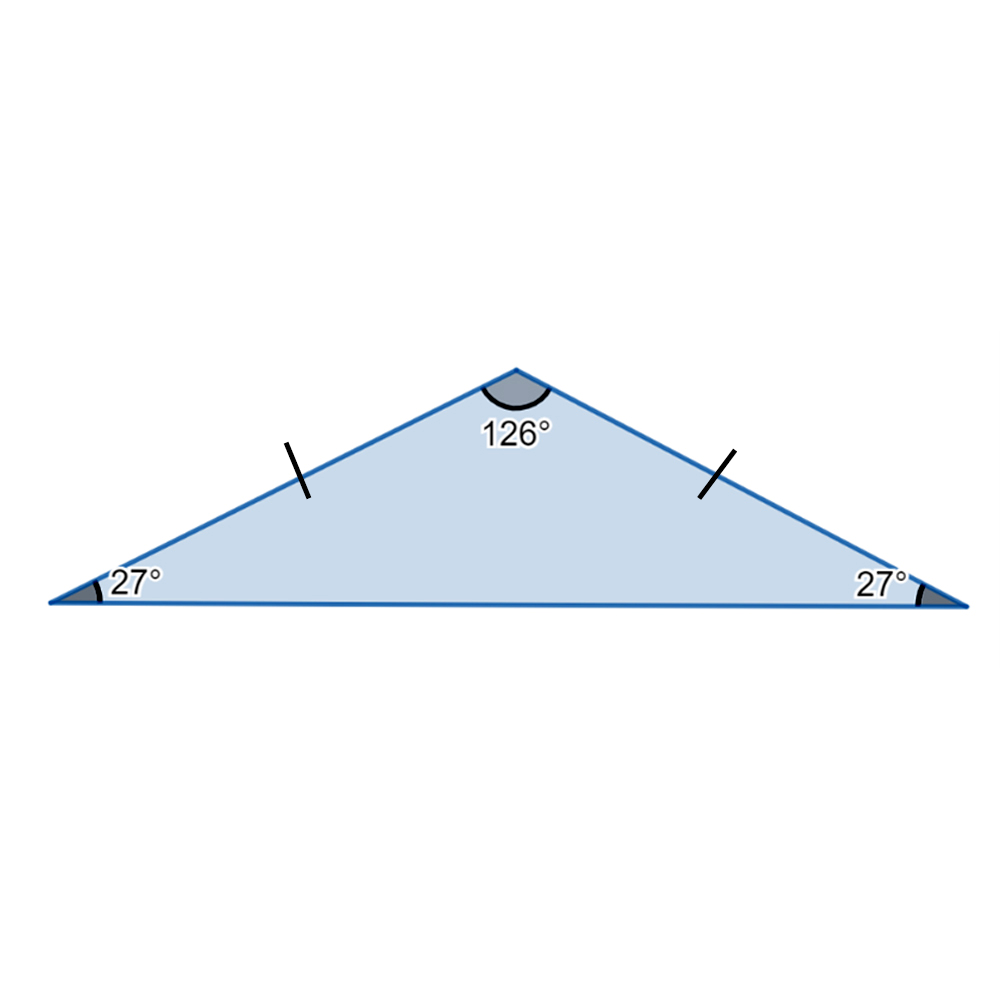 |
Even though only one angle measurement is displayed, two angle measurements are known. When an angle is represented with a square instead of an arc, it is a right angle, which means it measures \(90^\circ\).
Label the other angle. (Use any letter.) |
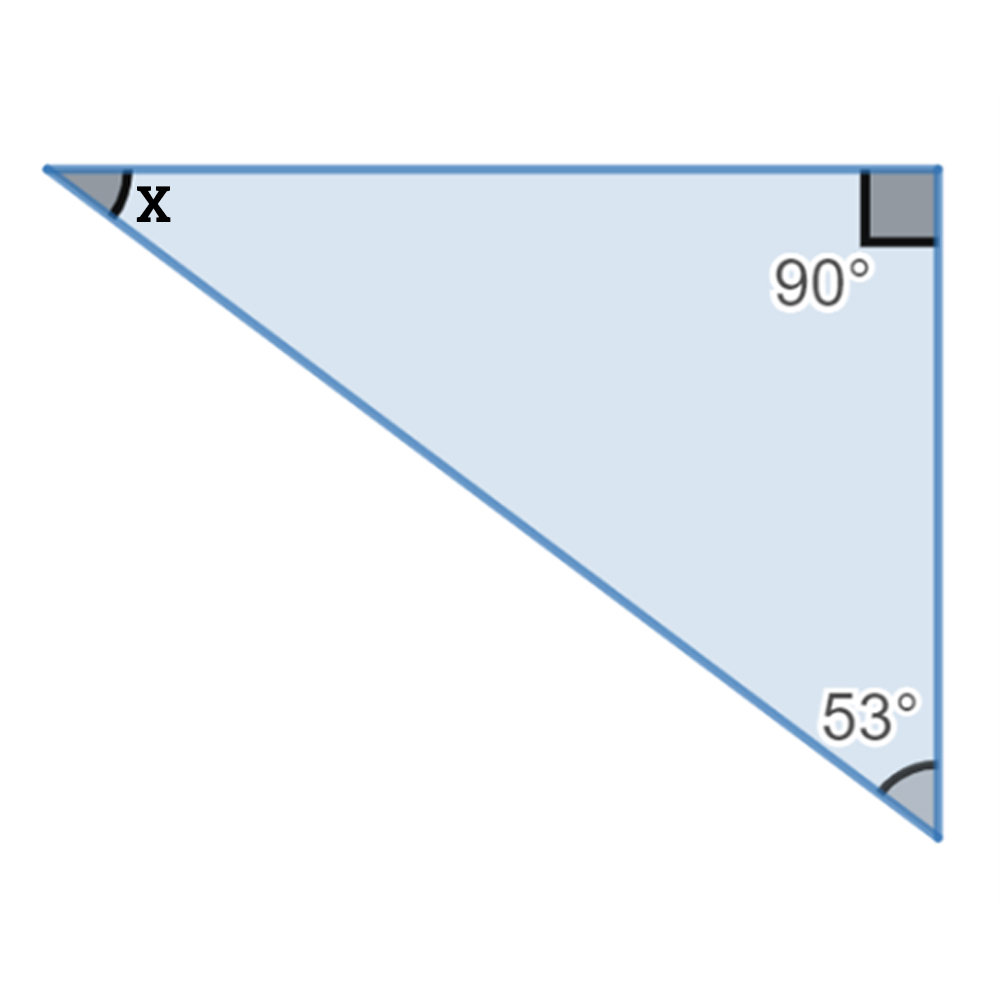 |
Since the triangle sum theorem states that all three interior angles, when added, must equal \(180^\circ\), set up an equation to solve for the missing angle measurement, \(x\). |
\(x+90^\circ+53^\circ=180^\circ\) |
Solve the equation for the unknown variable. |
\(x+90^\circ+53^\circ=180^\circ\) Add the two known angle measurements: \(x+143^\circ=180^\circ\) Subtract \(143^\circ\) from both sides of the equal sign to solve for the missing angle, \(x\): \(x=37^\circ\) The missing angle measurement is \(37^\circ\). |
Check your solution by adding all three angles measurements together: |
\(37^\circ+90^\circ+53^\circ=180^\circ\) \(180^\circ=180^\circ\) Since this is true, the missing angle measurement is equal to \(37^\circ\). 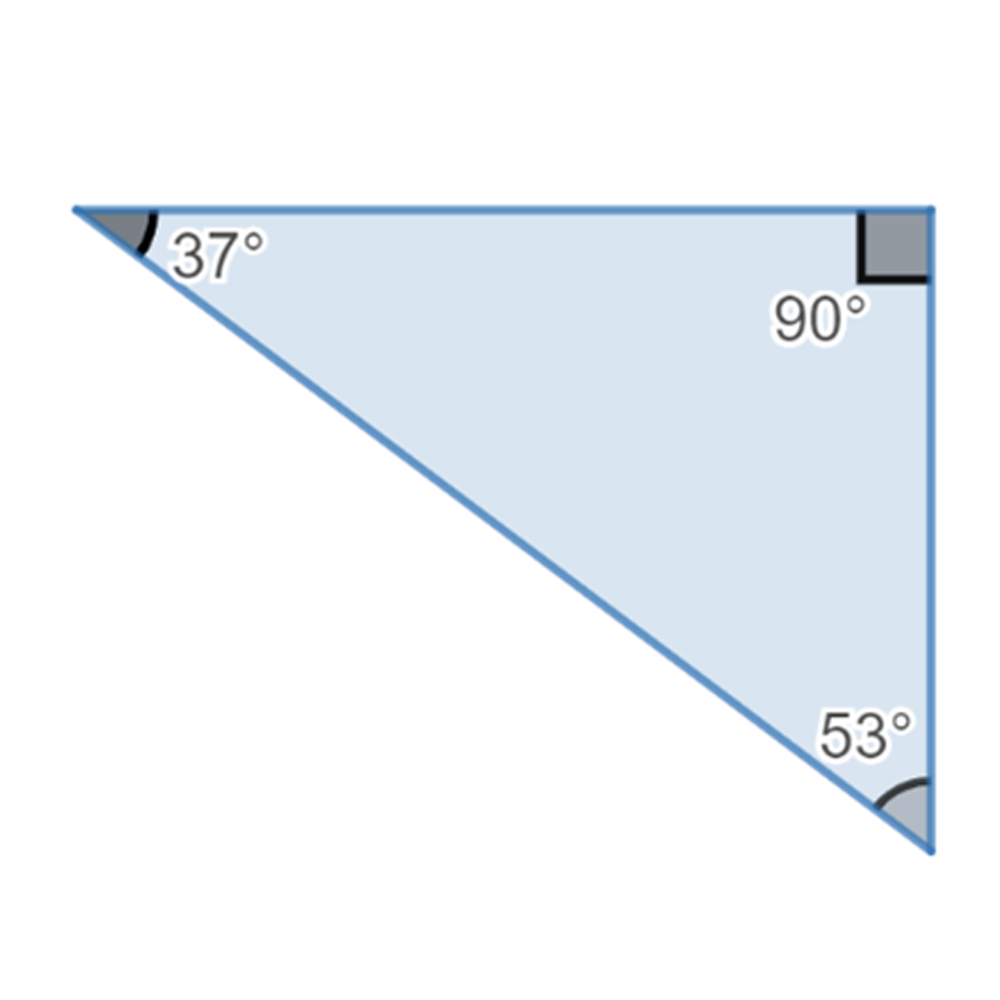 |
Question
Can any type of triangle be identified if only two of its interior angle measurements are known?
Yes. If you noticed above, every type of triangle has different interior angle measures. For example, suppose a triangle has two interior angles measuring \(34^\circ\) and \(112^\circ\). After using the triangle sum theorem, the third interior angle is found to measure \(34^\circ\). Since two angle measurements are congruent and the other is obtuse, these are the interior angle measurements for an obtuse isosceles triangle.
