
Let's Practice
Use your knowledge of the triangle sum theorem and the characteristics of the different types of triangles to complete the activity below. Solve for the missing interior angle measurements in the triangle on each tab. Then, check your answer.
What is the measurement of \(\angle\)B in \(\triangle\)ABC?
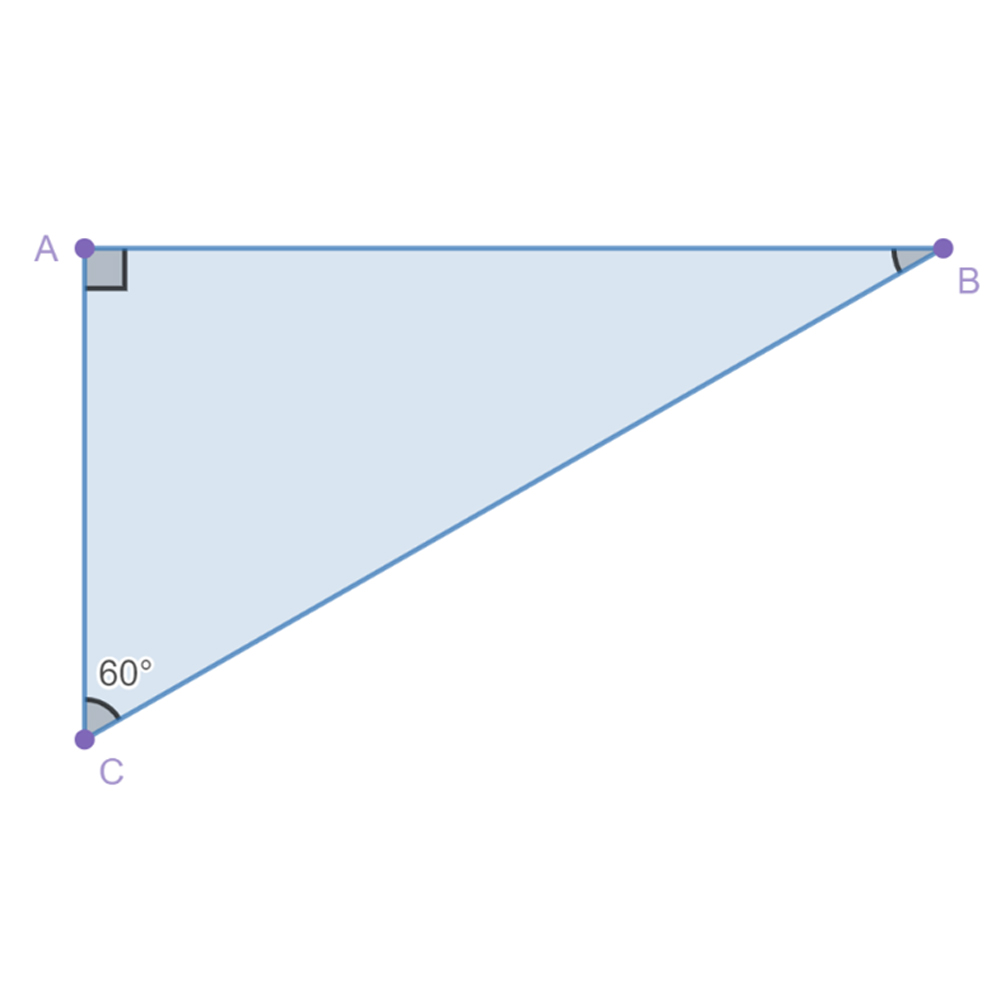
\( m \angle \)B \(=30^\circ\)
If you need help arriving at this answer, click the Solution button.
We are given \( m \angle \)C, which equals \(60^\circ\). Since this is a right triangle, \( m \angle \)A \(=90^\circ\).
Set up the equation using the triangle sum theorem to solve for \( m \angle \)B. |
\( m \angle \)A \(+ m \angle \)B \(+ m \angle \)C \(=180^\circ\) \(90^\circ + m \angle \)B \(+60^\circ =180^\circ\) |
Solve the equation for the unknown variable. |
\(90^\circ + m \angle \)B \(+60^\circ =180^\circ\) Add the two known angle measurements together: \( m \angle \)B \(+150^\circ =180^\circ\) Subtract \(150^\circ\) from both sides of the equal sign to solve: \( m \angle \)B \(=30^\circ\) |
Check your solution by adding all three angle measurements together. |
\(90^\circ +30^\circ +60^\circ =180^\circ\) \(180^\circ =180^\circ\) Since this is true, the missing angle measurement is equal to \(30^\circ\). 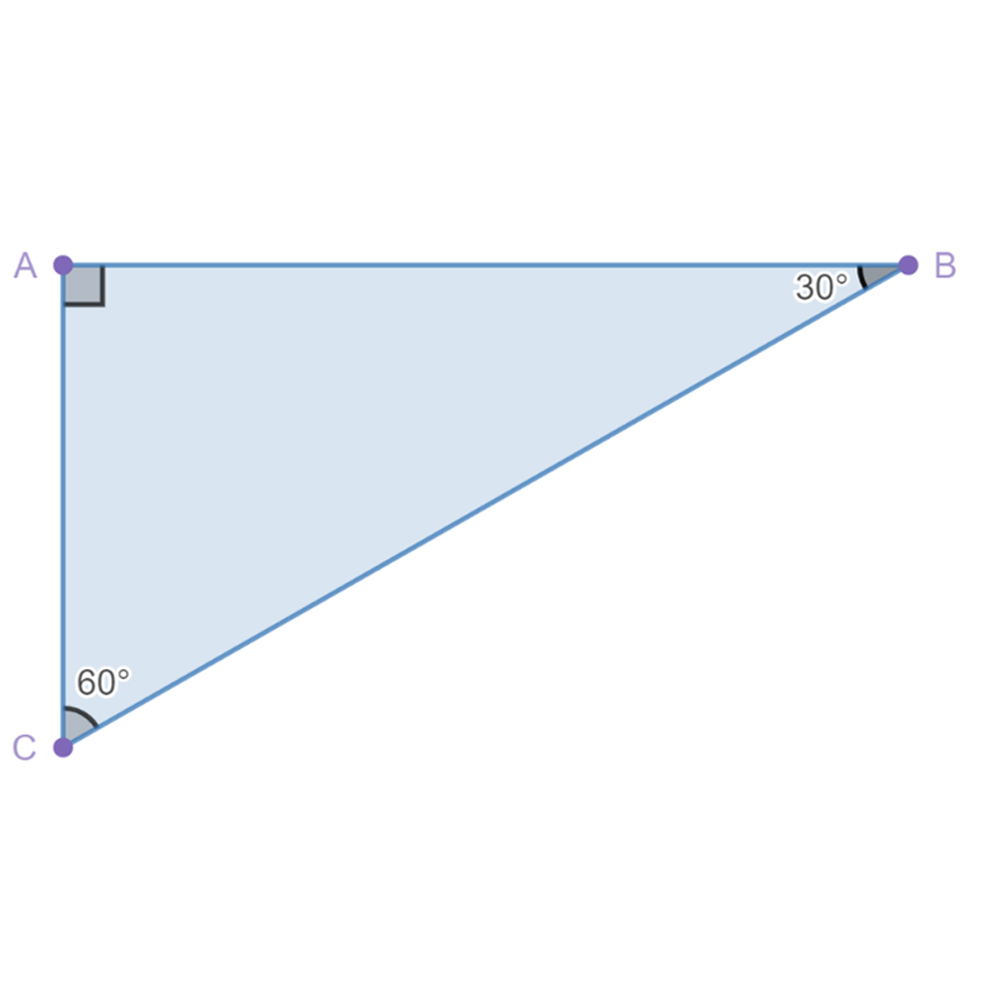
Right triangle ABC. Angle A is a right triangle. Angle B is labelled 30° and Angle C is labelled 60 Right triangle ABC. Angle A is a right triangle. Angle B is labelled 30° and Angle C is labelled 60°. |
Solve for the missing angle measurement, \(x\) in the triangle below.
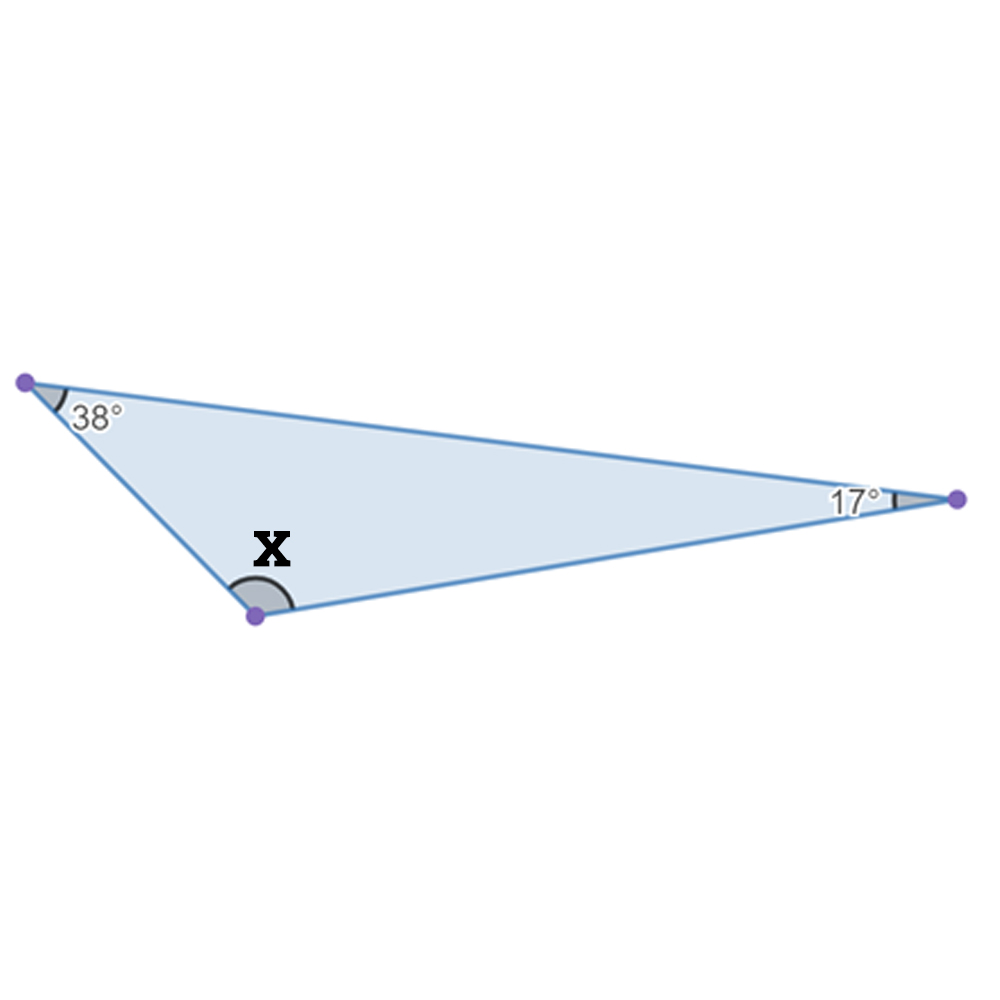
\(x=125^\circ\)
If you need help arriving at this answer, click the Solution button.
To solve for the missing angle measurement, \(x\), set up an equation by using the triangle sum theorem. |
\(x+38^\circ +17^\circ =180^\circ\) |
Solve the equation for the unknown variable. |
\(x+38^\circ +17^\circ =180^\circ\) Add the two known angle measurements together: \(x+55^\circ =180^\circ\) Subtract \(55^\circ\) from both sides of the equal sign to solve: \(x=125^\circ\) The missing angle measurement is \(125^\circ\). |
Check your solution by adding all three angle measurements together. |
\(125^\circ +38^\circ +17^\circ =180^\circ\) \(180^\circ =180^\circ\) Since this is true, the missing angle measurement is equal to \(125^\circ\). 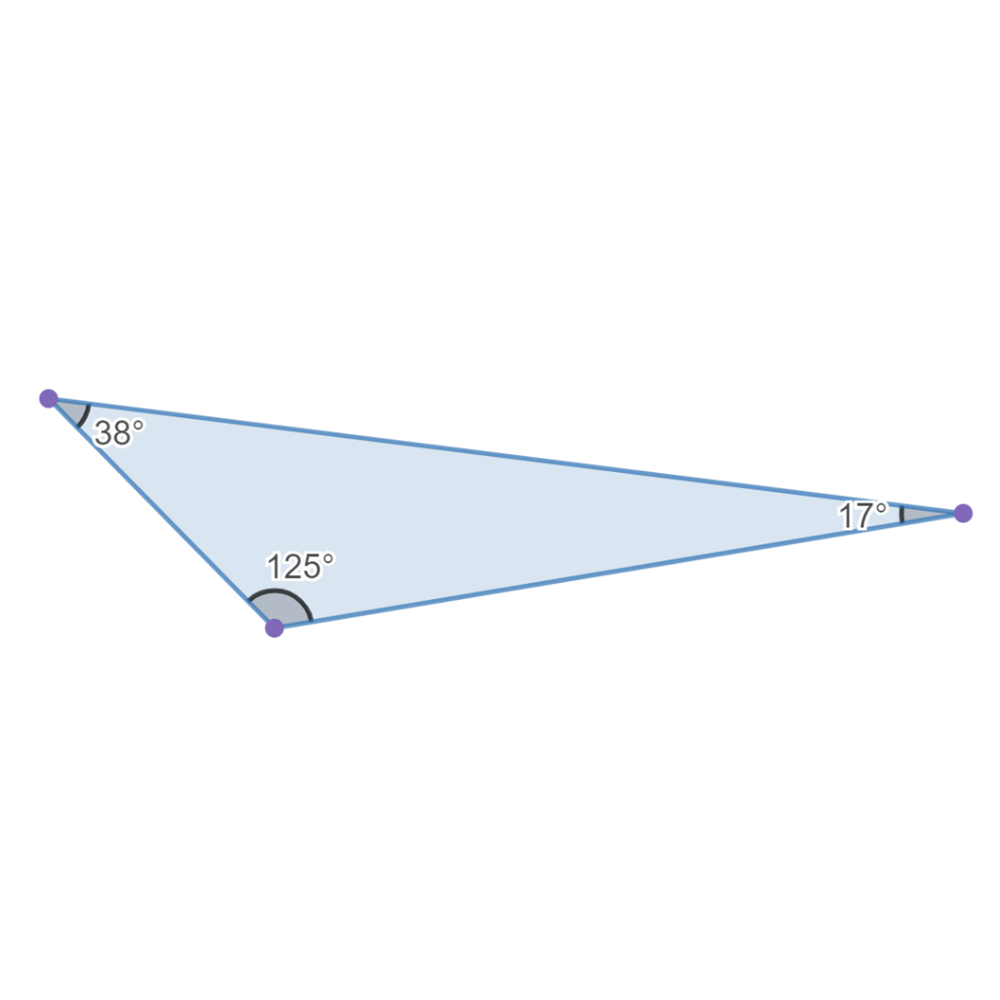 |
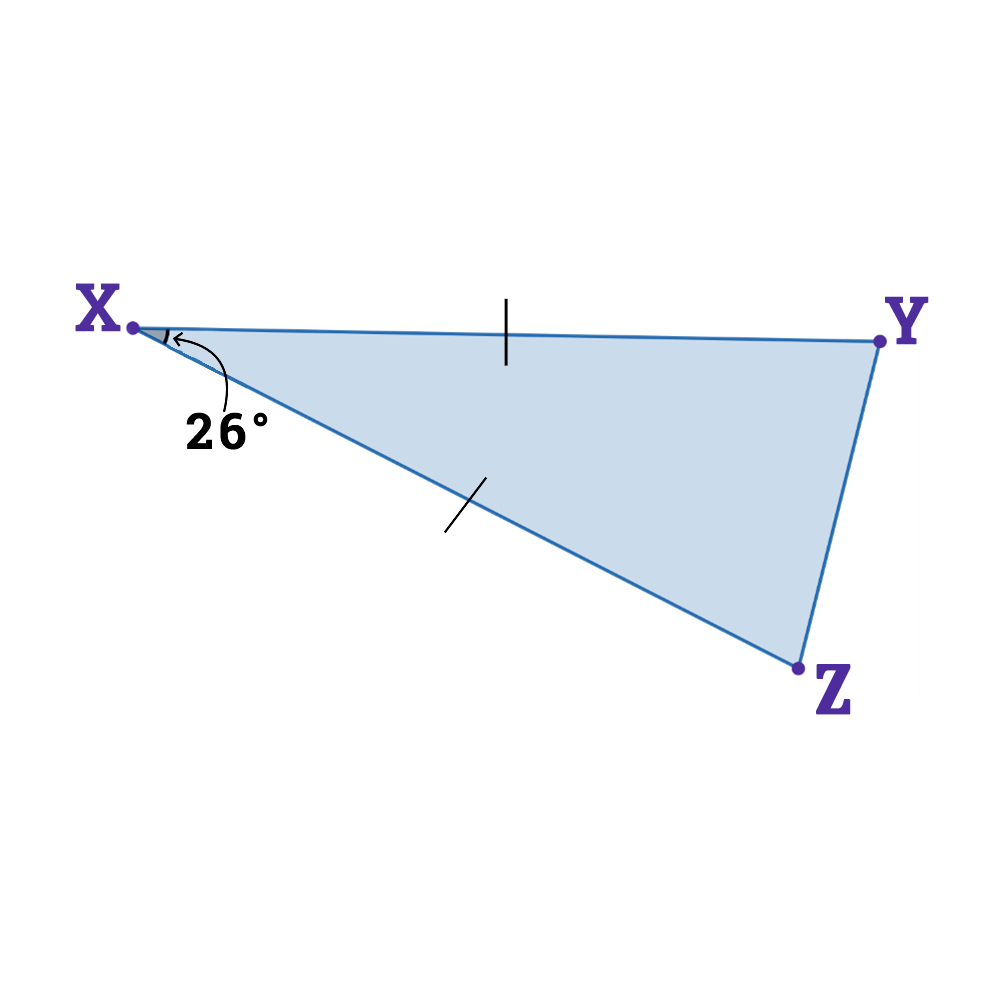
Find the missing angle measurements for \(\triangle\)XYZ.
\( m \angle \)Y \(=77^\circ\)
\( m \angle \)Z \(=77^\circ\)
If you need help arriving at this answer, click the Solution button.
This is an isosceles triangle, which means that two side lengths are equal and two interior angle measurements are congruent. Both of these angles will always be opposite the two side lengths that are equivalent. This means that:
\( m \angle \)Y \(= m \angle \)Z
To solve for the missing angle measurements, set up an equation by using the triangle sum theorem. |
\(26^\circ + m \angle \)Y \(+ m \angle \)Z \(=180^\circ\) Since, \( m \angle \)Y \(= m \angle \)Z, we can replace both angles with the variable \(x\), and then combine the angles: \(26^\circ +x+x=180^\circ\) \(26^\circ +2x=180^\circ\) |
Solve the equation for the unknown variable. |
\(26^\circ +2x=180^\circ\) Subtract \(26^\circ\) from both sides of the equal sign: \(2x=154^\circ\) \(2x=154^\circ\) Divide by \(2\) to solve: \(x=77^\circ\) This means that \( m \angle \)Y \(= m \angle \)Z \(=77^\circ\). |
Check your solution by adding all three angle measurements together. |
\(26^\circ +77^\circ +77^\circ =180^\circ\) \(180^\circ =180^\circ\) Since this is true, the missing angle measurement is equal to \(77^\circ\). 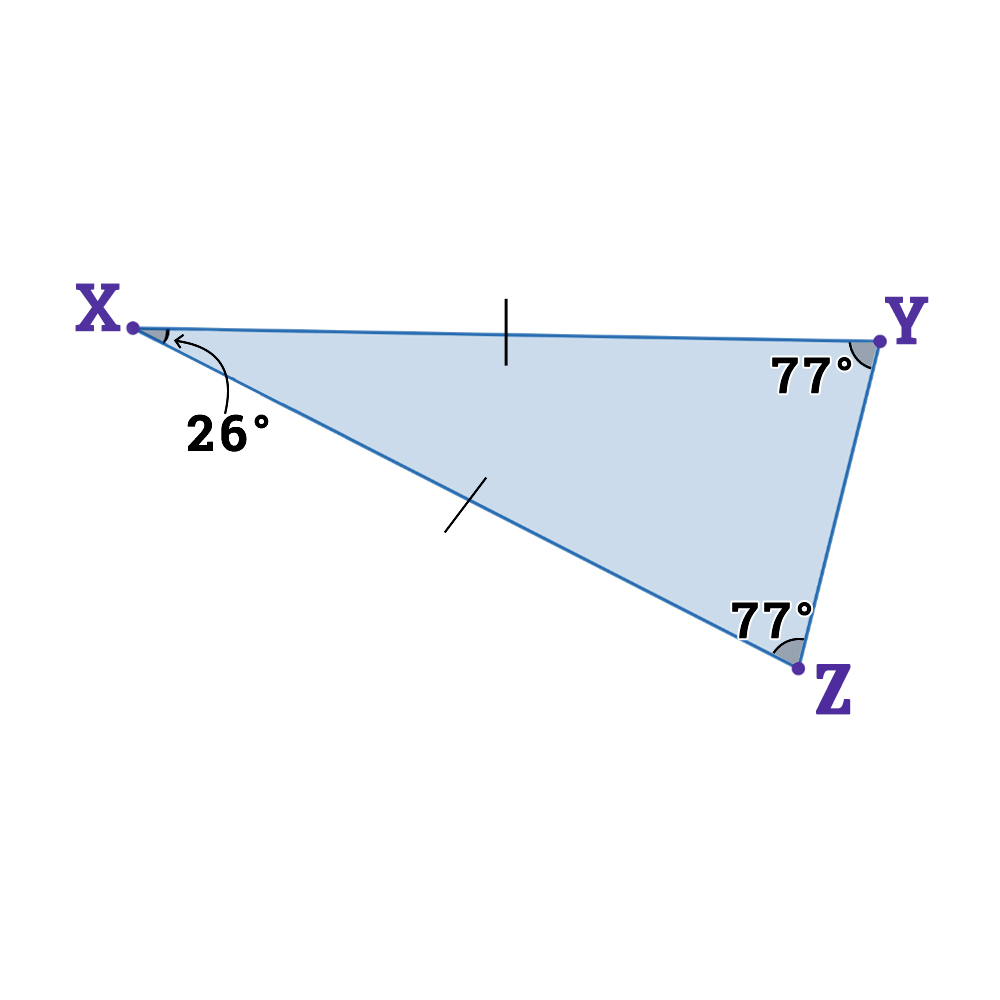
Isosceles triangle XYZ. Angle X is the non-base angle and is labelled 26 degrees. The base angles, Z and Y are labeled 77 degrees. |
What are all three interior angle measurements of the triangle below?
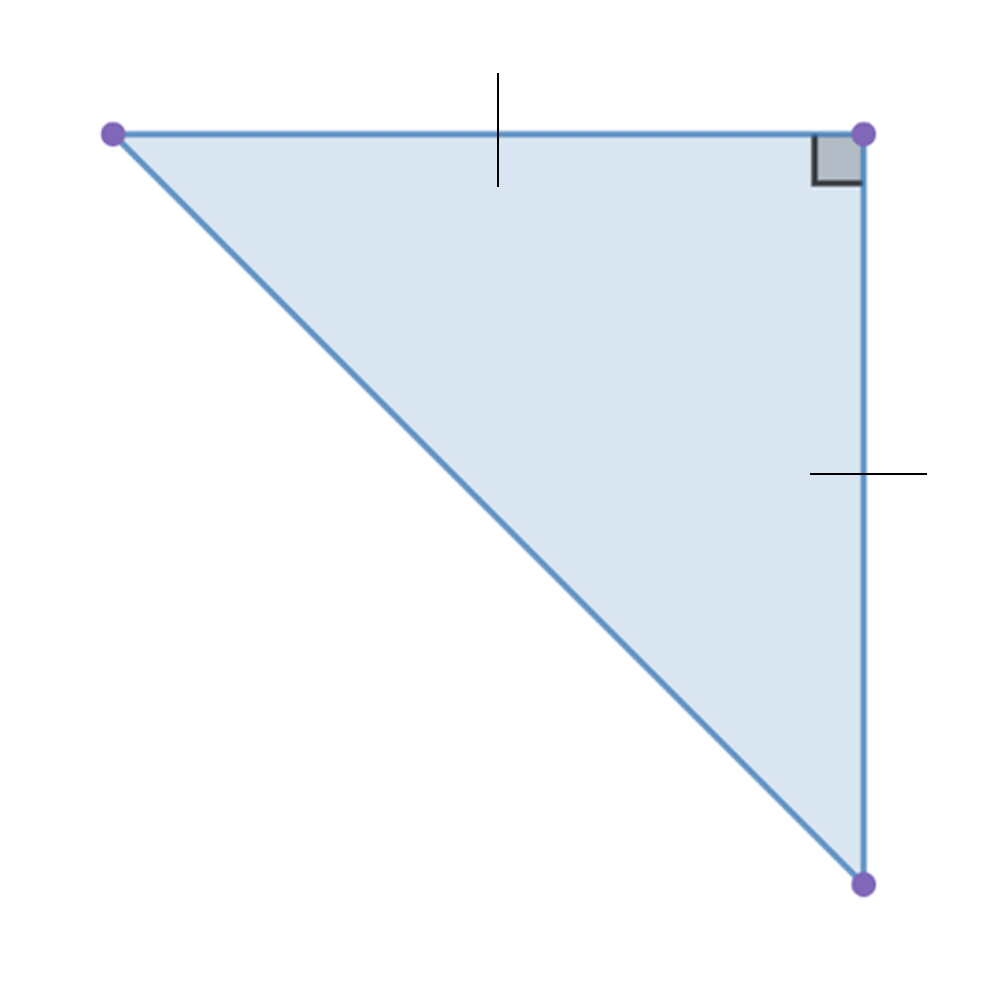
\(90^\circ,\ 45^\circ,\ 45^\circ\)
If you need help arriving at this answer, click the Solution Button
This is a right isosceles triangle, which means that two side lengths are equal, two interior angle measurements are congruent, and one angle measurement is equal to \(90^\circ\).
Label the missing angle measurements. (You can use any letter.) |
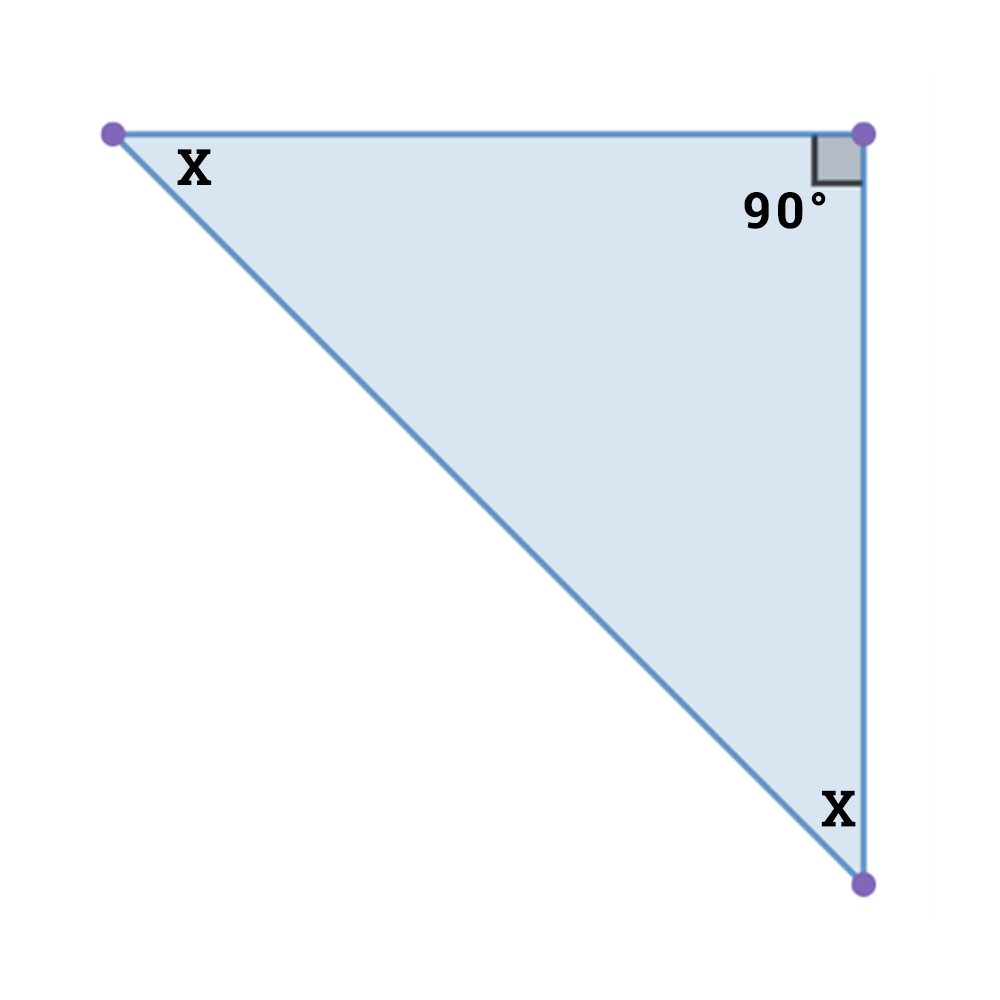 |
Since the triangle sum theorem states that all three interior angles, when added, must equal \(180°\), set up an equation to solve for the missing angle measurement, \(x\). |
\(90^\circ +x+x=180^\circ\) |
Solve the equation for the unknown variable. |
\(90^\circ +x+x=180^\circ\) Combine like terms: \(90^\circ +2x=180^\circ\) Subtract \(90^\circ\) from both sides of the equal sign: \(2x=90^\circ\) Divide by \(2\) to solve: \(x=45^\circ\) This means that both missing interior angle measurements are equal to \(45^\circ\). |
Check your solution by adding all three angle measurements together: |
\(90^\circ +45^\circ +45^\circ =180^\circ\) \(180^\circ =180^\circ\) Since this is true, the three interior angle measurements are \(90^\circ,\ 45^\circ,\ 45^\circ\). 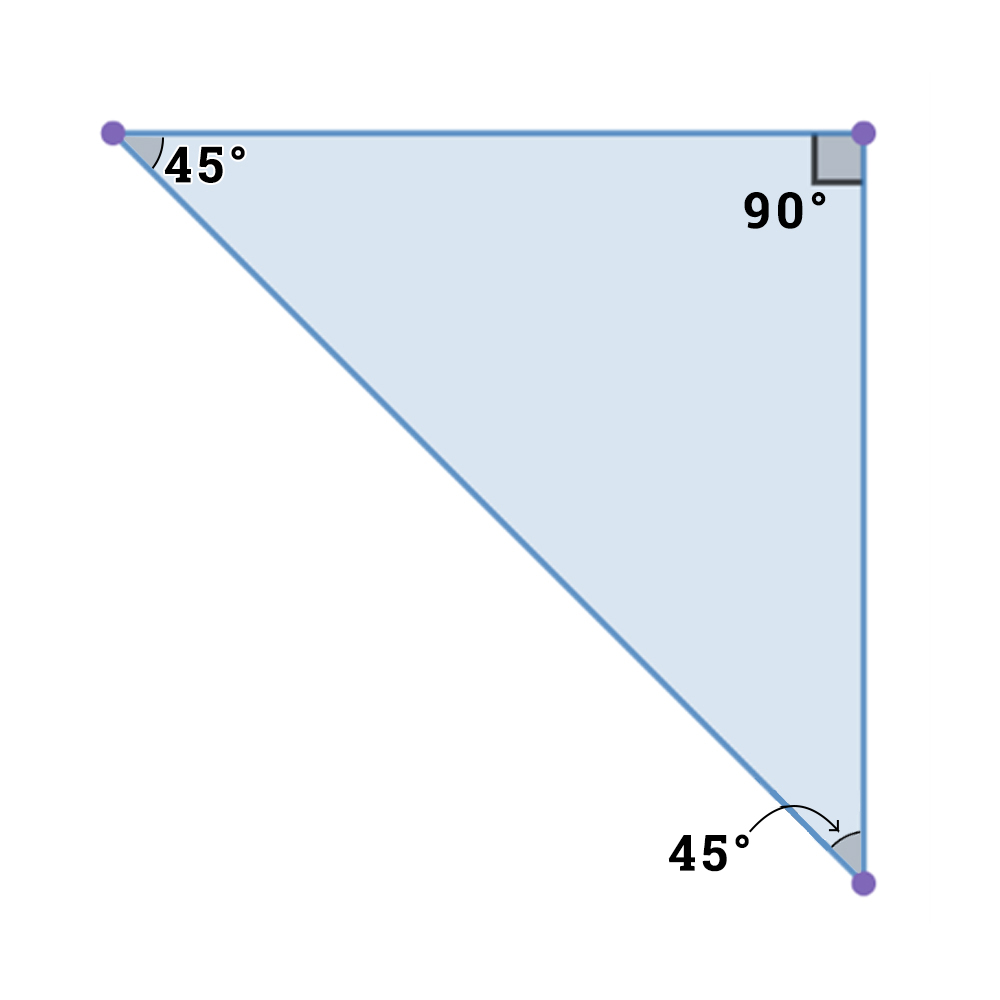 |
