
Show your skills!
Are you ready to take this lesson's quiz? The questions below will help you find out. Make sure you understand why each answer is correct—if you don't, review that part of the lesson.
\(\triangle\)ABC is a right scalene triangle. If \(\angle\)A \(=49^\circ\), what is the measure of \(\angle\)B?
-
\(49^\circ\)
-
\(41^\circ\)
-
\(52^\circ\)
-
\(45^\circ\)
This triangle is scalene. This means none of its interior angles are congruent. Use the triangle sum theorem by setting up an equation to solve for the missing angle measurement.
\( 49^{\circ}+m \angle \text{B}=180^{\circ} \) \( 139^{\circ}+m \angle \text{B}=180^{\circ} \) \( 139^{\circ}+m \angle \text{B}-139^{\circ}=180^{\circ}-139^{\circ} \) \( m \angle \text{B}=41^{\circ} \) Since two of this triangle's interior angle measurements are \(90^\circ\), and \(49^\circ\), from the triangle sum theorem, the third angle measurement must equal \(41^\circ\).
The triangle sum theorem states that the measure of a triangle's interior angles, when added together, must equal \(180^\circ\). Since this triangle is right, we know that one interior angle measures \(90^\circ\). Add this to the angle given and subtract the sum from \(180^\circ\) to solve for the missing angle measurement.
The triangle sum theorem states that the measure of a triangle's interior angles, when added together, must equal \(180^\circ\). Since this triangle is right, we know that one interior angle measures \(90^\circ\). Add this to the angle given and subtract the sum from \(180^\circ\) to solve for the missing angle measurement.
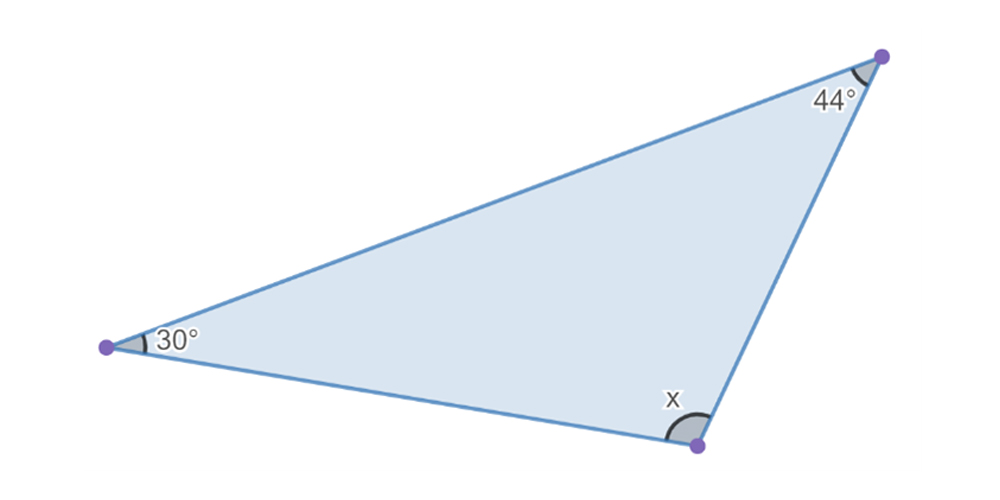
What is the value of \(x\) in the triangle shown?
-
\(126^\circ\)
-
\(91^\circ\)
-
\(74^\circ\)
-
\(106^\circ\)
The triangle sum theorem states that the measure of a triangle's interior angles, when added together, must equal \(180^\circ\). So, to solve for the missing angle, add the two interior angles given and subtract the sum from \(180^\circ\).
The triangle sum theorem states that the measure of a triangle's interior angles, when added together, must equal \(180^\circ\). So, to solve for the missing angle, add the two interior angles given and subtract the sum from \(180^\circ\).
The triangle sum theorem states that the measure of a triangle's interior angles, when added together, must equal \(180^\circ\). So, to solve for the missing angle, add the two interior angles given and subtract the sum from \(180^\circ\).
\(30^\circ +44^\circ +x=180^\circ\) \(74^\circ +x=180^\circ\) \(74^\circ +x-74^\circ =180^\circ –74^\circ\) \(x=106^\circ\) The three interior angles now sum to \(180^\circ :30^\circ +44^\circ +106^\circ =180^\circ\).
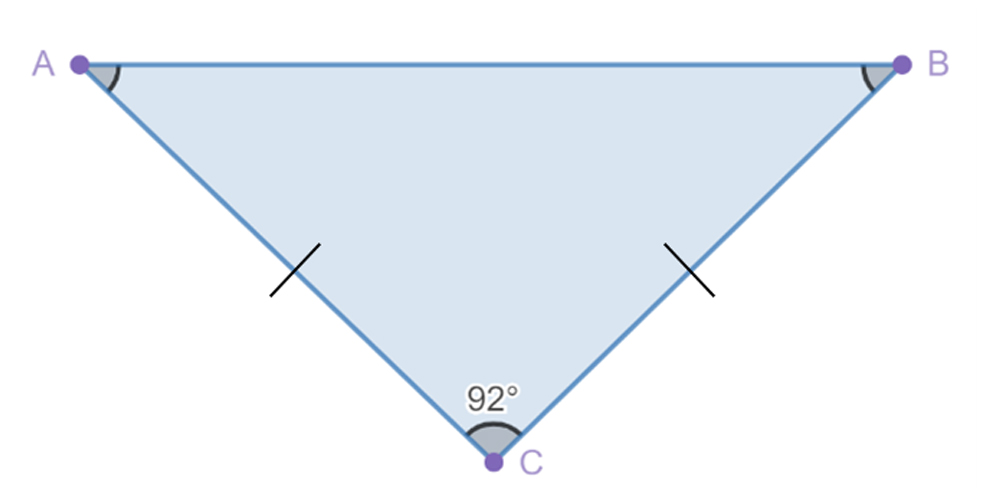
What is the measure of \(\angle\)A in the triangle shown?
-
\(24^\circ\)
-
\(32^\circ\)
-
\(44^\circ\)
-
\(58^\circ\)
The triangle sum theorem states that the sum of the measures of a triangle's interior angles is \(180^\circ\). Since this triangle is isosceles, the two interior angles that are opposite the congruent sides are also congruent. Therefore, \( m \angle \text{A} = m \angle \text{B} \). You can solve the equation \( 2 \cdot m \angle \text{A} + 92{^\circ} = 180{^\circ} \).
The triangle sum theorem states that the sum of the measures of a triangle's interior angles is \(180^\circ\). Since this triangle is isosceles, the two interior angles that are opposite the congruent sides are also congruent. Therefore, \( m \angle \text{A} = m \angle \text{B} \). You can solve the equation \( 2 \cdot m \angle \text{A} + 92{^\circ} = 180{^\circ} \).
Let \( m \angle \text{A} = m \angle \text{B} = x \). \(x+x+92^\circ =180^\circ\) \(2x+92^\circ =180^\circ\) \(2x+92^\circ -92^\circ =180^\circ -92^\circ\) \(2x=88^\circ\) \(\frac{2x}{2}=\frac{88^\circ}{2}\) \(x=44^\circ\) Isosceles triangles have two interior angle measurements which are congruent. \( 44{^\circ} + 44{^\circ} + 92{^\circ} = 180{^\circ} \)
The triangle sum theorem states that the sum of the measures of a triangle's interior angles is \(180^\circ\). Since this triangle is isosceles, the two interior angles that are opposite the congruent sides are also congruent. Therefore, \( m \angle \text{A} = m \angle \text{B} \). You can solve the equation \( 2 \cdot m \angle \text{A} + 92{^\circ} = 180{^\circ} \).
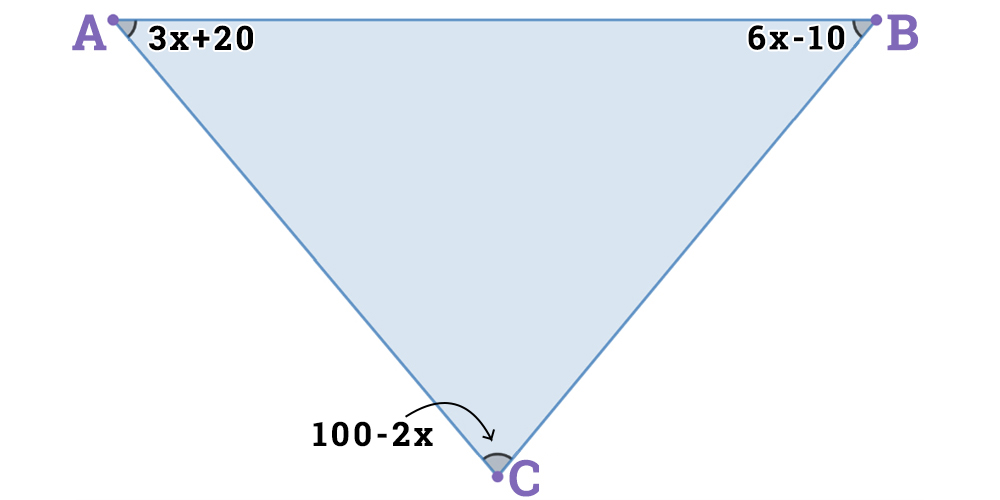
What are the three interior angle measurements for the triangle below?
-
\(50^\circ,\ 50^\circ,\ 80^\circ\)
-
\(60^\circ,\ 60^\circ,\ 60^\circ\)
-
\(45^\circ,\ 45^\circ,\ 90^\circ\)
-
\(50^\circ,\ 60^\circ,\ 70^\circ\)
\((3x+20^\circ)+(6x-10^\circ)+(100^\circ -2x)=180^\circ\) \(3x+20^\circ +6x-10^\circ +100^\circ -2x=180^\circ\) \(7x+110^\circ =180^\circ\) \(7x+110^\circ -110^\circ =180^\circ -110^\circ\) \(7x=70^\circ\) \(\frac{\bcancel{7}x}{\bcancel{7}}=\frac{70^\circ}{7}\) \(x=10^\circ\) \(3x+20^\circ =3(10^\circ)+20^\circ =\)\(30^\circ +20^\circ =50^\circ ;6x-10^\circ =6(10^\circ)-10^\circ =\)\(60^\circ -10^\circ =50^\circ ;100^\circ -2x=\)\(100^\circ -2(10^\circ)=100^\circ -20^\circ =80^\circ\) First, the triangle sum theorem is used to solve for the variable, \(x\). Next, substitute this value into each unknown angle measurement algebraic expression to solve.
First, the triangle sum theorem is used to solve for the variable, \(x\). Next, substitute this value into each unknown angle measurement algebraic expression to solve.
First, the triangle sum theorem is used to solve for the variable, \(x\). Next, substitute this value into each unknown angle measurement algebraic expression to solve.
First, the triangle sum theorem is used to solve for the variable, \(x\). Next, substitute this value into each unknown angle measurement algebraic expression to solve.
An obtuse isosceles triangle has one interior angle measurement of \(142^\circ\) and another interior angle measurement of \((10 - 3x)^\circ\). What is the value of \(x\)?
-
\(x=7\)
-
\(x=-3\)
-
\(x=3\)
-
\(x=19\)
Set up an equation using the triangle sum theorem to solve for \(x\). Since this an obtuse isosceles triangle, two of the acute interior angle measurements are congruent.
\(142^\circ +(10-3x)^\circ +(10-3x)^\circ =180^\circ\) \(142^\circ +10^\circ -3x^\circ +10^\circ -3x^\circ =180^\circ\) \(162^\circ -6x^\circ =180^\circ\) \(162^\circ -6x^\circ -162^\circ =180^\circ -162^\circ\) \(-6x^\circ =18^\circ\) \(\frac{\bcancel{-6}x^\circ}{\bcancel{-6}}=\frac{18^\circ}{-6}\) \(x=-3\) Set up an equation using the triangle sum theorem to solve for \(x\). Since this is an obtuse isosceles triangle, two of the acute interior angle measurements will be congruent.
Set up an equation using the triangle sum theorem to solve for \(x\). Since this is an obtuse isosceles triangle, two acute interior angle measurements will be congruent. Make sure the number is correctly either positive or negative.
This is the value of the interior angle, not of \(x\). Again, set up an equation using the triangle sum theorem to solve for \(x\).
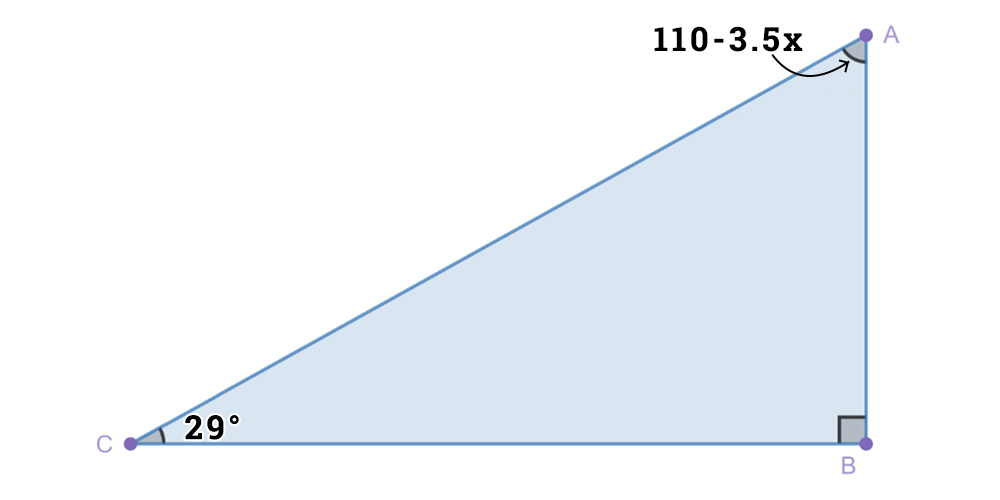
Given \(\triangle\)ABC below, what is the value of \(x\)?
-
\(x=7\)
-
\(x=61\)
-
\(x=14\)
-
\(x=-5\)
In order to solve for \(x\), set up an equation using the triangle sum theorem. Since this is a right triangle, two angle measurements are known, \(29^\circ\) and \(90^\circ\).
This is the measure of angle A. Set up the triangle sum theorem again to solve only for the variable, \(x\).
\(29^\circ +90^\circ +(110-3.5x)^\circ =180^\circ\) \(29^\circ +90^\circ +110^\circ -3.5x^\circ =180^\circ\) \(229^\circ -3.5x^\circ =180^\circ\) \(229^\circ -3.5x^\circ -229^\circ =180^\circ -229^\circ\) \(-3.5x^\circ =-49^\circ\) \(\frac{\bcancel{-3.5}x^\circ}{\bcancel{-3.5}}=\frac{(-49^\circ)}{(-3.5)}\) \(x=14\) Set up an equation using the triangle sum theorem to solve for \(x\).
In order to solve for \(x\), set up an equation using the triangle sum theorem. Since this is a right triangle, two angle measurements are known, \(29^\circ\) and \(90^\circ\).
Summary
Questions answered correctly:
Questions answered incorrectly:
