
Let's have a look...
Basic steps for using the triangle sum theorem to solve for unknown measurements with algebraic expressions are shown in the table below:
- Using the triangle sum theorem, set up an equation setting the three interior angle algebraic expressions equal to \(180^\circ\) and solve for the variable.
- Substitute the value of the variable into the expression(s) and find the measure of the indicated interior angle(s).
- Check your solution by adding all three angle measurements together. If their sum equals 180°, the value obtained for the variable is correct.

Think you got it?
Complete the activity below to practice solving for missing interior angle measurements that are represented by algebraic expressions. Use the steps in the table above to answer the question on each tab. Then, check your answers.

A graphic artist just finished designing a triangle with angle measurements of \((0.25x)^\circ, (x–13)^\circ,\) and \((0.5x + 18)^\circ,\) shown here:
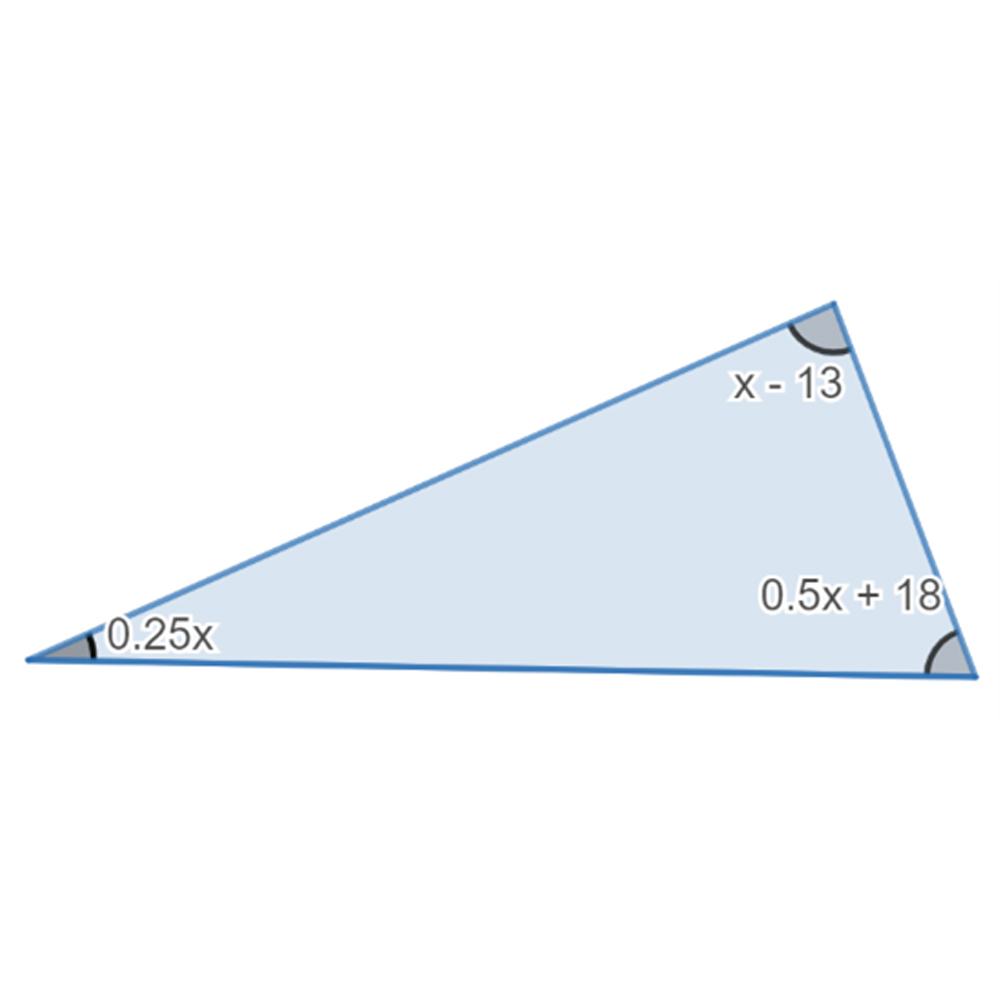
Solve for \(x\). What are the three interior angle measurements of this triangle design?
\(x=100\)
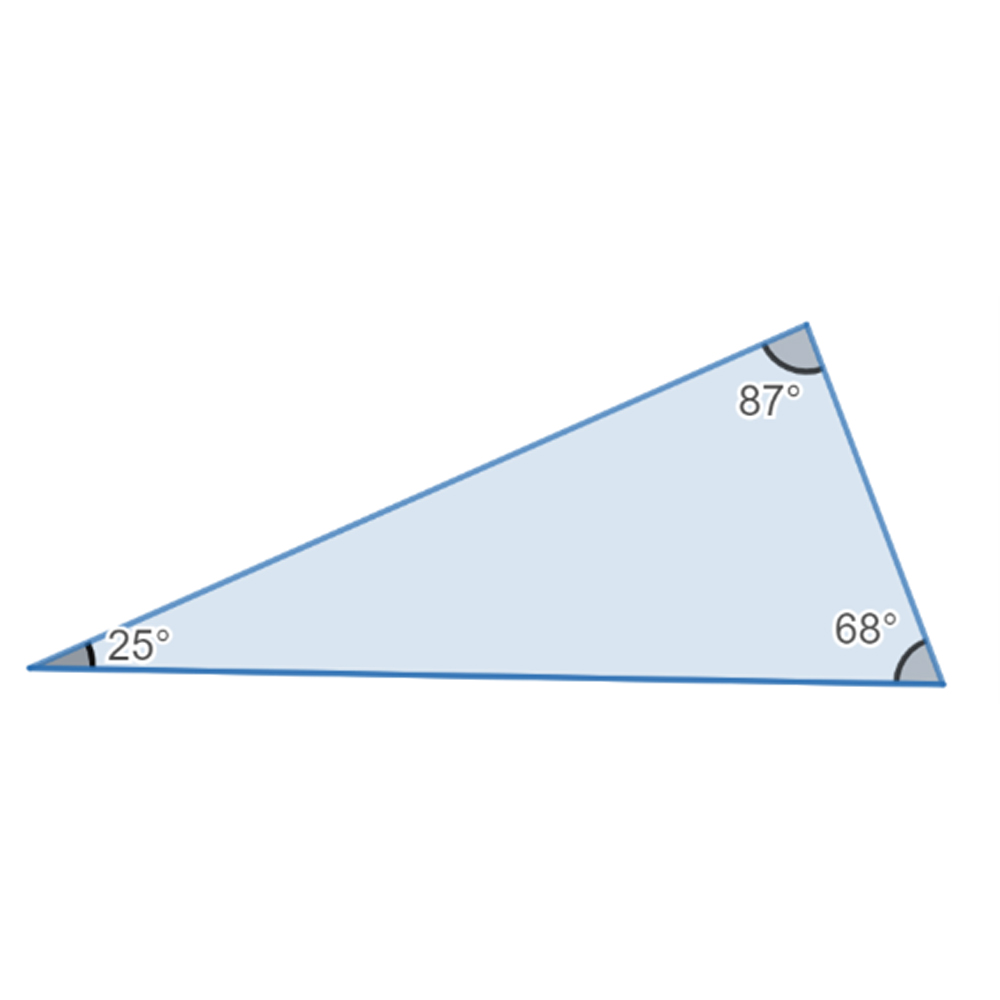
The angle measurements are shown in the triangle below.
If you need help arriving at this answer, click the Solution button.
Step 1: Using the triangle sum theorem, set up an equation making the three interior angle algebraic expressions equal to \(180^\circ\), and solve for the variable. |
\((0.25x)^\circ +(x–13)^\circ +\)\((0.5x+18)^\circ=180^\circ\) Rewrite the left-hand side of the equation without the parentheses and combine like terms: \(1.75x+5=180\) Subtract \(5\) on both sides: \(1.75x = 175\) Divide by \(1.75\) on both sides of the equal sign to solve: \(x=100\) |
Step 2: Substitute the value of the variable into the expression(s) and find the measure of the indicated interior angle(s). |
\((0.25x)^\circ =(0.25(100))^\circ =25^\circ\) \((x-13)^\circ =(100-13)^\circ =87^\circ\) \((0.5x+18)^\circ =(0.5(100)\)\(+18)^\circ =68^\circ\) |
Step 3: Check your solution by adding all three angle measurements together. If their sum equals 180°, the value obtained for the variable is correct. |
\(25^\circ +87^\circ +68^\circ =180^\circ\) \(180^\circ =180^\circ\) 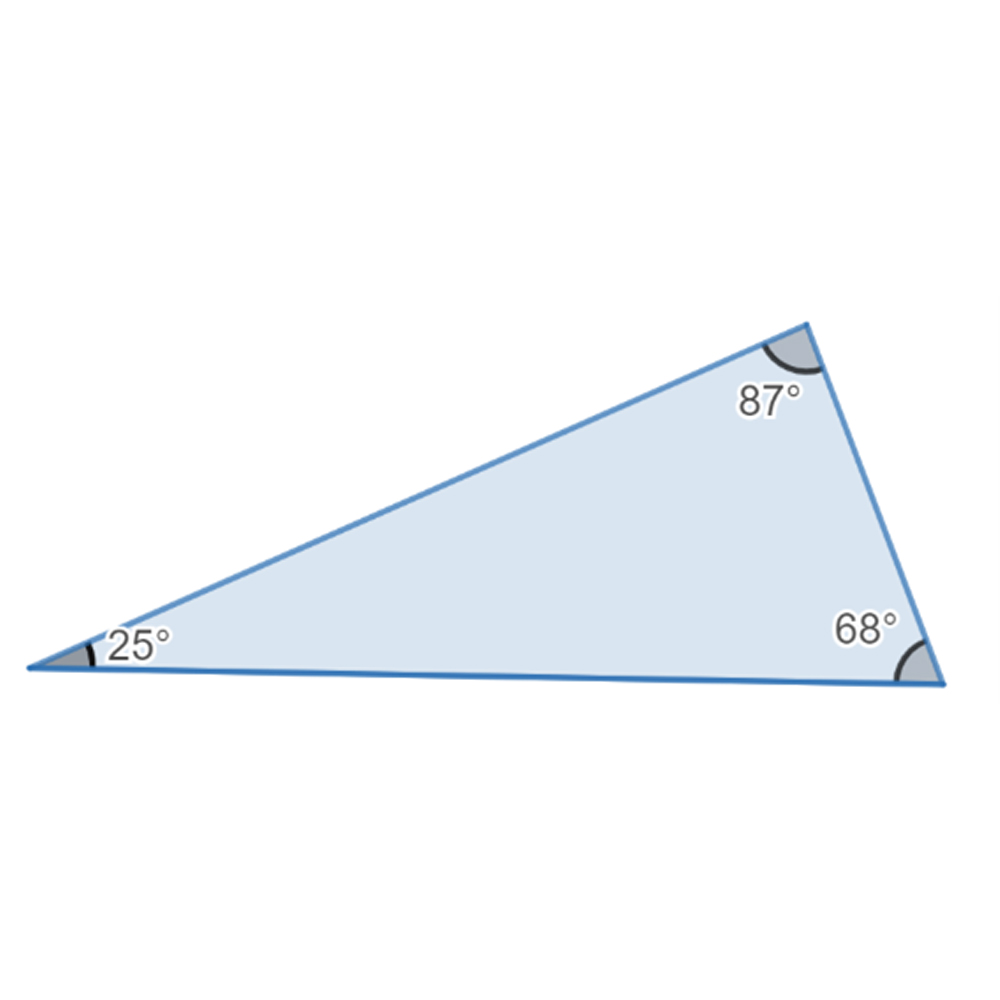 |
\(\triangle\)JKL is shown below:
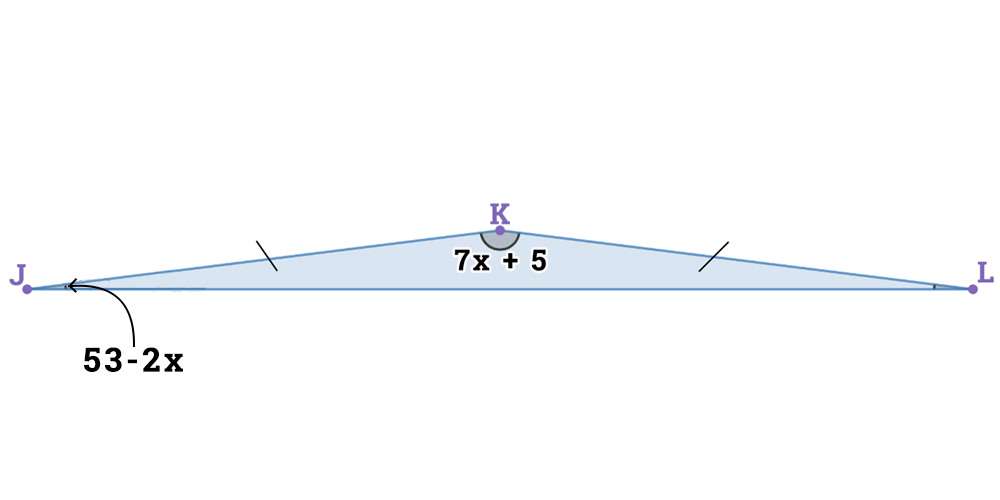
What is the value of \(x\)? What are the measurements for \(\angle\)J, \(\angle\)K, and \(\angle\)L?
\(x=23\)
The interior angle measurements are \(7^\circ, 7^\circ,\) and \(166^\circ\).
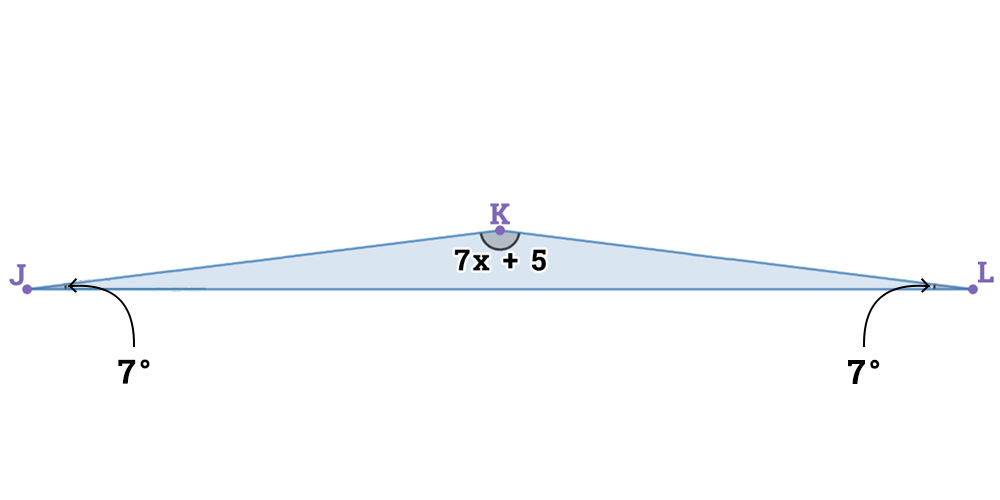
If you need help arriving at this answer, click the Solution Button.
This triangle is isosceles, meaning the two interior angle measurements opposite the two side lengths that are the same length, are congruent, so, \(\angle\)J \(= \angle\)L:
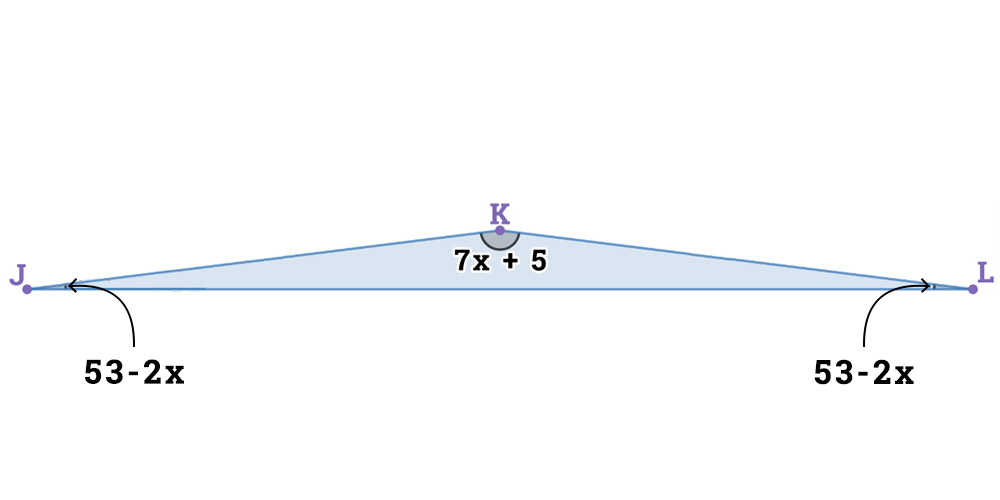
Step 1: Using the triangle sum theorem, set up an equation making the three interior angle algebraic expressions equal to \(180^\circ\) and solve for the variable. |
\((53–2x)^\circ +(7x+5)^\circ +\)\((53–2x)^\circ =180^\circ\) Rewrite the left-hand side of the equation without the parentheses and combine like terms: \(3x+111^\circ =180^\circ\) Subtract 111° on both sides: \(3x=69^\circ\) Divide by \(3\) on both sides of the equal sign to solve: \(x=23\) |
Step 2: Substitute the value of the variable into the expression(s) and find the measure of the indicated interior angle(s). |
\(\angle \text{J}=(53-2x)^\circ =\)\((53-2(23))^\circ =7^\circ\) \(\angle \text{K}=(7x+5)^\circ =\)\((7(23)+5)^\circ =166^\circ\) \(\angle \text{L}=(53-2x)^\circ =\)\((53-2(23))^\circ =7^\circ\) |
Step 3: Check your solution by adding all three angle measurements together. If their sum equals \(180^\circ\), the value obtained for the variable is correct. |
\(7^\circ +166^\circ+7^\circ =180^\circ\) \(180^\circ =180^\circ\) 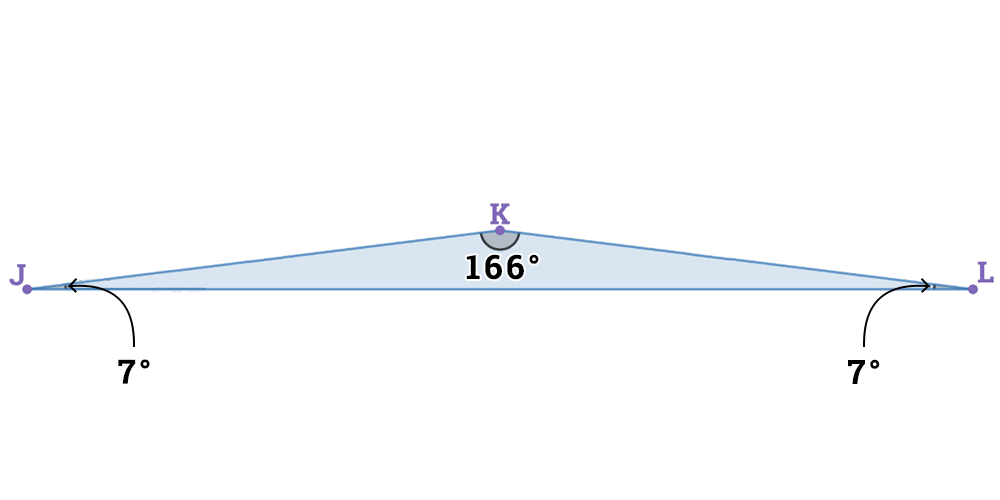 |
New houses with triangular-shaped roofs have just been built. The design for this roof is shown below:
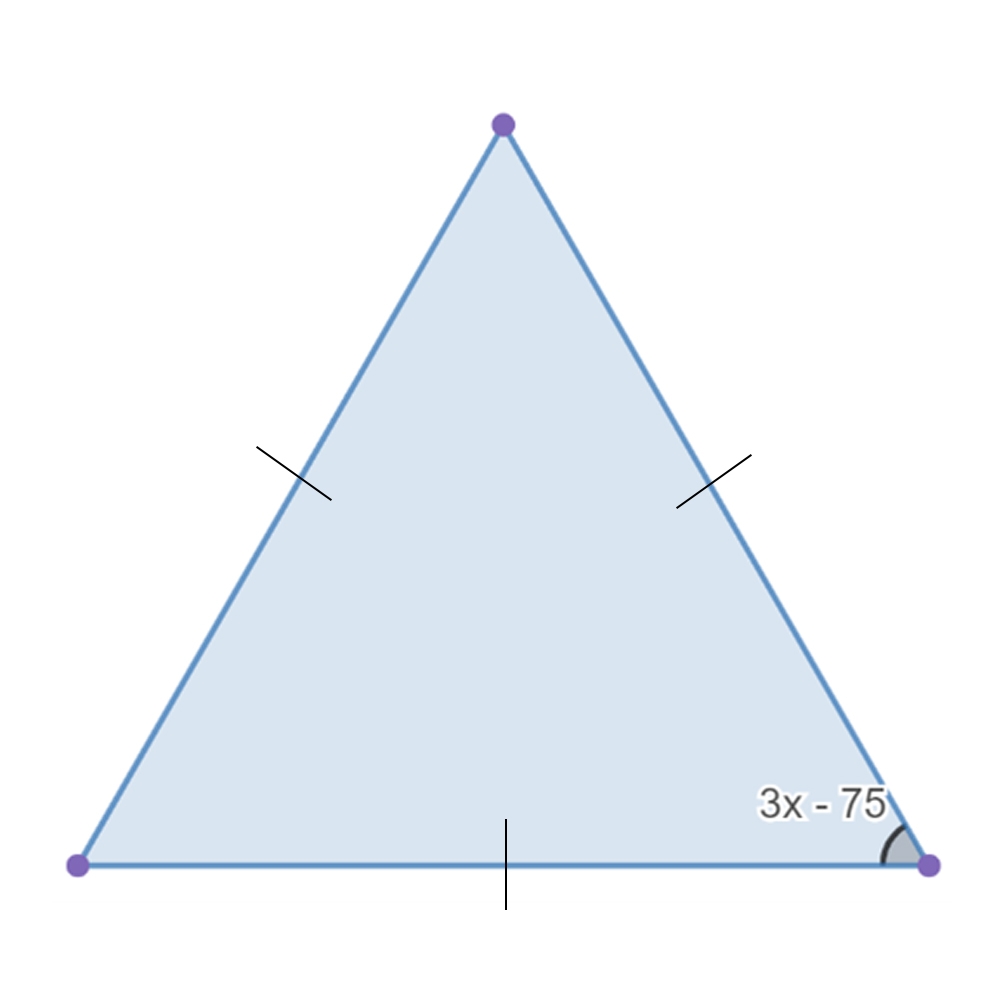
What is the value of \(x\)?
\(x=45\)
If you need help arriving at this answer, click the Solution button.
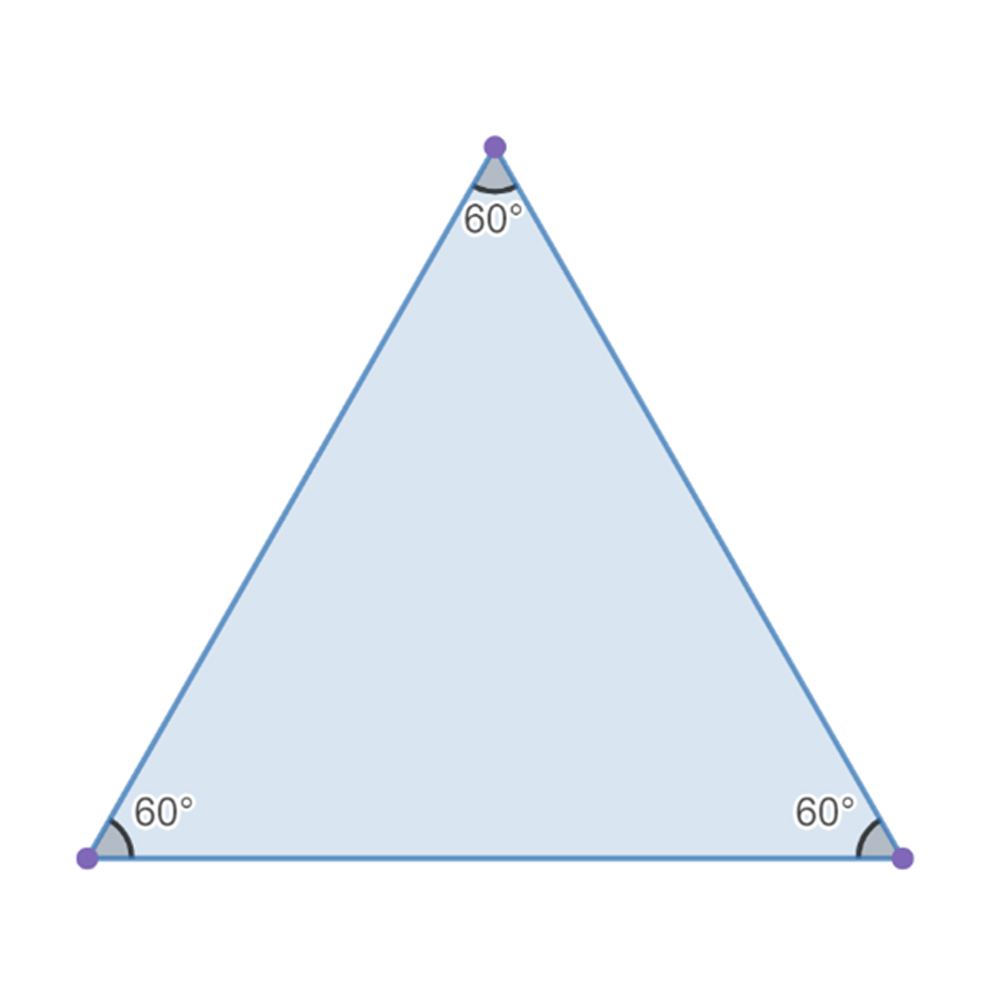
The design is of an equilateral triangle. This means that every interior angle measurement will be congruent; they will each equal the algebraic expression \(3x–75\).
Step 1: Using the triangle sum theorem, set up an equation making the three interior angle algebraic expressions equal to \(180^\circ\) and solve for the variable. |
\((3x–75)^\circ +(3x–75)^\circ\)\(+(3x-75)^\circ =180^\circ\) Rewrite the left-hand side of the equation without the parentheses and combine like terms: \(9x–225=180\) Add \(225\) to both sides of the equal sign: \(9x=405\) Divide both sides of the equal sign by \(9\) to solve for \(x\): \(x=45\) |
Step 2: Check your solution by adding all three angle measurements together. If their sum equals \(180^\circ\), the value obtained for the variable is correct. |
The angles all measure: \((3x–75)^\circ =(3(45)–75)^\circ\)\(=(135–75)^\circ =60^\circ\) This will be true of every equilateral triangle. 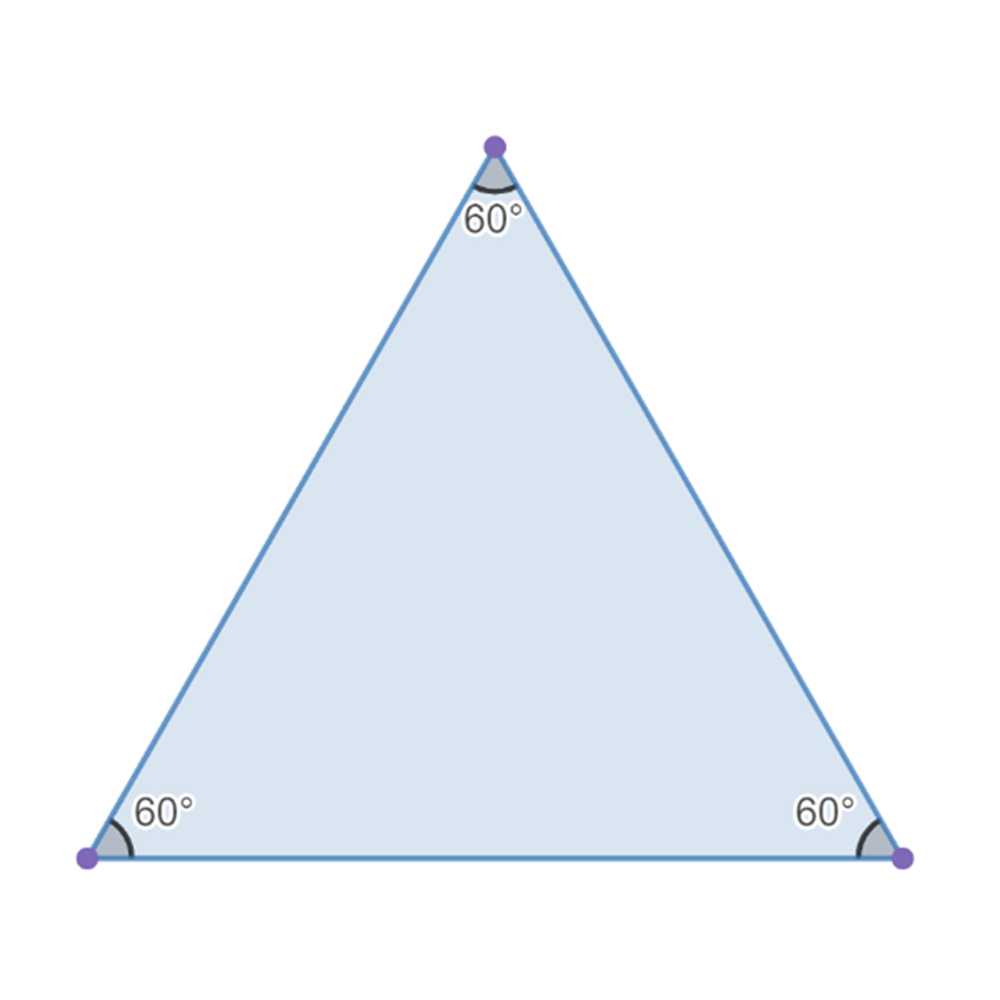 |
\(\triangle\)GHI is given below:
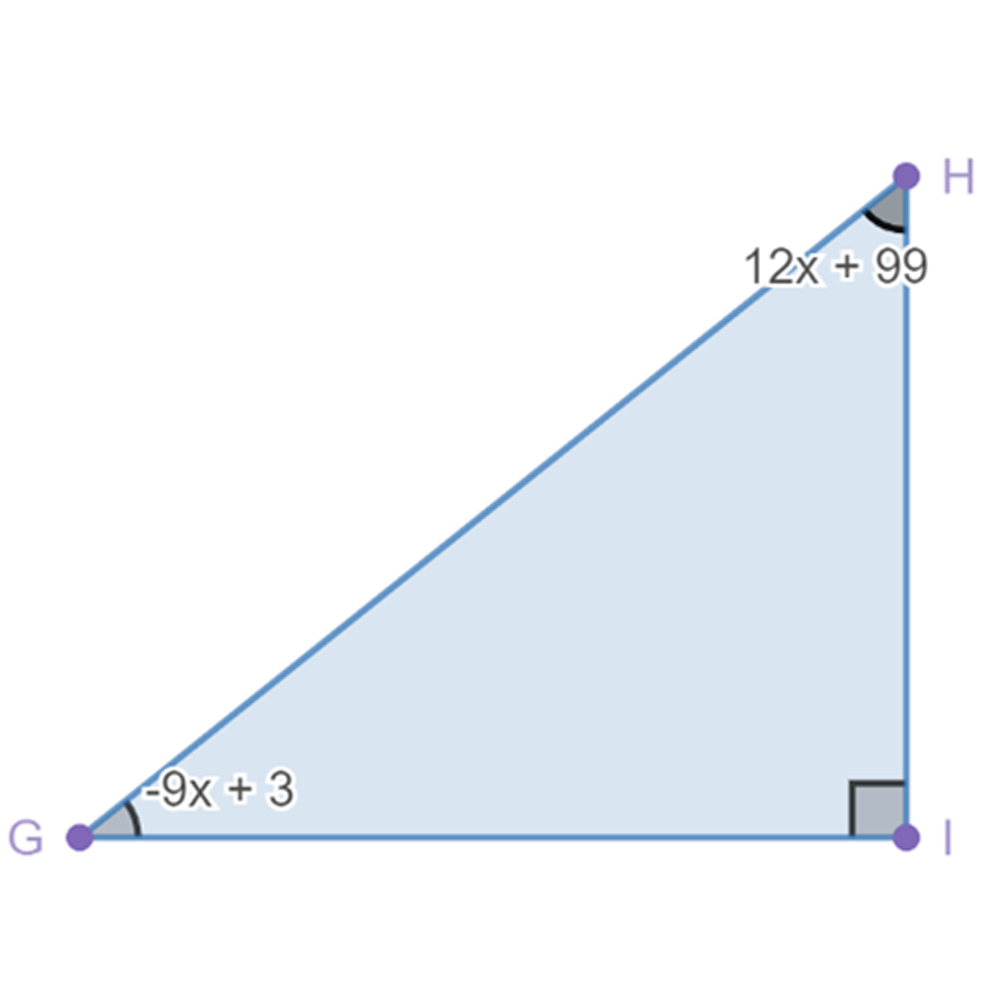
Solve for \(x\) and determine the measurements for \(\angle\)G and \(\angle\)H.
\(x=-4\)
If you need help arriving at this answer, click the Solution button.
Since this is a right triangle, one angle is equal to \(90^\circ\).
Step 1: Using the triangle sum theorem, set up an equation making the three interior angle algebraic expressions equal to \(180^\circ\) and solve for the variable. |
\((-9x+3)^\circ +(12x+99)^\circ +90^\circ=\)\(180^\circ\) Rewrite the left-hand side of the equation without the parentheses and combine like terms: \(3x+192=180\) Subtract \(192\) on both sides of the equal sign: \(3x=-12\) Divide by \(3\) to solve for \(x\): \(x=-4.\) |
Step 2: Substitute the value of the variable into the expression(s) and find the measure of the indicated interior angle(s). |
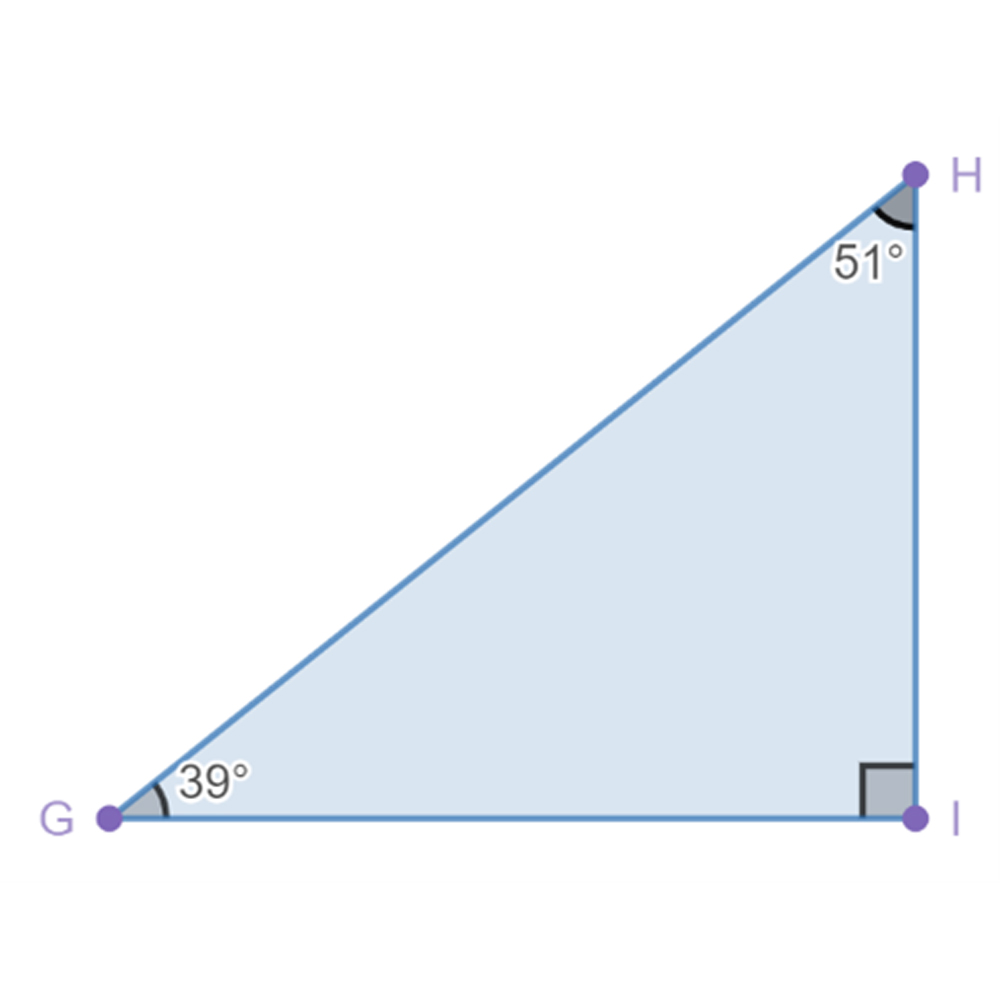
\( m \angle \text{G}=(-9x+3)^\circ =(-9(-4)+3)^\circ\)\(=(36+3)^\circ =39^\circ\) \( m \angle \text{H}=(99+12x)^\circ =(99+12(-4))^\circ\)\(=(99–48)^\circ =51^\circ\) |
Step 3: Check your solution by adding all three angle measurements together. If their sum equals \(180^\circ\), the value obtained for the variable is correct. |
\(90^\circ +39^\circ +51^\circ =180^\circ\) \(180^\circ =180^\circ\) 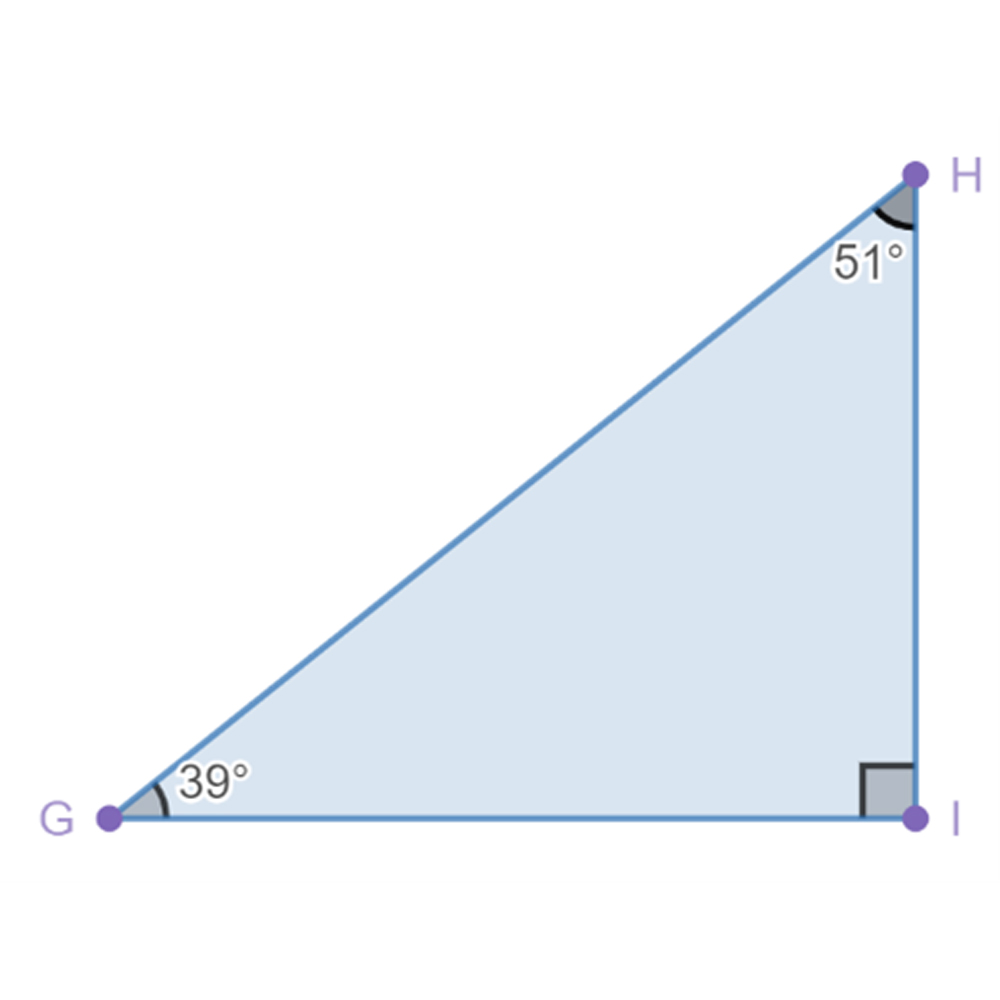 |

A new pool has just been installed outside the local recreation center. The pool is triangular in shape with interior angle measurements of \((2x–11)^\circ, (4x+4)^\circ,\) and \((85–2x)^\circ\).
What are the values of the three interior angle measurements? What type of triangle is this?
With \(x=25.5,\) the interior angle measurements are:
\(34^\circ,\ 40^\circ,\) and \(106^\circ\)
The pool is in the shape of an obtuse scalene triangle.
If you need help arriving at this answer, click the Solution button.
Step 1: Using the triangle sum theorem, set up an equation making the three interior angle algebraic expressions equal to \(180^\circ\) and solve for the variable. |
\((2x–11)^\circ +(4x+4)^\circ +(85–2x)^\circ\)\(=180^\circ\) Rewrite the left-hand side of the equation without the parentheses and combine like terms: \(4x+78=180\) Subtract \(5\) on both sides: \(4x=102\) Divide by \(4\) on both sides of the equal sign to solve: \(x=25\frac{1}{2}=25.5\) |
Step 2: Substitute the value of the variable into the expression(s) and find the measure of the indicated interior angle(s). |
\((2x-11)^\circ =(2(25.5)-11)^\circ =(51–11)^\circ\)\(=40^\circ\) \((4x + 4)^\circ =(4(25.5)-4)^\circ =(102+4)^\circ\)\(=106^\circ\) \((85-2x)^\circ =(85–2(25.5))^\circ =(85–51)^\circ\)\(=34^\circ\) |
Step 3: Check your solution by adding all three angle measurements together. If their sum equals \(180^\circ\), the value obtained for the variable is correct. |
\(40^\circ +34^\circ +106^\circ =180^\circ\) \(180^\circ =180^\circ\) 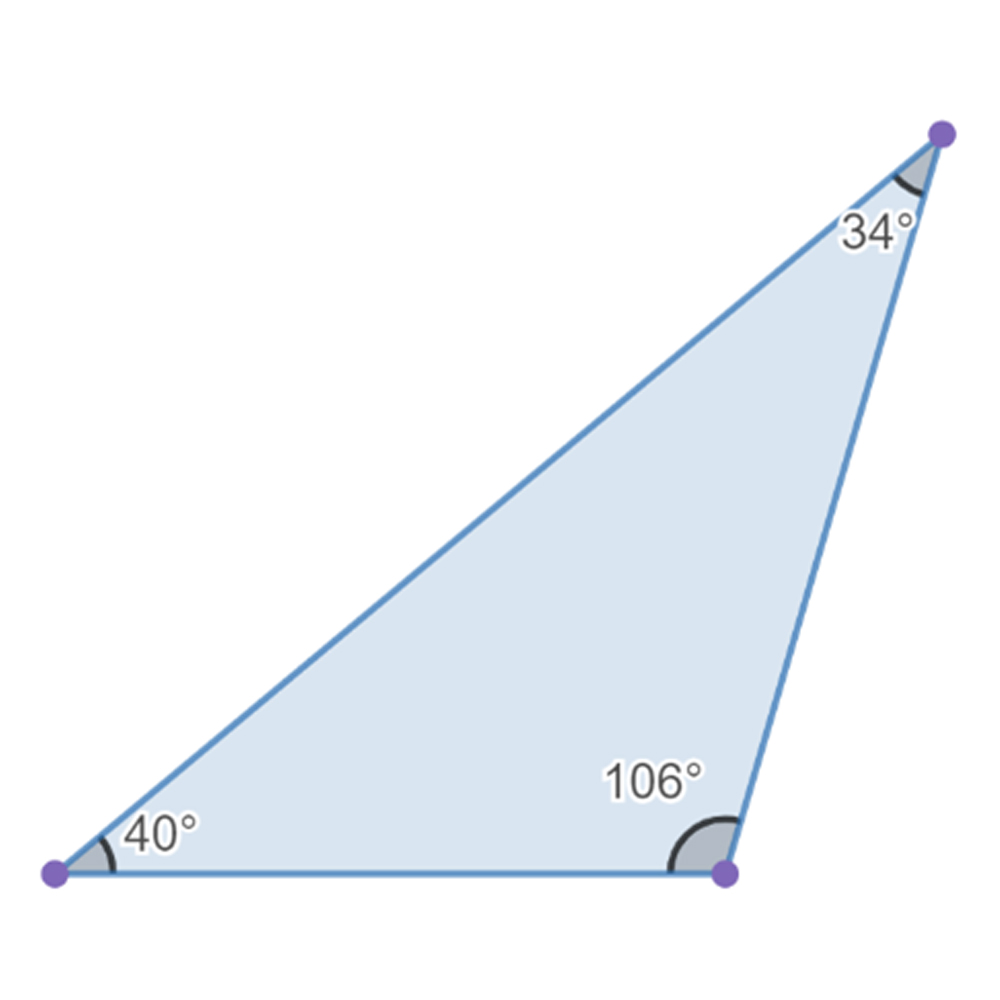 |
Since none of the angle measurements are congruent, this triangle is scalene. Since one interior angle measurement is greater than \(90^\circ\), this triangle is obtuse. So, the pool is in the shape of an obtuse scalene triangle.
