As this lesson demonstrated, a written explanation is different from a more general report of information. Explanations are needed when you're describing something fairly detailed, difficult, or complex--such as a process with many required steps or a situation that has many different causes. Explanatory text is particularly useful when readers encounter a topic they know very little about, especially if the topic is complicated.
Review the examples of explanatory text in the tabs below. Then use the Writing Explanations worksheet to create the first draft of an explanatory report. Be sure to choose a topic you know well enough to explain in detail!
Example 1
Example 2
Earlier in this lesson, you read an example of informative text about Laika, the space dog. While that passage provided only general information about Laika's mission, this passage provides a full explanation of tools and methods used to launch Laika into space.
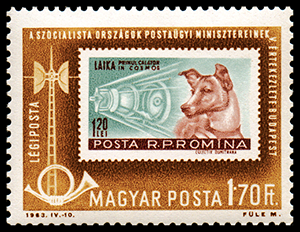 Laika's spacecraft was equipped with a life-support system consisting of an oxygen generator and several devices designed to avoid oxygen poisoning and to absorb carbon dioxide. A fan, set to activate whenever the cabin temperature exceeded 15 °C (59 °F), was added to keep the dog cool. Enough food (in a gelatinous form) was provided for a seven-day flight, and the dog was fitted with a bag to collect waste. A harness was designed to be fitted to the dog, and there were chains to restrict her movements to standing, sitting, or lying down; there was no room to turn around in the cabin. An electrocardiogram monitored heart rate and further instrumentation tracked respiration rate, maximum arterial pressure, and the dog's movements.
What does this passage include that the earlier passage about Laika did not?

details about how the Soviet scientists tried to keep Laika alive in space
Written directions almost always require the use of explanatory text. If you're trying to tell someone how to change a flat tire on a bike, for instance, you'll need to provide a very detailed explanation of the procedure.
If you use your bike as a main means of transportation, you need to know how to take care of a flat tire, though it's actually the tube inside the tire that goes flat, since that is what holds the air. To replace a flat, leaking tube with a new one, first take the wheel off the bike frame. If you’re changing the back wheel, you will have to lift the chain off of the gear set.
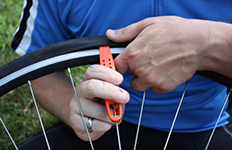
Use a couple of tire levers, or the handle of a spoon or a similar tool, to remove the tire from the wheel. Here’s how: Insert one lever under the wheel rim and carefully pull out the edge of the tire and push it up over the rim. Then insert another lever and slide it around the rim, leaving the first lever in place. If you slide the second lever all the way around the wheel, the tire should pop right off on one side.
|
|
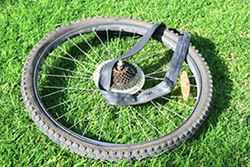
Now remove the old (flat) tube completely.
Pump a little air into the new tube—just enough to make it hold its circular shape. Insert one side of the tube into the tire first, between the rim and the inside of the tire. Then carefully push the rest of the tube into the tire and fit the new tube’s valve in the hole in the wheel rim.
Starting at the tire edge closest to the valve, push the other side of the tire over the rim and into the outside edge of the wheel rim.
Before you try to inflate the new tube, make sure the tube is set back from metal wheel rim all the way around. Also check to make sure that the tire is not pinching any part of the tube against the rim. Inflate the tube slowly and carefully, in case there are any pinches you didn’t see.
Click the Activity button below to access the Writing Explanations worksheet, which will help you create the first draft of an explanatory, or expository, report. When you have completed your draft, submit it to your teacher, and save a copy to use later in the course when you revise your report.
Your work on this assignment will be graded according to the following rubric.
| Criteria | |
| Topic Reflection 1 point |
1 Point: You list several topics that require explanation before selecting one as the actual topic of your explanatory report. |
| List of Ideas 2 points |
1 Point: You list all of the main ideas that should be part of your explanation. |
| 1 Point: You list a useful supporting detail for each of your main ideas. | |
| Explanation 2 points |
1 Point: Your explanation includes all of your main ideas. |
| 1 Point: Your explanation includes all of your supporting ideas. |
