Because their funds are limited, grassroots movements tend to use indirect rather than direct lobbying to influence policy makers. Essentially, grassroots organizers ask the general public to contact legislators and government officials to voice their concerns about the issue at hand, as individuals rather than as representatives of an interest group or lobbying firm. Study the slides below to learn more about grassroots approaches to impacting the behavior of public officials.
|
MediaGrassroots organizations frequently use the local media, including television, print, and online venues, to expand their outreach. Rarely can they afford to buy ads, so they depend on the news media to publicize their efforts. To draw the attention of news organizations, they may hold protests or announce boycotts or press conferences and hope that reporters and news cameras show up to cover the event.
Social MediaDuring the pass decade, grassroots movements have been transformed by the use of social media, which allows organizers to reach people beyond a local community, connecting with individuals around the world who are sympathetic to their cause. Social media is, by nature, grassroots organizing--it allows ordinary individuals to reach out to others, inspiring them and directing their energy in ways that help the movement advance.
Mass MovementsMobilizing groups of people nationwide allows grassroots organizations to pressure legislators into listening and addressing the groups' concerns. Generally, mass movements are used after grassroots organizations gain the public's trust and support by getting their message out. Organizers gather attention--and followers--by speaking at events, distributing flyers and other kinds of information, and using media outlets. |
 |



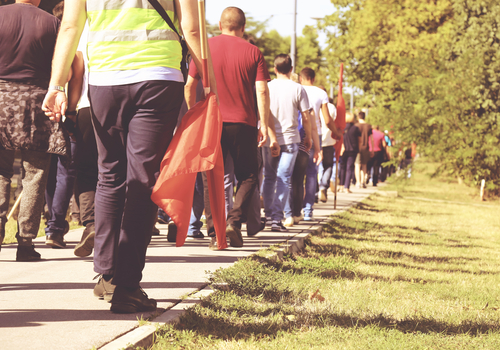
What accounts for the recent success of grassroots political movements in the U.S.? Undoubtedly, the use of social media has played a role. People are now able to organize and coordinate political activity quickly and easily using social media sites like Twitter, Instagram, and Facebook. In the past, structured political movements led by professional organizers were much more capable of public outreach than their grassroots counterparts. Making phone calls takes a great deal of time, and placing political ads costs an exorbitant amount of money. Now, however, people involved in grassroots movements are just as capable of reaching out to others as corporate sponsored campaigns, and this type of political organizing is only expected to increase. Ordinary citizens are beginning to realize that they can easily be involved in various movements.
Use the following questions to further explore the processes used by grassroots groups to impact policy and government behavior.
Which tactic is most likely to garner free exposure in print or televised media?
- sending packets of letters to the local newspaper editor
- organizing a public protest or demonstration of support
- handing out flyers in a nearby shopping center
Demonstrations, rallies, boycotts, and protests generally gain some sort of media attention, all of which are free.
Demonstrations, rallies, boycotts, and protests generally gain some sort of media attention, all of which are free.
Demonstrations, rallies, boycotts, and protests generally gain some sort of media attention, all of which are free.
What medium is now considered the most effective way to reach a very large number of people?
- social media sites
- television ads
- spontaneous rallies
Social media has recently become the single most effective way to spread a message quickly and gain mass support.
Social media has recently become the single most effective way to spread a message quickly and gain mass support.
Social media has recently become the single most effective way to spread a message quickly and gain mass support.
Why is grassroots organizing considered indirect lobbying?
- Organizers contact lawmakers themselves and demand change.
- Organizers persuade other people to contact their representatives.
- Organizers refuse to accept payment for the work they do.
Grassroots organizers are not attempting to influence the legislators directly. They are simply rallying support and asking members of their movement to individually reach out to the government and promote awareness of their issue, which will often get the attention of lawmakers and government.
Grassroots organizers are not attempting to influence the legislators directly. They are simply rallying support and asking members of their movement to individually reach out to the government and promote awareness of their issue, which will often get the attention of lawmakers and government.
Grassroots organizers are not attempting to influence the legislators directly. They are simply rallying support and asking members of their movement to individually reach out to the government and promote awareness of their issue, which will often get the attention of lawmakers and government.
Why are mass movements so effective?
- Large protests make communities nervous about the possibility of violence.
- Mass movements rely on citizens who don't work during the day.
- Thousands of voices saying the same thing really amplifies a message.
Many voices speaking as one, with the same message or demands for change, can force government to pay attention to them.
Many voices speaking as one, with the same message or demands for change, can force government to pay attention to them.
Many voices speaking as one, with the same message or demands for change, can force government to pay attention to them.
Summary
 Questions answered correctly:
 Questions answered incorrectly:
