The period of a pendulum in simple harmonic motion is affected by the length of the pendulum. The period of a mass-spring system depends on both the mass attached and the spring constant of the spring. In each case, the period can be found using the equations for period.
Period of a Pendulum in SHM
\(\large\mathsf{ T = 2 \pi \sqrt{\frac{L}{g}} }\)
...where T is the period, L is the length of the pendulum, and g is the acceleration of gravity at that location.
Period of a Mass-Spring in SHM
\(\large\mathsf{ T = 2 \pi \sqrt{\frac{m}{k}} }\)
...where T is the period, m is the mass of the object attached, and k is the spring constant of the spring.
Practice using these equations in the problems below.
| Problem | Picture | Given/Find | Equation | Solution |
|---|---|---|---|---|
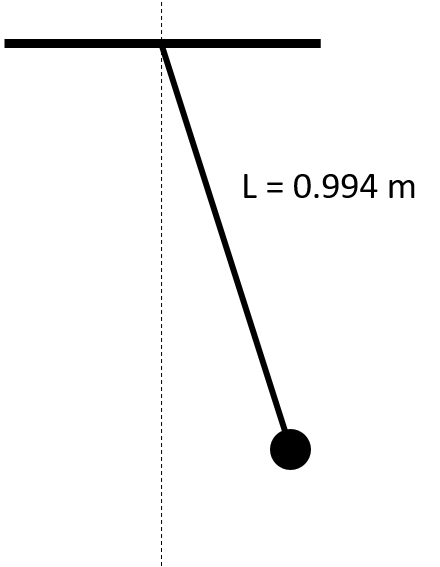
| A Grandfather clock has a pendulum length of 0.994 m. What is the period of the pendulum? |
|
\(\mathsf{ T = ? \text{ s}}\) \(\mathsf{ g = 9.81 \text{ m/s}^2 }\) \(\mathsf{ L = 0.994 \text{ m} }\) |
\(\mathsf{ T = 2 \pi \sqrt{\frac{L}{g}} }\) | \(\mathsf{ T = 2 \pi \sqrt{\frac{0.994 \text{ m}}{9.81 \text{ m/s}^2}} }\) \(\mathsf{ T = 2 \pi \sqrt{0.101 \text{ m}^2\text{/s}^2} }\) \(\large\mathsf{ T = 2.00 \text{ s} }\) |
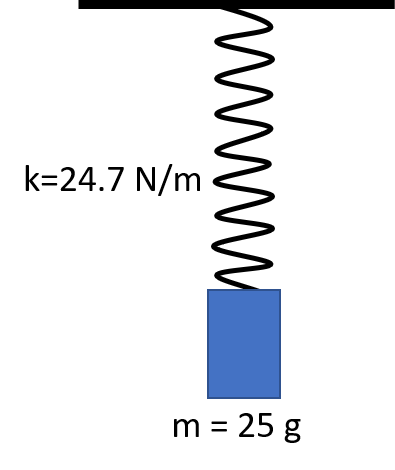
| What is the period of a mass-spring system in simple harmonic motion if the mass is 25 g and the spring constant is 24.7 N/m? |
|
>\(\mathsf{ T = ? \text{ s}}\) \(\mathsf{ m = 25 \text{ g} = 0.025 \text{ kg} }\) \(\mathsf{ k = 24.7 \text{ N/m} }\) |
\(\mathsf{ T = 2 \pi \sqrt{\frac{m}{k}} }\) | \(\mathsf{ T = 2 \pi \sqrt{\frac{0.025 \text{ kg}}{24.7 \text{ N/m} }} }\) \(\mathsf{ T = 2 \pi \sqrt{0.00101 \text{ s}^2} }\) \(\mathsf{ T = 2 \pi \times 0.0318 \text{ s} }\) \(\mathsf{ T = 0.20 \text{ s} }\) |
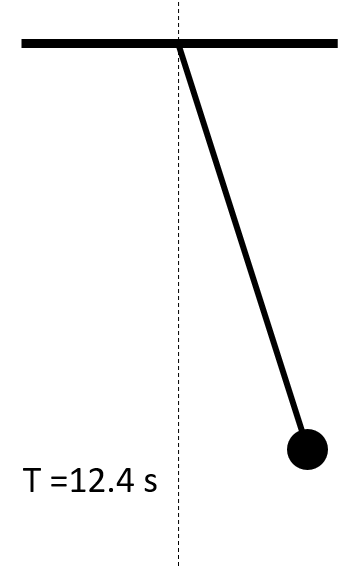
| A pendulum is hung from the ceiling in a tall room. The period of the pendulum is 12.4 seconds. How tall is the building? |
|
\(\mathsf{ T = 12.4 \text{ s}}\) \(\mathsf{ g = 9.81 \text{ m/s}^2 }\) \(\mathsf{ L = ? \text{ m} }\) |
\(\mathsf{ T = 2 \pi \sqrt{\frac{L}{g}} }\) | \(\mathsf{ 12.4 \text{ s} = 2 \pi \sqrt{\frac{L}{9.81 \text{ m/s}^2}} }\) \(\mathsf{ \frac{12.4 \text{ s}}{2 \pi} = \sqrt{\frac{L}{9.81 \text{ m/s}^2}} }\) \(\mathsf{ 1.97 \text{ s} = \sqrt{\frac{L}{9.81 \text{ m/s}^2}} }\) \(\mathsf{ (1.97 \text{ s})^2 = \frac{L}{9.81 \text{ m/s}^2} }\) \(\mathsf{ (3.88 \text{ s}^2)(9.81 \text{ m/s}^2) = L }\) \(\mathsf{L = 38.1 \text{ m} }\) |
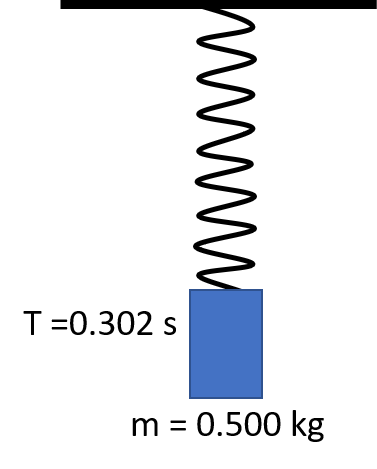
| A 0.500 kg mass is suspended on a spring and set into simple harmonic motion. If the period of the motion is 0.302 seconds, what is the spring constant of the spring? |
|
\(\mathsf{ T = 0.302 \text{ s}}\) \(\mathsf{ m = 0.500 \text{ kg} }\) \(\mathsf{ k = ? \text{ N/m} }\) |
\(\mathsf{ T = 2 \pi \sqrt{\frac{m}{k}} }\) | \(\mathsf{ 0.302 \text{ s} = 2 \pi \sqrt{\frac{.500 \text{ kg}}{k}} }\) \(\mathsf{ \frac{0.302 \text{ s}}{2 \pi} = \sqrt{\frac{.500 \text{ kg}}{k}} }\) \(\mathsf{ (0.0481 \text{ s})^2 = \frac{.500 \text{ kg}}{k} }\) \(\mathsf{ 0.00231 \text{ s}^2 = \frac{.500 \text{ kg}}{k} }\) \(\mathsf{ k = \frac{.500 \text{ kg}}{0.00231 \text{ s}^2} }\) \(\mathsf{ k = 216 \text{ N/m} }\) |