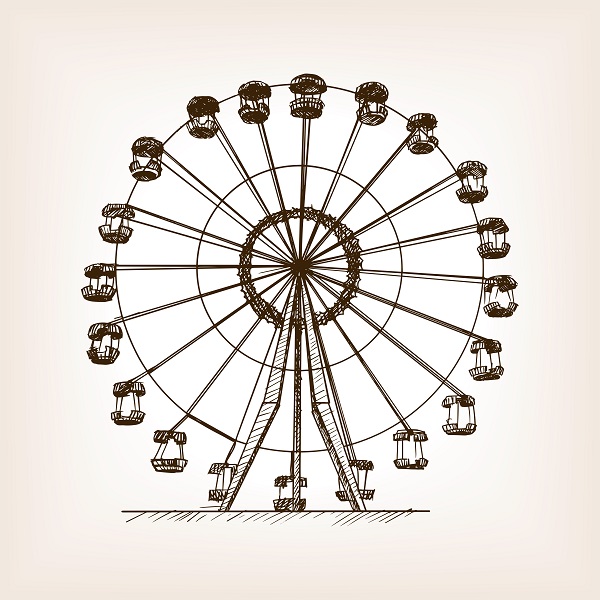
Remember the Ferris wheel from your studies of circular motion? Circular motion is just another example of periodic motion. Like circular motion, in simple harmonic motion we use the same terms to talk about time: period and frequency. When thinking of a Ferris wheel, the period is the time it takes for one complete revolution. In simple harmonic motion, the period is the time it takes for one complete "back and forth" cycle. It is measured in seconds and we still use the variable T.
Frequency, on the other hand, is the number of cycles in a specific time or the rate at which something happens. We can actually call the cycle one vibration or oscillation. In fact, these terms are often used interchangeably, but they mean the same thing. So, frequency is the time for one cycle, vibration, or oscillation. We use the variable f to reference the frequency in equations. It is measured in Hertz which is equivalent to \(\mathsf{ \frac{1}{s} }\).
Remember, period and frequency are similar but are not the same. One is seconds per cycle and the other is cycles per second. What this means is that they are inverses of one another. If you are given one, you can find the other.
Period and Frequency
\(\large\mathsf{ T = \frac{1}{f} }\)
\(\large\mathsf{ f = \frac{1}{T} }\)
...where f is in Hertz and T is in seconds.
One other term you will need to be able to use is called amplitude. For a mass-spring system, you measure the amplitude as the distance from the equilibrium position. For a pendulum, the amplitude is the maximum displacement from the equilibrium position. Though it is sometimes measured in degrees or radians, it is more commonly measured as the distance from the equilibrium position.
Question
The frequency of a pendulum is 0.05 Hz. What is the period of the pendulum?
Use \(\mathsf{ T = \frac{1}{f} }\): \(\mathsf{ T = \frac{1}{0.05 \text{ Hz}} = 20 \text{ s} }\)
