For some more challenging problems, you may have to recall how to figure out the period from a frequency value or figure out the spring constant using Hooke's Law prior to solving the period problem. Keep this in mind as you work through these more challenging problems. Here are the equations that you may need to solve these problems.
Hooke's Law
The force needed to compress or stretch a spring is directly proportional to the displacement of the spring.
\(\large\mathsf{ F_{elastic} = -kx }\)
...where F is the spring force, k is the spring constant of the specific spring, and x is the displacement of the object from its equilibrium point.
Period and Frequency
\(\large\mathsf{ T = \frac{1}{f} }\)
\(\large\mathsf{ f = \frac{1}{T} }\)
...where f is in Hertz and T is in seconds.
Period of a Pendulum in SHM
\(\large\mathsf{ T = 2 \pi \sqrt{\frac{L}{g}} }\)
...where T is the period, L is the length of the pendulum, and g is the acceleration of gravity at that location.
Period of a Mass-Spring in SHM
\(\large\mathsf{ T = 2 \pi \sqrt{\frac{m}{k}} }\)
...where T is the period, m is the mass of the object attached, and k is the spring constant of the spring.
| Problem | Picture | Given/Find | Equation | Solution |
|---|---|---|---|---|
| A trapeze artist is swinging back and forth with a frequency of 0.263 Hz. How long are the cables that are supporting the trapeze artist? |
|
\(\mathsf{ f = 0.263 \text{ Hz} }\) \(\mathsf{ T = ? \text{ s}}\) \(\mathsf{ g = 9.81 \text{ m/s}^2 }\) \(\mathsf{ L = ? \text{ m} }\) |
\(\mathsf{ T = \frac{1}{f} }\) \(\mathsf{ T = 2 \pi \sqrt{\frac{L}{g}} }\) |
\(\mathsf{ T = \frac{1}{0.263 \text{ Hz}} = 3.80 \text{ s} }\) \(\mathsf{ 3.80 \text{ s} = 2 \pi \sqrt{\frac{L}{9.81 \text{ m/s}^2}} }\) \(\mathsf{ \frac{3.80 \text{ s}}{2 \pi} = \sqrt{\frac{L}{9.81 \text{ m/s}^2}} }\) \(\mathsf{ 0.605 \text{ s} = \sqrt{\frac{L}{9.81 \text{ m/s}^2}} }\) \(\mathsf{ (0.605 \text{ s})^2 = \frac{L}{9.81 \text{ m/s}^2} }\) \(\mathsf{ (0.366 \text{ s}^2)(9.81 \text{ m/s}^2) = L }\) \(\mathsf{L = 3.59 \text{ m} }\) |
| A 0.35 kg mass stretches a spring to a displacement of 0.20 m. The mass is then set into simple harmonic motion on that spring. What is the period of the movement? |
|
\(\mathsf{ F_{elastic} = 0.35 \text{ kg} \times 9.81 \text{ m/s}^2 = 3.4 \text{ N}}\) \(\mathsf{ k = ? \text{ N/m} }\) \(\mathsf{ x = -0.020 \text{ m}}\) \(\mathsf{ T = ? \text{ s}}\) \(\mathsf{ m = 0.35 \text{ kg}}\) |
\(\mathsf{ F_{elastic} = -kx }\) \(\mathsf{ T = 2 \pi \sqrt{\frac{m}{k}} }\) |
\(\mathsf{ 3.4 \text{ N} = -k(-0.20 \text{ m}) }\) \(\mathsf{ k = -\frac{3.4 \text{ N}}{-0.20 \text{ m}} }\) \(\mathsf{ k = 17 \text{ N/m} }\) \(\mathsf{ T = 2 \pi \sqrt{\frac{0.35 \text{ kg}}{17 \text{ N/m} }} }\) \(\mathsf{ T = 2 \pi \sqrt{0.0206 \text{ s}^2} }\) \(\mathsf{ T = 2 \pi \times 0.143 \text{ s} }\) \(\mathsf{ T = 0.90 \text{ s} }\) |
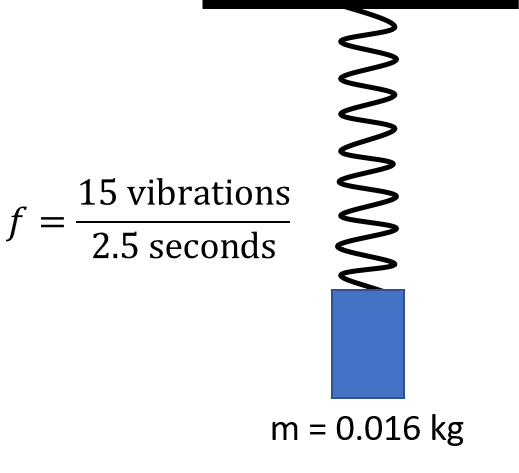
| A mass of 0.016 kg is attached to a spring and set into simple harmonic motion. It completes 15 vibrations in 2.5 seconds. What is the spring constant of the spring? |
|
\(\mathsf{ f = \frac{15}{2.5} = 6.0 \text{ Hz}}\) \(\mathsf{ T = ? \text{ s}}\) \(\mathsf{ m = 0.016 \text{ kg}}\) |
\(\mathsf{ T = \frac{1}{f} }\) \(\mathsf{ T = 2 \pi \sqrt{\frac{m}{k}} }\) |
\(\mathsf{ T = \frac{1}{6.0 \text{ Hz}} = 0.17 \text{ s} }\) \(\mathsf{ 0.17 \text{ s} = 2 \pi \sqrt{\frac{0.016 \text{ kg}}{k}} }\) \(\mathsf{ \frac{0.17 \text{ s}}{2 \pi} = \sqrt{\frac{0.016 \text{ kg}}{k}} }\) \(\mathsf{ (0.027 \text{ s})^2 = \frac{0.016\text{ kg}}{k} }\) \(\mathsf{ 0.00073 \text{ s}^2 = \frac{0.016 \text{ kg}}{k} }\) \(\mathsf{ k = \frac{0.016 \text{ kg}}{0.00073 \text{ s}^2} }\) \(\mathsf{ k = 22 \text{ N/m} }\) |