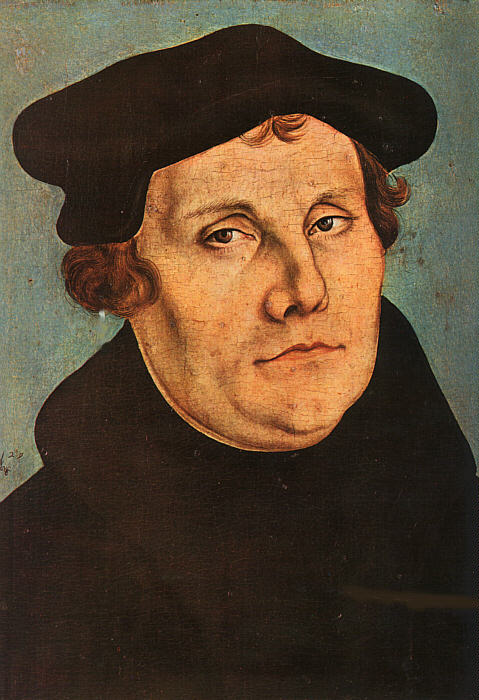
The Protestant Reformation was a movement to break away from the Catholic Church. It was started in Germany by Martin Luther in 1517. Luther was a Benedictine Monk who was increasingly frustrated with the power and wealth of the Catholic Church. He wrote a list of 95 frustrations and nailed it to a church in Wittenburg. This act caused a split from the Catholic Church.
This new movement appealed to many who felt the Catholic Church was more about power than religion. Through the efforts of John Calvin in Switzerland and Henry VIII in England, the Protestant movement had an impact all throughout Europe. This caused much religious strife, and in some cases, wars in Europe. There were many who wanted to escape this turmoil and establish colonies where they were free to worship as they pleased.
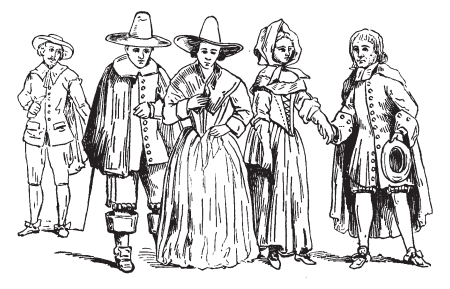
Puritans in the mid-17th century sought to purify the Church of England from all Roman Catholic practices.
Unlike the Jamestown settlers, the next wave of colonists would arrive in search of religious freedom. England had been a Protestant country since 1534, when King Henry VIII broke away from the Roman Catholic Church and formed the Church of England, or Anglican Church. Not everyone in England was happy with the new church, however. Many people dissented—they disagreed with the beliefs or practices of the Anglicans. English Catholics, for example, still considered the pope the head of the church, and they were often persecuted, or treated harshly, for that reason. Often hiding to practice their faith, they became known as Recusants. Some wealthier powerful noble families who remained Catholic could covertly practice, even with royal knowledge, but poorer Catholics could not. Even the nobles were executed at times.
At the same time, some Protestants wanted further change and reform in the Anglican Church, while others wanted to break away from it altogether. The Protestants who wanted to reform the Anglican Church were called Puritans. Those who wanted to leave and set up their own churches were known as Separatists. The Separatists were persecuted in England, and some fled to the Netherlands. Though they found religious freedom there, the Separatists had difficulty finding work. They also worried that their children were losing their religious values and their English way of life.
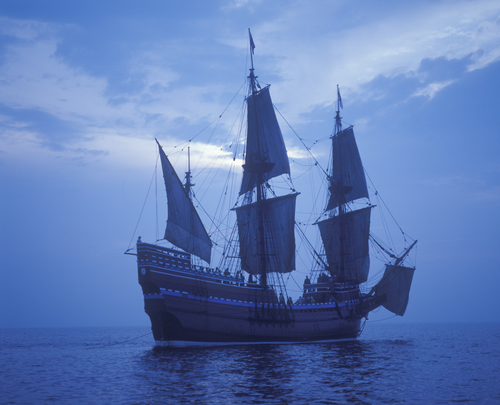
A replica of the 1620 Mayflower that the Pilgrims used to sail to the New World.
Some Separatists in the Netherlands arranged with the Virginia Company. The Separatists could settle in Virginia and practice their religion freely. In return they would give the company a share of any profits they made. The Separatists considered themselves Pilgrims because their journey had a religious purpose. Only 35 of the 102 passengers who boarded the Mayflower in September 1620 were Pilgrims. The others were called “strangers.” They were common people—servants, craftspeople, and poor farmers—who hoped to find a better life in America. Because Pilgrim beliefs shaped life in the Plymouth colony, however, all the early settlers are usually called Pilgrims.
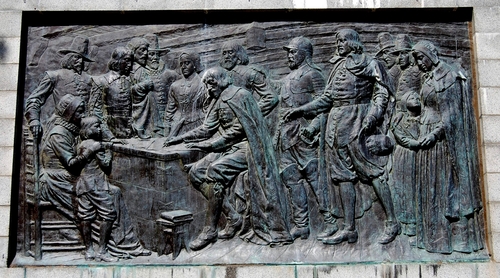
A bas-relief panel on the base of the Pilgrim Monument depicts the Pilgrims signing the Mayflower Compact in 1620.
The Mayflower’s passengers planned to settle in the Virginia colony. The first land they sighted was Cape Cod, well north of their target. Because it was November and winter was fast approaching, the colonists decided to drop anchor in Cape Cod Bay. They went ashore on a cold, bleak day in December at a place called Plymouth. William Bradford, their leader and historian, reported that “all things stared upon them with a weather-beaten face.” Plymouth was outside the territory of the Virginia Company and its laws. Before going ashore, the Pilgrims drew up a formal document called the Mayflower Compact. The compact pledged their loyalty to England and declared their intention of forming “a civil body politic, for our better ordering and preservation.” The signers also promised to obey the laws passed “for the general good of the colony.” The Mayflower Compact was a necessary step in the development of representative government in America.
When you are finished reading, answer the questions below to see how well you understood the text.
| Whose protests started the Protestant Reformation in Europe? | Martin Luther |
| How did the religious rivalries in Western Europe affect the Americas? | Rivalries brought immigrants to America looking to escape religious persecution. |
| Who was John Calvin? | John Calvin was a Protestant reformer from France who developed Calvinism. |
| What did the English Parliament do in 1533 that helped establish England as a Protestant nation? | The Parliament established the Church of England as the official church of English Protestantism. |
| Why did Henry VIII rebel against the Pope and the Catholic Church? | so he could divorce his wife |
