The American Imagists wanted to create vivid pictures in the minds of readers—images that would reveal moments of truth about the modern, industrialized world. Imagist poems were written in free verse, with no official structure or rhyme scheme. The poems' sparse, unregulated forms contributed to the Imagists' overall goal of cutting away anything unnecessary to the image.
Unlike British Modernists, whose work was marked by negativity and pessimism after World War I, American Modernists like William Carlos Williams wanted to make more positive art. They looked back to the overflowing optimism in the work of American writers like Walt Whitman and tried to re-create moments of sympathy and strength that might better represent "the American attitude" toward tragedy and hardship.
Read two of William Carlos Williams' most famous poems, "The Great Figure" and "The Red Wheelbarrow," on the tabs below. These are some of his earliest published works, so they reveal more of an Imagist influence than do his later works.
The Great Figure
The Red Wheelbarrow
"The Great Figure" was published in the collection Sour Grapes in 1921. Like other Imagist poems, it's short—only one sentence—and it focuses on a single image. As you read, think of the different ways the poem connects to the Imagist movement as a whole.
![By Thomas R Machnitzki (Own work) [CC BY-SA 3.0 (http://creativecommons.org/licenses/by-sa/3.0) or GFDL (http://www.gnu.org/copyleft/fdl.html)], via Wikimedia Commons](https://s3.amazonaws.com/cms.accelerate-ed.com/image/c637d555-6af6-487f-a072-6544b21ebf0a.jpg) The Great Figure
The Great Figure
Among the rain
and lights
I saw the figure 5
in gold
on a red
firetruck
moving tense
unheeded
to gong clangs
siren howls
and wheels rumbling
through the dark city.
How does Williams use the adjectives tense and unheeded in this poem? What purpose do these words serve in the poem?
The word tense is the only example of figurative language in the poem—the firefighters are tense, and their truck has adopted that human characteristic too. The word unheeded emphasizes the chaos of the city. (If people aren't paying attention to a roaring fire truck, the city must be busy and chaotic.) Both words help readers see the firetruck and the golden number 5 as essential parts of the landscape, and as symbols of order in a bustling city.
"The Red Wheelbarrow" is William Carlos Williams' most famous work. When it was originally published in 1923, it didn't have a title. It's a very short poem, and some critics believe that the addition of a title distracts readers from the purity of the image Williams was creating.
Read the entire text of "The Red Wheelbarrow" below, and think about why it might be considered one of the defining works of Imagism.
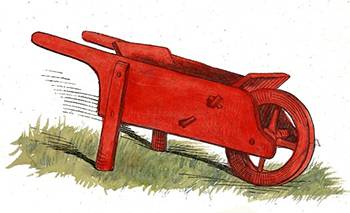 The Red Wheelbarrow
so much depends
upon
a red wheel
barrow
glazed with rain
water
beside the white
chickens.
Why is syntax—the order of the words and the structure of the sentence—so important in a short poem like this one?
When a poem is this short, the arrangement of the words plays a large role in creating meaning for readers. For example, while this poem is a single sentence, Williams separated it into four stanzas, and the rhythm of the words creates natural stopping points at the end of each line or stanza. The most important verb in the sentence, depends, looms over the rest of the poem, creating a sense of tension and mystery.
