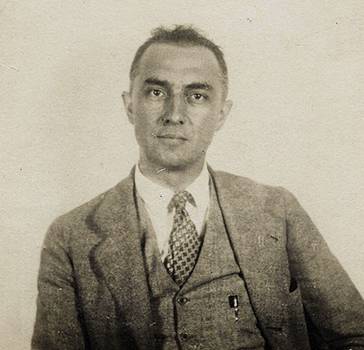
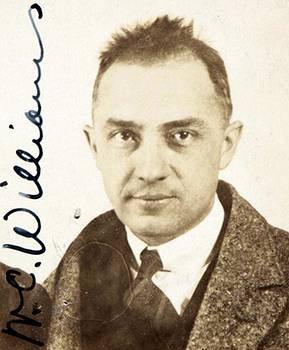
Like the American poet Wallace Stevens, who worked as an executive at an insurance company, William Carlos Williams didn't consider poetry his main profession. Learn more about Williams' life and career by clicking through the slideshow.
|
William Carlos Williams was born in 1883 in Rutherford, New Jersey, just outside New York City. He spent most of his life in that area, apart from some high school years in France and Switzerland and some medical studies in Germany. By trade, he was a doctor who specialized in both pediatrics and general medicine. Williams saw patients during the day and perfected his poems at night.
William Carlos Williams met the American poets Ezra Pound and Hilda Doolittle (also known as H.D.) while he was in college at the University of Pennsylvania, where they introduced him to ideas attributed today to Imagism. While Williams gained initial fame as an Imagist, he eventually developed his own ideas about poetry and associated with other American poets in the New York area, including Wallace Stevens and Marianne Moore.
Williams' first big success as a poet came in 1923, when he published a collection called Spring and All. At the time, Modernists like T.S. Eliot were becoming popular among academics for their highly intellectual, elusive poems that broke from the traditional forms of the 19th century but were addressed to very highly educated readers. Williams also rejected traditional poetic forms, but he believed that American poetry should be accessible to everyone, even readers without the means to secure an advanced education. Instead of the classical allusions and sometimes obscure language favored by Modernists like Eliot, Williams used language that reflected everyday speech and the colloquial dialects of the New York City area.
In the 1950s, William Carlos Williams suffered a heart attack and a stroke, but he remained the chief of pediatric medicine at Passaic General Hospital until his death in 1963. During that time, Williams was still famous for his poetry, and he served as a mentor to members of the upcoming "Beat Generation," such as the poet Allen Ginsberg. Today his simplest poems from the Imagist tradition form a central part in his literary legacy. |
 |

![By John Vandenberg (commons) [CC BY-SA 3.0 (http://creativecommons.org/licenses/by-sa/3.0)], via Wikimedia Commons](https://s3.amazonaws.com/cms.accelerate-ed.com/image/eca8cbbf-ed3a-487a-a388-e571d2fdbe5c.jpg)
![Vysotsky (Wikimedia) [CC BY-SA 4.0 (http://creativecommons.org/licenses/by-sa/4.0) or Attribution], via Wikimedia Commons](https://s3.amazonaws.com/cms.accelerate-ed.com/image/2988a112-5763-47a4-ad11-e96cd1410f63.jpg)
Question
How did William Carlos Williams' job as a family doctor contribute to his writing of "local" poetry?
