Frank was a very talented artist. By the time he was in 10th grade, he'd already made several pieces that were on display in local shops and restaurants around town. Because he enjoyed creating many different types of art, his latest project was especially intriguing.
Frank's high school recently built a new math lab, complete with state-of-the-art computers, mathematics software, and physical models to be used as teaching tools. In order to make the space more appealing to students, the principal invited everyone to submit art to be displayed on the walls in the lab. Students could submit as many pieces as they'd like, but only those chosen by popular vote would become a permanent part of the lab's decor. The only stipulation was that each work of art had to be relevant to some area in mathematics. Frank decided to create an installation that contained several different works of geometry.
|
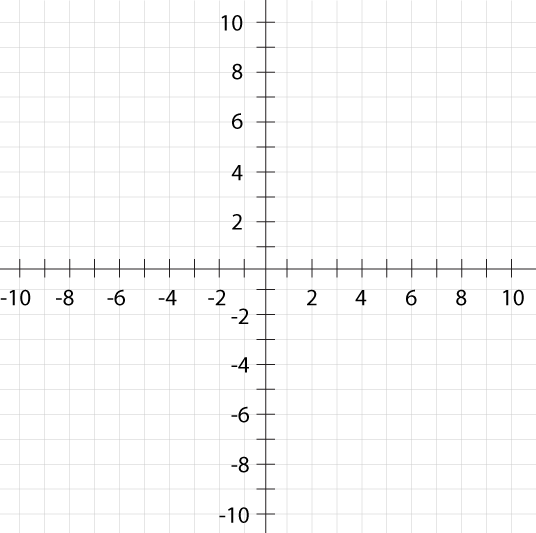
Frank wanted all of his pieces to connect through a common theme. For his first piece, he showed this grid.
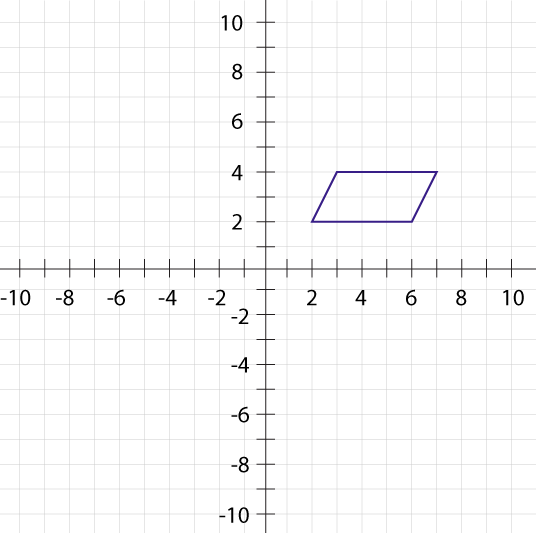
Next, Frank showed a parallelogram.
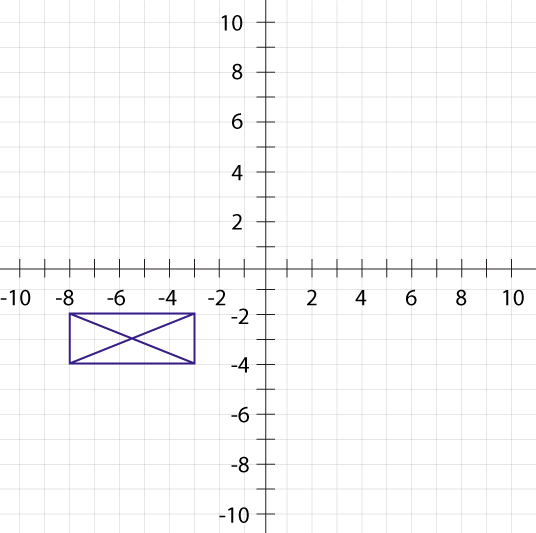
His third drawing showed a rectangle.
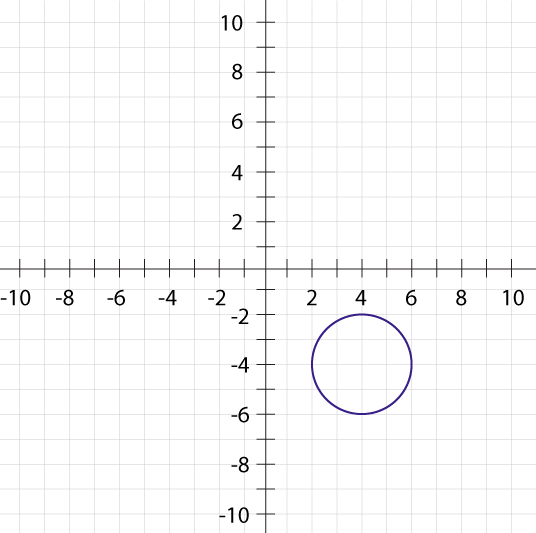
For his next piece, Frank drew a circle.
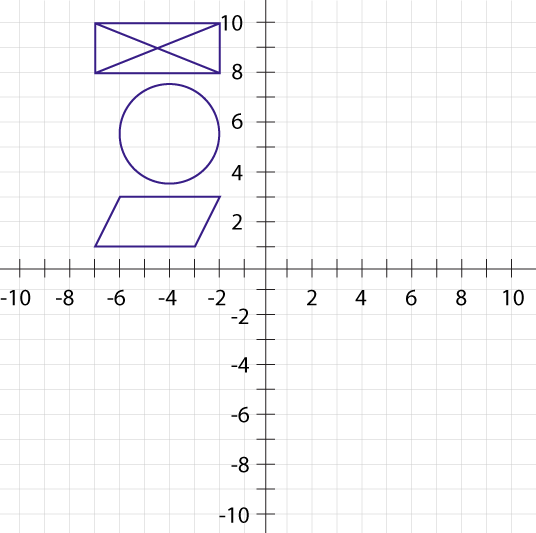
Frank drew all of the figures in his final piece.
Which quadrant contains the figures? The second quadrant Frank noticed that it was much easier to draw geometric figures on a coordinate plane. In fact, he could determine lots of information about each figure from inspection alone.
Both the principal and the student body liked how Frank combined geometry and art. His work was simple yet effective. The students voted to use all of his pieces in the new math lab. |
 |

Frank created art by placing geometric figures on a grid. You can also use the grid, along with other tools, to prove simple geometric theorems algebraically. Hence, using this grid to create algebraic proofs is the focus of this lesson.
