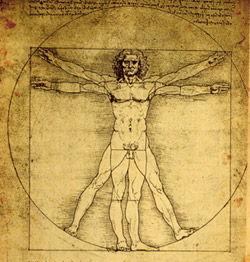
In the beginning of this lesson, Frank created art work by drawing different shapes on a Cartesian coordinate plane. Although his pieces were created primarily to introduce the concepts covered in this lesson, mathematicians have been combining art and geometry for centuries. Consider Leonardo da Vinci's drawing Vitruvian Man.
The artist drew this image to show how human proportions correspond to geometry. See how you can use the Vitruvian Man to make several geometric calculations.
As you watch this video, use the study guide to follow along if you'd like. Click the button below to download the study guide.
 In this video, I would like to help you see two ways we see how Leonardo Da Vinci used Geometry in his drawing of what's known as the Vitruvian Man.
First we will look at the wingspan of the Vitruvian man and compare it to his overall height. Most would argue that a person is taller than the width their arms can reach. By examining the drawing closely, we see the man is drawn to fit within a square. You should remember that a square is a quadrilateral whose height and width are equal. Therefore, since the measurement from head to toe fits within the height of the square, and the arm span also fits within the width of the square, we know the two lengths are equal. Even if it appears that a person is taller than the width their arms can reach, it is actually true that these two measurements are remarkably close.
Next, we look at the Vitruvian Man with his arms raise. We can show that the distance from his naval to his fingertips is the same distance as his naval to the floor. Consider the right triangle formed in this position… its base is 4 units wide while its height is 3 units. Using the Pythagorean equation we see the length along the diagonal, which is the length from the naval to fingertip, is 5 units long… By counting the vertical distance from his naval to the ground, we see that it too is 5 units.
These are just two of the many parallels between Da Vinci's drawing and the study of Geometry. Can you find others?
Question
How do you show that a figure defined by four points is a rhombus?
