Finding the right words isn't always easy. Writing clear, compelling, beautiful sentences takes creativity, skill, and most of all, practice. In fact, it's a lot like being an artist. Artists try to evoke emotions with their work, and carefully choose every part of their creations to achieve the desired effect. They think hard about what colors to use, how to arrange their subjects on the canvas, how much detail to add, where to be realistic, and where to be imaginative.
In the same way, good writers can paint pictures in the minds of their readers. They thoughtfully compose their sentences, pay close attention to each word, and balance descriptive and figurative language until every idea is expressed with just the right shade of meaning. You can make the first draft of your story stronger just by adding some "masterpiece" sentences of your own--statements that you craft as carefully as an artist works on a favorite painting. To create masterpiece sentences, though, you need to understand what you're working with.
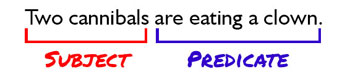
In their simplest form, sentences are made of two parts: the subject and the predicate. The subject of the sentence tells us who or what the sentence is about, while the predicate tells us what happens--what the subject does.

Let's find the subject of this sentence first. Who or what is this sentence about?
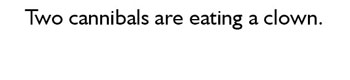
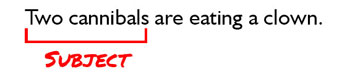
This sentence is about two cannibals, so that's its subject. Remember, a subject always contains a noun. Now, to find the predicate, we have to figure out what this sentence tells us about the subject.
The verb "are eating" tells us what the subjects of the sentence are up to: They're eating a clown. Predicates always contain verbs.

The verb "are eating" tells us what the subjects of the sentence are up to: They're eating a clown. Predicates always contain verbs.
Find the subject of this sentence: "One cannibal turns to the other and says, 'Does this taste funny to you?'"
- Does this taste funny
- turns to the other and says,
- to you?
- One cannibal
Incorrect. The cannibal's question is still in the predicate, because it talks about what the subject is doing. In this case, he's asking his friend a question.
Incorrect. The verb "turns" lets us know that whatever comes next describes the action of the subject of the sentence, so it's the predicate.
Incorrect. This is still part of the predicate, because it describes the actions of the subject.
Correct. The sentence is about one cannibal, and everything else in the sentence tells us about what he does.
Find the subject of this sentence: "Biting his tongue, Gerald decided not to tell his arachnophobic uncle about the baby spider in his tea."
- his arachnophobic uncle
- baby spider
- Gerald
- Biting his tongue
Incorrect. Gerald's arachnophobic uncle is not the subject of the sentence, because the sentence is about Gerald's decision not to tell his uncle about the spider.
Incorrect. The baby spider isn't the subject of this sentence, because it's not taking any action. The sentence is about Gerald.
Correct. Gerald is the subject of this sentence, since he is the one biting his tongue and deciding not to tell his uncle about the spider.
Incorrect. Biting his tongue is something the subject of the sentence, Gerald, does, so it belongs in the predicate.
Find the predicate of this sentence: "No one knows where the sea cucumbers came from."
- knows where the sea cucumbers came from
- No one
- one knows where
- sea cucumbers
Correct. This whole thing is the predicate, because it tells us information about the subject ("no one").
Incorrect. "No one" is the subject of this sentence, not the predicate.
Incorrect. Even though this part contains a verb ("knows"), it's only part of the predicate.
Incorrect. Sea cucumbers are inside the predicate, but they're only part of the predicate.
Summary
 Questions answered correctly:
 Questions answered incorrectly:
