Complete the mixture problems below. You will need to set up the mixture equation and solve it for the variable.
Problem 1
Problem 2
Problem 3

How many liters of a 10 percent salt solution should be combined with a 60 percent solution to make 15 liters of a 25 percent salt solution?
| Define the variable. | a = amount of 10 percent solution 15 − a = amount of 60 percent solution |
| Make sense of what is known. | The 10 percent salt solution has 0.10a units of salt. The 60% salt solution has 0.60(15 – a) units of salt. There will be a total of 15 liters. |
| Set the two rational expressions equal to each other. | \(\small\mathsf{ \frac{0.10a + 0.60(15 − a)}{15} = \frac{25}{100} }\) |
| Solve. | Cross multiply to get 10a + 60(15 – a) = 375 10a + 900 – 60a = 375 -50a + 900 = 375 -50a = -525 a = 10.5 |
10.5 liters of the 10 percent solution and 4.5 liters of the 60 percent solution would be needed.
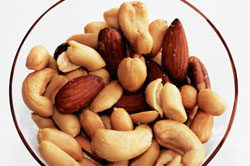 A party planner mixed almonds, cashews, and peanuts. Five pounds of cashews costing $4 per pound were mixed with eight pounds of almonds costing $3 per pound.
How many pounds of peanuts costing $2.00 per pound need to be mixed so the average price per pound is $2.50?
| Define the variable. | p = amount of peanuts |
| Make sense of what is known. | The 5 pounds of cashews cost $4 per pound, for a total of 5(4). The 8 pounds of almonds cost $3 per pound, for a total of 8(3). The p pounds of peanuts cost $2 per pound, for a total of p(2). There will be a total of 5 + 8 + p pounds. |
| Set the two rational expressions equal to each other. | \(\small\mathsf{ \frac{5(4) + 8(3) + p(2)}{5 + 8 + p} = \frac{2.50}{1} }\) |
| Solve. | Cross multiply to get 20 + 24 + 2p = 32.5 + 2.5p 44 + 2p = 32.5 + 2.5p -0.5p = -11.5 p = 23 |
The planner needs 23 pounds of peanuts.
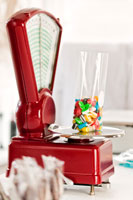 Candy worth $1.30 per pound was mixed with 20 pounds of candy worth $2.50 per pound. A mixture
worth $1.75 per pound was created.
Candy worth $1.30 per pound was mixed with 20 pounds of candy worth $2.50 per pound. A mixture
worth $1.75 per pound was created.
How many pounds of each kind of candy were used to make the mixture?
| Define the variable. | a = amount of candy worth $1.30 per pound |
| Make sense of what is known. | The a pounds of the first type cost $1.30 per pound, for a total of a(1.30). The 20 pounds of the second type cost $2.50 per pound, for a total of 20(2.50). There will be a total of a + 20 pounds. |
| Set the two rational expressions equal to each other. | \(\small\mathsf{ \frac{a(1.30) + 20(2.50)}{a + 20} = \frac{1.75}{1} }\) |
| Solve. | Cross multiply to get 1.3a + 50 = 1.75a + 35 -0.45a = -15 a = 33\(\small\mathsf{ \frac{1}{3} }\) |
33\(\small\mathsf{ \frac{1}{3} }\) pounds of candy costing $1.30 would be needed.
