Using the sample mixture problem shown below, you will see two distinct methods to solve this problem. Write the problem out and then try to solve it by repeating the steps on paper after you've viewed the video. You will be shown two different methods of solving the problem. Choose the one that makes the most sense to you. All mixture problems can be solved using either method.
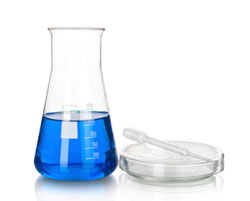 Suppose you work in a lab. You need a 15 percent acid solution for a certain test, but your supplier only ships a 10 percent acid solution and a 30 percent acid solution. Rather than pay the hefty surcharge to have the supplier make a 15 percent solution, you decide to mix 10 percent solution with 30 percent solution, to make your own 15 percent solution. You need 10 liters of the 15 percent acid solution. How many liters of 10 percent solution and 30 percent solution should you use?
 The next type of problem we're going to solve are called mixture problems. It's where we take one item such as the yellow paint can shown here and another item such as the blue paint can shown here and we mix them together. Now back in your art days of learning primary colors you know that when you mix those two together, you're going to get a color similar to the one shown here in green.
In most of the problems that you're going to see in this example as well as the other examples that you see in algebra class or anytime, you're going to be using solutions of things. And the best way to think about that is to again use paint but in a different way. So here I have basically test tubes full of a liquid. In the first one I have what looks like a red liquid, a dark liquid. And if you can just imagine this as a container with water with a lot of food coloring and that food coloring has made it red. Over here in this other round tube we have a liquid that looks white with a little hint of red in it, you can see the little bit of red on the edge here. This is the same type of liquid, it's got water in it and just imagine only a few drops of red food coloring in it. What happens when you mix the two together.
You basically have a really strong mixture over here on the left and a really weak mixture over here on the right. When you mix the two together you're going to get some kind of mixture in between those two shades. So by mixing the darker with the lighter, you're going to get some shade in between, we don't know what percentage that is, but you're going to get something in between. And that's basically how our mixture problems work, you're going to get something in between. Let's take a look at what an example might look like.
In our first example, we are going to be working in a lab situation and we need a 15% acid solution but the supplier only ships us two different solutions that are 10% and 30%. What that means is we have two liquids and 10% of the first liquid is an acid and 30% of the second solution is an acid. It's mixed with some other liquid, we'll just assume it is water in this case. Rather than pay the hefty surcharge to have the supplier make a 15% solution, you can mix the 10% and the 30% solution to make your own 15% solution which means the new liquid that you make will have 15% of the acid and the rest of it will be made up with water. So you need 10 liters total to be 15% acid solution. So your question is how many liters of the 10% solution and how many liters of the 30% solution should you use? And you can use algebra to solve this.
I'm going to show you two different ways to solve this problem and the first is to create a chart of information that you have. Notice I have a 10% row and a 30% row. We're going to combine the two to yield a 15% solution. The given information for our 10% row is that we have two variables. We have how many liters of our 10% solution and how many liters of our 30% solutions. We don't know what those numbers are, so they are our variables here – x and y as you can see here – represent our liters of the solution. When we add those two together, we get a total of 10 liters. So we want 10 liters of the 15% solution so we simply take our variables and add them together. I'm going to then have a column of % acid and I know I have 10% so I'm going to convert that to a decimal, to .10. My 30% is converted to .30 and my total mixture then is going to be .15.
My last column, I'm looking for how many liters of acid I have, and since I can take my liters of solution
times the percent of acid, this column times this column, I'm going to get .10x in the first row that
represents the total liters of acid for my 10% solution. .30y is going to represent my liters for my 30%
solution and when I take my mixture, what I can do is take the .15 times my total number of liters which
is 10 and that ends up giving or yielding a 1.5.
So a couple of things I can do here now, I can take my equation x plus y equals 10 and I can solve it for x
by subtracting y from both sides. What that allows us to do is it allows us to replace on the chart
anything with an x with that equation. So, X equals 10 minus y, so I can replace my x there with the 10
minus y. I can also replace my x over here with a 10 minus y and by substituting that in I now have a
chart that has all the same variables in this set up here.
So what I'm going to do is I am going to take my 10% total number of liters of acid. I'm going to add that
to my 30% numbers of liters of acid and I'm going to get a total of 1.5 liters of acid. So I can set up an
equation now using one variable. And now I can solve for y. So I'm going to distribute my .10 and
rewrite the rest of the equation. Combine my like terms. Notice I have a negative .10 plus .3 all as part
of my y variable, so that is a .2y and it's positive. So the final step here before I can isolate my y is to
subtract 1 and I'm left with .20y on the left and .5 on the right. I divide by .20 and on the left they cancel
and I'm left with y equals .5 divided by .2 which is 2.5. So that means I have 2.5 liters of my 30% solution
and I have a total of 10 liters so my difference then or if I subtract it, I have 7.5 liters of my 10% solution
and that is going to give me a total of 10 liters of my 15% solution.
So if you think about it, it makes sense because - I will draw a little diagram over here. I have 10%
solution that I'm mixing with 30% solution and I need to get 15% solution. Well 15% solution is closer to
10% so I'm going to need, according to what I discovered, I'm going to need 2.5 liters of my 30% and 7.5
liters of my 10% - that makes sense because if I want it to be more like the 10%, I need more of that
solution and less of the stronger amount. So I need more of the weaker, less of the stronger if that
makes sense.
Let's take a look at this problem in a slightly different way but keeping in mind my example – my little
diagram that I drew a minute ago. I'm going to compare this to a see-saw. If you think about it, if you
are on a see-saw and you have a person at the one end, to keep it balanced you have to have somebody
on the other end that is of equal weight. So you have to have the same sized person as long as these
distances are the same apart.
If you think about the solution that we just took a look at, we had a 15% solution and we had a 30%
solution which clearly are not the same weight. They're not the same distance from the center either.
So we determined in the last picture that we were closer to the 10% but we need more of that 10% so if
you think of it as a see-saw, (I'm going to change this to 10% here, actually let me just erase that since I
messed that up), I'm going to change this to 10% as our problem indicates and a 30%. So our 30% is
heavier or bigger, if you will, and we are going to need less of that to keep our seesaw balanced. So if this is our middle, we're closer to the center, further away from the center, we're going to need more of it.
If you take a look at our problem, in any seesaw situation and that's really what a mixture problem is, your distance times the weight of one side is going to equal your distance times the weight of another side. So if we consider 15% balanced, then we're going to take how far away from 15% each one of these numbers is as our distance. So for example, 10% is 5 away from the 15 and 30% is 15 away from the 15%, so our distance on the left is 5 and our distance on the right is 15. Again this is just another way to solve the problem – if the chart works better for you stick with that method. I just thought this would be nice to show you how to do this.
We have a total amount of 10% liters that we're trying to solve for. You can choose whichever side you want to be the variable. I'm going to let x equal my number of liters of the 10% solution. Therefore I am going to put an x times 5 on the left and on the other side, I know that 10 is my total amount so I'm going to use 10 minus x as the number of liters of my 30% solution. So I'm going to put 10 minus x over here. So now I have a nice little equation with one variable. I have 5x on the left and I have 15 times the quantity of 10 minus x, which is 150 minus 15x. And I'm going to combine my exes by adding 15x to both sides, on the left I have a 20X and on the right I have 150 since my exes wipe out, and then I divide by 20 and this becomes a very simple algebra problem at this point. The 20s on the left wipe out and 150 divided by 20 is 7.5. So it looks like according to my comparison to a seesaw, I need 7.5 liters – what did we say x is? - of the 10% solution and if I substitute that in over here, 10 minus 7.5 indicates that I need 2.5 liters of the 30% solution. So if you kind of use that seesaw with weight times distance equals weight times distance you can solve any mixture problem using that if you like. If the chart works better for you, you can certainly use the chart.
