Early in this lesson, you saw a regular pentagon. What made that pentagon regular? What makes any polygon regular?
A polygon is regular if all angles have equal measures and all sides have equal lengths.
To find the area of the regular pentagon, you divided it into five congruent triangles. Can you apply this method to other regular polygons? If so, does the equation for the area of a regular polygon have a special form? Explore these questions by reading through the slide show.
|
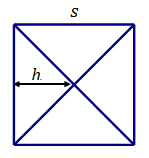
Consider this square, which is a regular polygon with four sides. You can divide this square into four congruent triangles. In this case, the area of the square is the sum of the area of the triangles.
\(\mathsf{ A_{\text{square}} = (4)(\frac{1}{2})bh }\) The base (b) of each triangle is the same as the side (s) of the square. Therefore, you could write \(\mathsf{ A_{\text{square}} = (4)(\frac{1}{2})sh }\).
You know the perimeter of the square is the sum of all the sides, s. Hence, 4s is the perimeter of the square.
\(\mathsf{ A_{\text{square}} = (\text{perimeter})(\frac{1}{2})h }\) The height, h, has a special name—apothem. An apothem is any segment from the center of a regular polygon that is perpendicular to any side.
An apothem is any segment from the center of a regular polygon that is perpendicular to any side. Hence, the area of the square can be written as \(\mathsf{ A_{\text{square}} = (\text{perimeter})(\frac{\text{apothem}}{2}) }\).
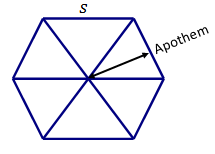
In other words, the area of the square is half the apothem times the perimeter. Of course, you could have calculated the area of the square by squaring a side since A = s2. So does this equation apply to other regular polygons? Consider this regular hexagon that has been divided into 6 congruent triangles.
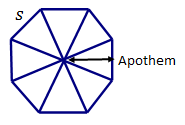
The area of the hexagon is: \(\mathsf{ A_{\text{hexagon}} = (6)(\frac{1}{2})(b)(h) }\) \(\mathsf{ A_{\text{hexagon}} = (6)(s)(\frac{1}{2})(\text{apothem}) }\) \(\mathsf{ A_{\text{hexagon}} = (\text{perimeter})(\frac{\text{apothem}}{2}) }\) This equation is true for a regular hexagon. Try one more regular polygon. Consider this regular octagon that's been divided into eight congruent triangles.
The area of the octagon is: \(\mathsf{ A_{\text{octagon}} = (8)(\frac{1}{2})(b)(h) }\) \(\mathsf{ A_{\text{octagon}} = (8)(s)(\frac{1}{2})(\text{apothem}) }\) \(\mathsf{ A_{\text{octagon}} = (\text{perimeter})(\frac{\text{apothem}}{2}) }\) Yes! The equation is also true for a regular octagon. In fact, you can find the area of any regular polygon if you know the length of one side and the apothem. Just multiply the perimeter of the polygon by half the apothem. |
 |

Question
What is the equation for calculating the area of a regular polygon?
