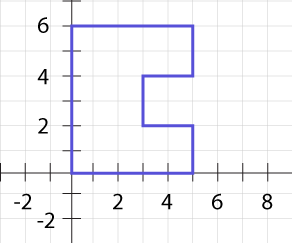
In previous examples, you were given a few dimensions of each polygon in order to calculate its area. What if the polygon were placed on a coordinate plane? Could you figure out the necessary dimensions to calculate the area if none were provided? Work through this process by reading through the slide show.
|
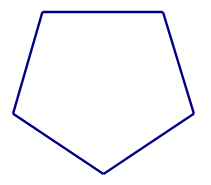
Consider the regular pentagon you saw earlier in this lesson.
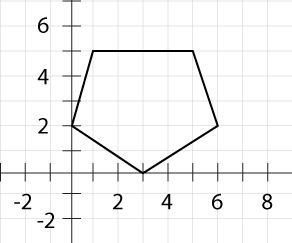
Now, look at the pentagon on a coordinate plane.
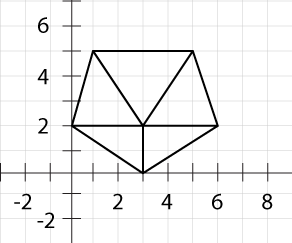
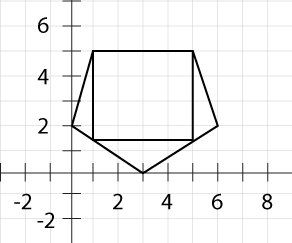
Previously, the pentagon was divided for you into congruent triangles, but here you can use the plane to divide the pentagon any way you like. Here are two other possible configurations you could use to calculate the area.
Configuration 1 divides the pentagon into five non-congruent triangles. Configuration 2 uses three triangles and a square. Any configuration is acceptable for calculating the area, as long as you can determine the base and height of each sub-part. Practice calculating the area of this polygon in a coordinate plane.
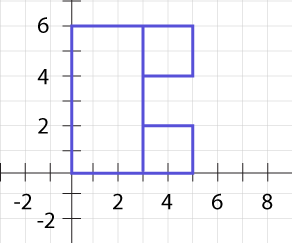
You can divide the polygon into several different sub-parts. Here's a possible configuration containing one rectangle and two squares.
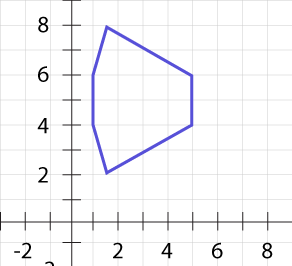
If you use this configuration, what is the area of the polygon? The area of one square = (2)(2) = 4 square units. Try working another example. Calculate the area of this polygon in a coordinate plane.
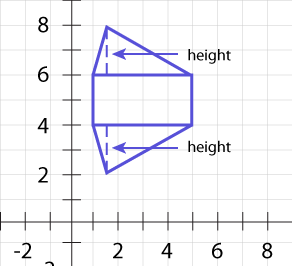
This is a possible configuration with one rectangle and two triangles.
|
 |