Make sure you understand the material covered in this lesson by answering these practice questions. Go back and review any concepts you have difficulty with before you take the lesson quiz.
A regular pentagon has side, s = 10 and apothem = 4. What is the area?
- 100 square units
- 90 square units
- 40 square units
- 120 square units
A pentagon has five sides. Find the perimeter and multiply by half the apothem.
A pentagon has five sides. Find the perimeter and multiply by half the apothem.
A pentagon has five sides. Find the perimeter and multiply by half the apothem.
A pentagon has five sides. Find the perimeter and multiply by half the apothem.
What is the area of this polygon?
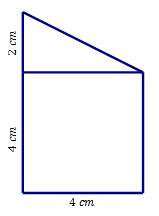
- 10 cm2
- 24 cm2
- 16 cm2
- 20 cm2
Add the areas of the triangle and square.
Add the areas of the triangle and square.
Add the areas of the triangle and square.
Add the areas of the triangle and square.
When finding the area of a polygon on a coordinate plane, which of the following statements is FALSE?
- The coordinate plane can be used to calculate the area of the polygon.
- The polygon can be divided into triangles and rectangles to find the area.
- The polygon can only be divided into one configuration of sub-parts to find the area.
- The polygon can be divided into many different configurations of sub-parts to find the area.
Any configuration of sub-parts can be used to find the area of a polygon.
Any configuration of sub-parts can be used to find the area of a polygon.
Any configuration of sub-parts can be used to find the area of a polygon.
Any configuration of sub-parts can be used to find the area of a polygon.
What is the area of this polygon?
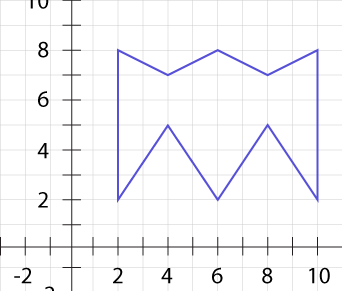
- 32 square units
- 48 square units
- 80 square units
- 27 square units
Divide the polygon into six triangles and one rectangle. Then, find the sum of the individual areas.
Divide the polygon into six triangles and one rectangle. Then, find the sum of the individual areas.
Divide the polygon into six triangles and one rectangle. Then, find the sum of the individual areas.
Divide the polygon into six triangles and one rectangle. Then, find the sum of the individual areas.
Summary
 Questions answered correctly:
 Questions answered incorrectly:
