As Michael demonstrated at the beginning of this lesson, you can find the area of a polygon by first dividing it into triangle and rectangle sub-parts and then calculating the area of the individual pieces. Finally, take the sum of all the sub-parts to determine the area of the whole polygon. When employing this technique, make sure you follow two rules:
- The triangle and rectangle sub-parts must cover the polygon with no space and no overlap.
- You must be able to calculate the area of the triangle and rectangle sub-parts.
Now, find the area of several polygons by working the examples in the next tab set.
Example 1
Example 2
This regular pentagon is divided into five congruent triangles. Find the area of the pentagon.
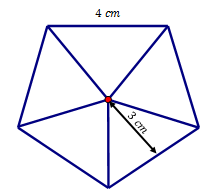
Use the steps presented in the table below to solve this problem.
| Consider one equilateral triangle within the pentagon. What are the base and height of one triangle? | The base and height are 3 cm and 4 cm. It doesn't matter which dimension is chosen for the base or height. |
| What is the area of one equilateral triangle within the pentagon? | \(\mathsf{ A = \frac{1}{2}bh = \frac{1}{2}(4)(3) = 6cm^{2} }\). |
| What is the sum of the areas of the equilateral triangles in the pentagon? | The sum of the areas is \(\mathsf{ (5)(6) = 30cm^{2} }\). |
| What is the area of the pentagon? | The area of the pentagon is \(\mathsf{ 30cm^{2} }\). |
Notice that you only needed two dimensions of the pentagon to calculate the entire area. Because the polygon is regular, you know the length of every side is 4 cm. Because the triangles are congruent, you know the height of every triangle is 3 cm. To solve the problem, you had to apply these dimensions appropriately to all the inner triangles.
Find the area of this polygon. The upper peaks are parts of congruent triangles.
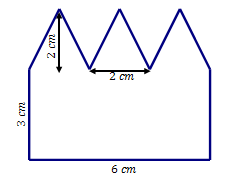
Use the next table to work through the steps in solving this problem.
| Since the upper peaks are part of congruent triangles, what is the area of one of the triangles? | \(\mathsf{ A = \frac{1}{2}(2)(2) = 2cm^{2} }\) |
| What is the total area of all three congruent triangles? | Total area of congruent triangles: \(\mathsf{ (3)(2) = 6cm^{2} }\). |
| What is the area of the lower rectangle? | \(\mathsf{ A = bh = (6)(3) = 18cm^{2} }\) |
| What is the area of the polygon? | Total area of the polygon: \(\mathsf{ 18 + 6 = 24cm^{2} }\) |
Even though this figure is not a regular polygon, you still need only a few dimensions to calculate the total area. Because the peaks are parts of congruent triangles, you need the base and height of one triangle to determine the area of all three. Since the base of the figure is a rectangle, you need the length and width to calculate the area.
For both of these examples, you were given only a few dimensions for the figure, and this will be the case the vast majority of the time. You will have to apply what you know about polygons to figure out the other dimensions and then calculate the relevant areas.
These examples show you how to calculate the area of regular and irregular polygons. In both cases, first, divide the polygon into triangles and rectangles. Next, find the area of those triangles and rectangles. Finally, take the sum of the individual areas to find the total area of the polygon.
