 Michael, a local tenth grade student, was extremely excited about the holiday season. He really enjoyed the family gatherings and delicious food But even more than eating, Michael especially looked forward to receiving special gifts!
That's why he was shocked and quite sad when his parents decided to use the money they would've spent on gifts to volunteer in South America. Michael expressed his disappointment, but his parents insisted on taking the family trip. Michael didn't know this experience would change his life...
|
Michael assumed he'd spend his holiday serving food or performing some other menial task. However, when his parents arrived at a small school house, he was surprised and curious.
Michael walked into the class just as the teacher was was explaining a class project. The student had made several gifts for their friends and families. Michael recognized they didn't have the money to buy gifts, and he marveled at their creativity. Now, the students needed to calculate each gift's area. The purpose of this project was to teach the students how to model real-life objects as polygons. The students were concerned because they only knew how to calculate the area of triangles and rectangles, but none of the gifts had triangular or rectangular shapes.
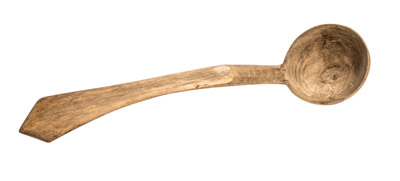
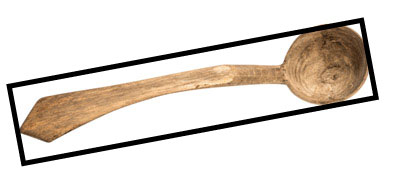
Michael got excited because he had recently studied the area of polygons in his own geometry class. He asked the teacher if he could help explain this concept to the class. Consider this hand-carved wooden ladle.
You can model the ladle as a rectangle. The length of the ladle represents the height of the rectangle, and the ladle's diameter is the rectangle's width.
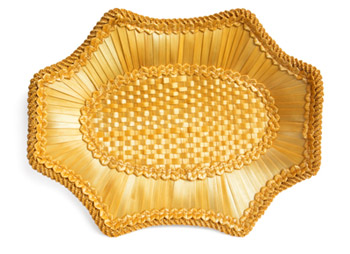
The students understood the concept of modeling the spoon as a rectangle, but what about a gift like this tray?
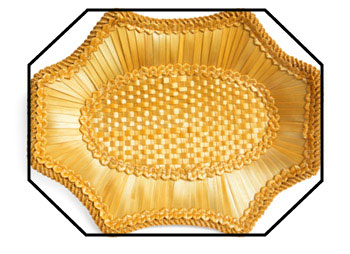
Michael explained they could also model this tray as a rectangle. However, a more accurate model would be an octagon.
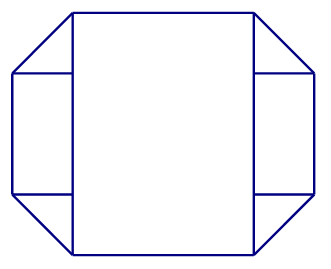
The students looked puzzled. The students reminded Michael that they only knew the area formulas for triangles and rectangles. So how could they find the area of an octagon? Michael drew this image on the chalk board.
They could divide the octagon into triangles and rectangles. Then, they could calculate the area of each figure and add them to get the area of the octagon. Then, the students understood! Michael smiled as he watched them apply what he had just showed them to calculate the area of every gift they'd made. Some students modeled gifts as hexagons, and others used star shapes. Some used more triangles and rectangles. Michael worked diligently in that classroom every day. Not only did he help teach the students, but he learned a lot from them as well. He even admitted to his parents that this experience was the best idea they'd ever had. |
 |

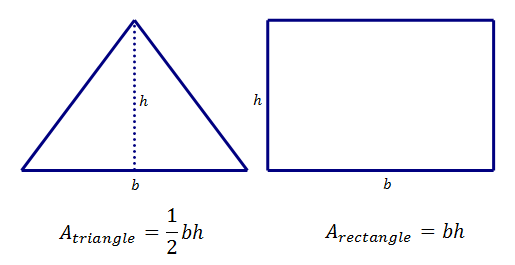
Michael demonstrated how to model real life objects as polygons in order to calculate their areas, and you will learn that technique in this lesson.
Question
How can you calculate the area of a dodecagon?
