Why do people need lawyers today? Why not just find a copy of the nation's laws and figure out your own case? If you're like most people, you find the number and complexity of laws far too overwhelming to navigate on your own. When you hire a lawyer, you expect that person to know your country's laws well enough to help you use them to your advantage--whether that involves getting a fair trial or settling a dispute with an employer or a neighbor.
We can thank the Roman justice system for creating a model that was so complex and detailed that lawyers were needed to help ordinary citizens interpret it. The Romans introduced the idea of jurisprudence—the study of the law as a type of knowledge, like science or medicine. Soon, the amount of information and detail related to creating and enforcing laws was astounding in scope.
How did the Roman system of jurisprudence affect the way we do law today? The slides below will help explain how.
|
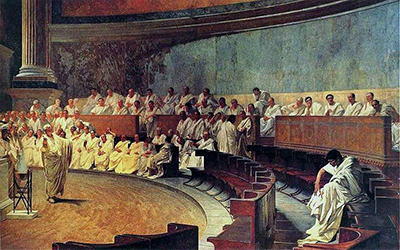
The Roman justice system was based on precedent. That means courts decided cases based on similar decisions made in the past. For instance, if the question of stealing chickens had been decided in court before, and the thief had been sentenced to death, the next person to steal chickens would also likely be sentenced to death. Lawyers like the one above had to know what hundreds of laws said and how hundreds of cases had already been decided. It was up to the defense lawyer to prove his client was innocent.
U.S. courts also rely on precedent to decide cases, though they can reject precedent if they want to. But it’s the prosecutor, the lawyer for the victim, who has to prove that the defendant is guilty in our courts.
Tacitus (56-117 CE) was a great Roman lawyer and historian. Roman society had legal experts like Tacitus who could give their opinions on difficult legal questions. These men charged fees for their services, and the harder the case, the higher the fee. Sometimes lawyers demanded to be left something in a client’s will! The poor were often unable to afford a lawyer.
Lawyers are a key part of the legal system in the U.S., and we also have legal experts who study the law and interpret it. Lawyers can also charge high fees. But in the U.S., everyone is entitled to a lawyer: If you can’t afford a lawyer, the state you are in pays for it.
Themis was the Roman goddess of Justice. She is shown here holding scales to weigh someone’s guilt or innocence, and she is blindfolded so that the social class of the people involved in the case won’t influence her. That concept of blind justice was not actually part of Roman law—early statues of Themis do not show her blindfolded. The wealthy and the powerful got better treatment in court than the poor and weak.
The U.S. legal system strives to erase privilege--to treat the rich and the poor, the powerful and the weak, in exactly the same way. |
 |




Question
What elements of modern law do we see emerging more fully under the Romans?
