After the fall of the Western Roman Empire around 476 CE, Germanic tribes controlled most of Europe. Their legal practices were based on the concept of “trial by ordeal” rather than the jury trials used by the Greeks and Romans. Germanic law, and later church law, represented quite a step backward for regions that had been under Roman rule, as you’ll see in these flashcards.
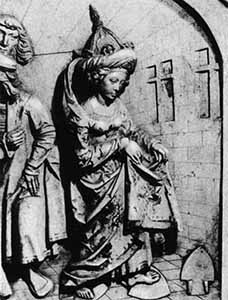
The Germanic justice system did not use a written code of law, lawyers, legal experts, or innocence until proof of guilt. Germanic law in the early Middle Ages (a period that lasted from the fall of Rome in 476 CE until about 1000 CE) was more like ancient customary law. It allowed acts of vengeance and it often demanded that someone accused of a serious crime go through trial by ordeal. This usually meant binding someone’s hands and throwing them into a body of water to see if they would drown (as the ancient Babylonians had done), or forcing them to hold a red-hot iron or walk over hot coals. This picture shows a woman being forced to walk over hot coals. If a person thrown into a body of water swam to shore, he or she was thought to be innocent. A burn victim was thought to be innocent if he or she survived without an infection of the wound.
Who decided if someone put through an ordeal was innocent or guilty?
God was seen as the judge. If God wanted the person to survive a nearly impossible test, then that person was innocent. Only God could help someone exposed to drowning or burning.
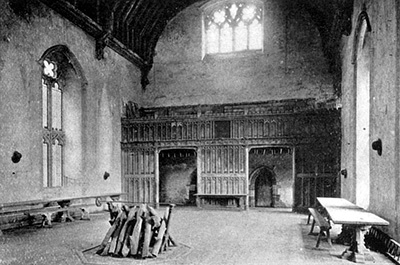
As Christianity spread in Europe, trial by ordeal began to be replaced by seigniorial law and church law. Seigniorial law meant that the local lord (a wealthy landowner) held court in the great hall of his manor home, like the one in this picture, and listened to people’s arguments. The lord decided the case, and dictated its punishment. Church courts were run by priests, who used the Bible and church teachings to decide cases and punishments. Average people preferred to go to a church court because many lords in seigniorial courts demanded bribes or held personal grudges against the local people who came to court.
What were seigniorial and church courts?
Seigniorial courts were held by local landowners, and church courts were held by priests. In a seigniorial court, the landowner or lord used his own judgment to decide who was right or wrong. In the church courts, the priests used the Bible and church teachings to decide cases.
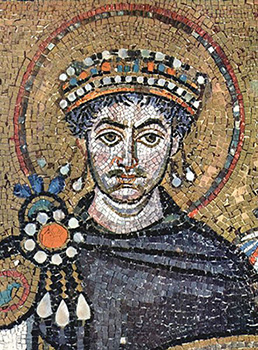
In the 11th century CE the law codes of the eastern Roman emperor Justinian I (529-565 CE), depicted in this mosaic portrait, were rediscovered in Europe. The Code of Justinian, or Corpus Juris Civilis, was a compilation of Roman laws from the classical period. The idea of a code of law that was objective (not based on the personal opinions of a landowning lord) and secular (not based on church teachings) was revolutionary in Europe at the time. A judge in the Italian city of Bologna named Pepo began to teach the Code of Justinian at the University of Bologna. Eventually courts in Europe began to use the Code of Justinian, while seigniorial and church law were used only by peasants.
What was revolutionary about the Corpus Juris Civilis?
It was objective and secular.
Summary
 Correct:
 Incorrect:
Question
Why was the rediscovery of the Corpus Juris Civilis considered a turning point in Western legal history?
