
Show your skills!
Are you ready to take this lesson's quiz? The questions below will help you find out. Make sure you understand why each correct answer is correct—if you don't, review that part of the lesson.
Which is the formula for the volume of a sphere?
\(V= \pi r^2 \frac{h}{3}\)
\(V= \frac{4}{3} \pi r^3\)
\(V= \pi r^2 h\)
\(V=a^2+b^2\)
This is the formula for the volume of a cone.
This is the formula for the volume of a sphere.
This is the formula for the volume of a cylinder.
This formula combines the formula for volume with the Pythagorean theorem.
Which figure is a sphere?
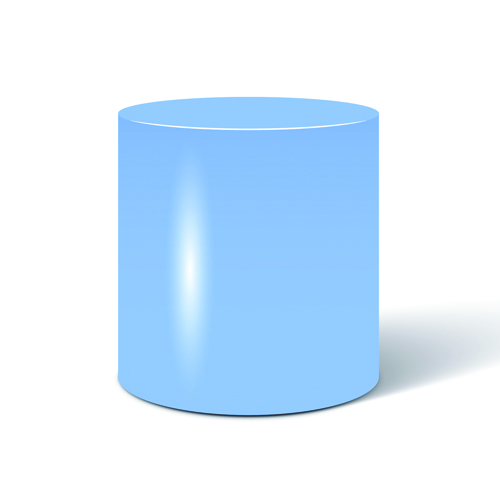


This figure is a cylinder. It’s not a sphere because it has parallel bases that are connected by a curved surface. Several points on the surface are not the same distance from the center.
This figure is a sphere. It’s three-dimensional and round, and every point on its surface is the same distance from its center.
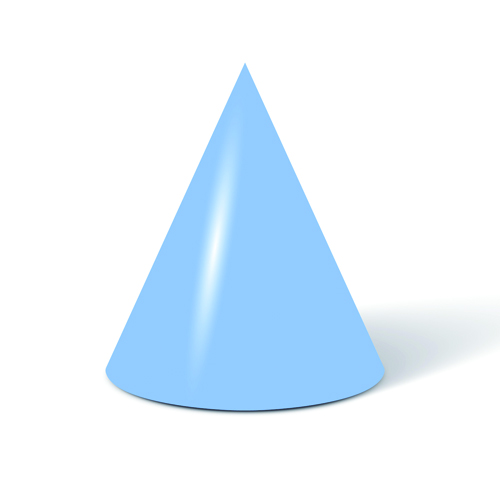
This figure is not a sphere. This is a cone because it has a circular base and tapers to a point.
This figure is a cube. It’s not a sphere because it’s not round.
Which statement best describes a sphere?
A sphere is three-dimensional figure with two circular or oval bases. The bases are parallel and are connected by a curved surface.
A sphere is a three-dimensional, round figure, and every point on its surface is the same distance from its center.
A sphere has a circular base and tapers to a point.
A sphere is a two-dimensional, round figure, and every point on its surface is the same distance from its center.
This is a definition of a cylinder.
This is the definition of a sphere.
This is a definition of a cone.
This is a definition of a circle because it is two dimensional instead of three dimensional.
A sphere has radius of \(2.5\) cm. What is the volume of the sphere? Round your final answer to the nearest hundredth.
\(V \approx 2.5 \pi\ \text{cm}^3\)
\(V \approx 20.83 \pi\ \text{cm}^3\)
\(V \approx 5 \pi\ \text{cm}^3\)
\(V \approx 10.74 \pi\ \text{cm}^3\)
This answer includes the radius but does not use the equation \(V=\frac{4}{3} \pi r^3\).
\(V=\frac{4}{3} \pi r^3=\frac{4}{3} \pi(2.5)^3=\frac{4}{3} \pi(2.5)(2.5)(2.5)=\frac{4}{3} \pi(15.625)=\frac{62.5}{3} \pi \approx 20.83 \pi\ \text{cm}^3\)
This answer doubles the radius but does not use the equation \(V=\frac{4}{3} \pi r^3\).
This answer does not use the equation \(V=\frac{4}{3} \pi r^3\).
A right triangle is drawn inside a sphere, and the hypotenuse is 8 cm. What is the radius of the sphere? Round your final answer to the nearest hundredth.
\(r \approx 8\) cm
\(r \approx 5.66\) cm
\(r \approx 4\) cm
\(r \approx 7.65\) cm
The radius is does not equal the hypotenuse. Use the Pythagorean theorem to find the radius.
\(a^2+b^2=c^2\) \(r^2+r^2=c^2\) \(2r^2=c^2\) \(r^2=\frac{c^2}{2}\) \(r=\sqrt{\frac{c^2}{2}}\) \(r=\sqrt{\frac{8^2}{2}}\) \(r=\sqrt{\frac{64}{2}}\) \(r=\sqrt{32}\) \(r \approx 5.66\ \text{cm}\)
This answer divides the radius in half. Instead, use the Pythagorean theorem to find the radius.
Use the Pythagorean theorem to find the radius.
Summary
Questions answered correctly:
Questions answered incorrectly:
