
Think you got it?
In the video, you learned how to use the Pythagorean theorem to draw a right triangle inside a sphere. The sphere’s radii formed the legs of the right triangle, and you were given the value of the hypotenuse. Next, you used the Pythagorean theorem to solve for the radius. Then, you used the radius to find the volume of the sphere.
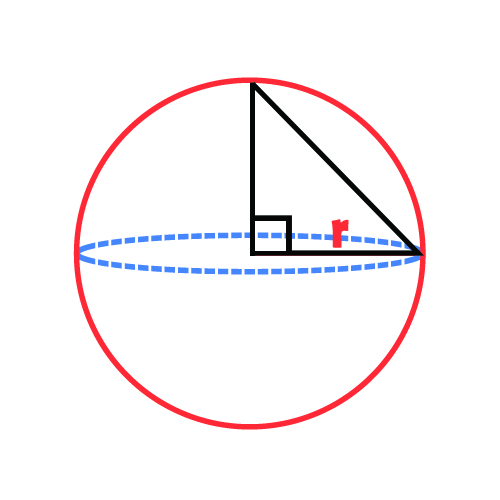
Now it’s your turn to practice using the Pythagorean theorem to find the radius of a sphere. Then you’ll use the radius to find the sphere’s volume. Practice these calculations by answering the questions on each tab below and check your answer. Use the image of the sphere to answer the questions.
For the right triangle in the sphere, the hypotenuse is \(6\) cm. What is the radius of the sphere? What is the volume of the sphere? Round the radius to the nearest hundredth and use that rounded radius to calculate the volume. Round the volume to the nearest hundredth.
\(r \approx 4.24\) cm
\(V \approx 101.63 \pi\ \text{cm}^3\)
If you need help arriving at this answer, click the Solution button.
Step 1: Use the Pythagorean theorem to find the radius. Remember that sides \(a\) and \(b\) are both equal to radius, \(r\). Remember to add the unit to your answer. |
\(a^2+b^2=c^2\) \(r^2+r^2=c^2\) \(2r^2=c^2\) \(r^2=\frac{c^2}{2}\) \(r=\sqrt{\frac{c^2}{2}}\) \(r=\sqrt{\frac{6^2}{2}}\) \(r=\sqrt{\frac{36}{2}}\) \(r=\sqrt{18}\) \(r \approx 4.24\) cm |
Step 2: Use the radius to find the volume. Remember to add the unit to your answer and keep your answer in terms of \(\pi\). |
\(V=\frac{4}{3} \pi r^3\) \(V=\frac{4}{3} \pi(4.24)^3\) \(V=\frac{4}{3} \pi(4.24)(4.24)(4.24)\) \(V \approx 101.63 \pi\ \text{cm}^3\) |
For the right triangle is the sphere, the hypotenuse is \(7\) cm. What is the radius of the sphere? What is the volume of the sphere? Round the radius to the nearest hundredth and use that rounded radius to calculate the volume. Round the volume to the nearest hundredth.
\(r \approx 4.95\) cm
\(V \approx 161.72 \pi\ \text{cm}^3\)
If you need help arriving at this answer, click the Solution button.
Step 1: Use the Pythagorean theorem to find the radius. Remember that sides \(a\) and \(b\) are both equal to radius, \(r\). Remember to add the unit to your answer. |
\(a^2+b^2=c^2\) \(r^2+r^2=c^2\) \(2r^2=c^2\) \(r^2=\frac{c^2}{2}\) \(r=\sqrt{\frac{c^2}{2}}\) \(r=\sqrt{\frac{7^2}{2}}\) \(r=\sqrt{\frac{49}{2}}\) \(r=\sqrt{24.5}\) \(r \approx 4.95\) cm |
Step 2: Use the radius to find the volume. Remember to add the unit to your answer and keep your answer in terms of \(\pi\). |
\(V=\frac{4}{3} \pi r^3\) \(V=\frac{4}{3} \pi(4.95)^3\) \(V=\frac{4}{3} \pi(4.95)(4.95)(4.95)\) \(V \approx 161.72 \pi\ \text{cm}^3\) |
For the right triangle is the sphere, the hypotenuse is \(9\) cm. What is the radius of the sphere? What is the volume of the sphere? Round the radius to the nearest hundredth and use that rounded radius to calculate the volume. Round the volume to the nearest hundredth.
\(r \approx 6.36\) cm
\(V \approx 343.01 \pi\ \text{cm}^3\)
If you need help arriving at this answer, click the Solution button.
Step 1: Use the Pythagorean theorem to find the radius. Remember that sides \(a\) and \(b\) are both equal to radius, \(r\). Remember to add the unit to your answer. |
\(a^2+b^2=c^2\) \(r^2+r^2=c^2\) \(2r^2=c^2\) \(r^2=\frac{c^2}{2}\) \(r=\sqrt{\frac{c^2}{2}}\) \(r=\sqrt{\frac{9^2}{2}}\) \(r=\sqrt{\frac{81}{2}}\) \(r=\sqrt{40.5}\) \(r \approx 6.36\) cm |
Step 2: Use the radius to find the volume. Remember to add the unit to your answer and keep your answer in terms of \(\pi\). |
\(V=\frac{4}{3} \pi r^3\) \(V=\frac{4}{3} \pi(6.36)^3\) \(V=\frac{4}{3} \pi(6.36)(6.36)(6.36)\) \(V \approx 343.01 \pi\ \text{cm}^3\) |
