
Let's Watch
In this lesson, you’ve learned how to identify and find the volume of spheres using the formula shown below.

Volume of a Sphere
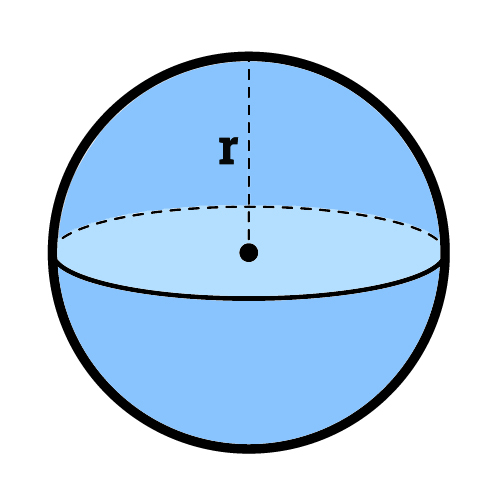
\(V=\frac{4}{3} \pi r^3\)
Where:
- \(V\) is the volume of the sphere
- \(r\) is the radius of the sphere, which is the distance from the center to any point on the surface
- the symbol \(\pi\) represents the number pi.
So far, you have been given the radius of the sphere, and you used the radius to calculate the sphere’s volume. But what if the sphere’s radius is not given? Can you find the radius and then calculate the volume? Yes, you can! But how?
You can use the radius of the sphere to draw a right triangle if you know the length of the hypotenuse. Then you can use the Pythagorean theorem to calculate the length of the radius. An instructor will show you the process to use in the video below.
Pay close attention to how a right triangle can be drawn inside the sphere. Notice how the length of each leg in the triangle is equal to the radius since each leg extends from the center to a point on the surface. Then observe how the Pythagorean theorem is applied to find the missing radius for the sphere. Finally, the radius can be used to calculate the sphere’s volume.
You may want to use the study guide to follow along. If so, click below to download the study guide.

This first question reads, “A right triangle is drawn inside a sphere such that the legs of the triangle are both radii. If the length of the hypotenuse is 10 centimeters, what is the radius of the sphere? What is the volume?” Well, we know that that right triangle is going to look something like this, where each of the legs has radius r and the hypotenuse has length 10 centimeters. Now we can use the Pythagorean theorem equation to solve for the radius, r, that will be r squared plus r squared equals 10 squared. R squared plus r squared is 2 r squared, and 10 squared is 100. If we divide both sides of this equation by 2, then we get r squared equals 50. Now we can take the square root of both sides of this equation and we get r equals the squared root of 50 centimeters. Now that's pretty much as far as we can go without using any rounding, but if we are going to use rounding we can say that r approximately equals 7.07 centimeters.
The second part of this question asks us to find the volume, and the volume of a sphere is found using the formula V equals 4 thirds pi r cubed, and we can substitute our value for r into this formula. Doing that gives us V equals 4 thirds times pi times the square root of 50 cubed. Now if we multiply all these terms together then we get V equals 4 pi times the square root of 50 cubed all over 3 centimeters cubed. But that's really about as far as we can get without using any rounding.
This one reads, “Two points on the surface of a sphere are separated by 90 degrees. If the straight-line distance between those two points is 12 centimeters, what is the radius of the sphere? What is the volume?” Again, we can sketch this out because we know that that right triangle will have legs both of length r, the radius, and the hypotenuse of 12 centimeters. So again we can apply the Pythagorean theorem equation as r squared plus r squared equals 12 squared. R squared plus r squared is 2 r squared, and 12 squared is 144. If we divide both sides of this equation by 2, 2 r squared divided by 2 just leaves us with r squared, and 144 divided by 2 is 72. Now we can take the square root of both sides of this equation, and we get r equals the square root of 72 centimeters. And again, that's as far as we can go without using any rounding. But if we are going to use rounding we can say that r approximately equals 8.48 centimeters.
The next part of the question asks us what the volume is, and again we're going to use the formula V equals 4 thirds pi r cubed, and we're going to substitute this value in for r. That gives us V equals 4 thirds times pi times the square root of 72 cubed. Just as in the last one, if we multiply all those terms together then we get V equals 4 pi times the square root of 72 cubed all over 3 centimeters cubed.
Question
Suppose you are given the hypotenuse of a right triangle drawn inside a sphere. How can you use the Pythagorean theorem to determine the radius of the sphere?
Both legs of the right triangle are radii. You can use the equation \(r^2+r^2=hyp^2\).
