A trophic level is a living organism's position in the flow of energy through an ecosystem. What is the source of energy in an ecosystem? Some organisms are able to synthesize (make) their own food from abiotic factors. These organisms are called autotrophs. Auto- means "self" and -troph means "feeding," so autotrophs are "self-feeders." Autotrophs belong to the trophic level called primary producers. If the hierarchy of a business has a large number of employees at a low level of power, then the hierarchy of an ecosystem has a large number of primary producers with a low level of power. But by transforming energy from abiotic factors to energy that can be used by living organisms, primary producers do a job that organisms on no other trophic level can do. Click each tab to learn about two different groups of primary producers.
Chemoautotrophs
Photoautotrophs
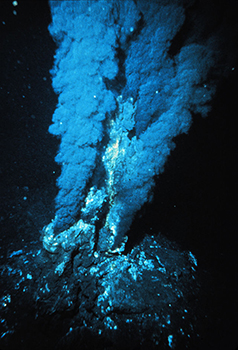 Chemoautotrophs are the rarer of the two types of autotrophs. Mostly bacteria, these organisms are able to transform elements like sulfur, iron, hydrogen, or ammonia into energy. They tend to inhabit ecosystems found around oceanic thermal vents (broken spots in the ocean floor that release warm water.)
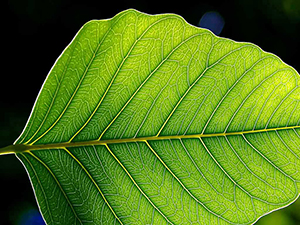 Photoautotrophs are by far the most common type of autotroph. Any organism that can carry out photosynthesis is considered a photoautotroph.
What happens during the process of photosynthesis? Think about your answer and then click Answer to find out if you are correct.
During photosynthesis, light energy is transformed into chemical energy.
In this process, energy from the sun (light energy) is used to convert carbon dioxide from the air, along with water from the soil, into a sugar called glucose (chemical energy). Oxygen is released as a by-product.
Photoautotrophs are able to create chemical energy through the use of chlorophyll, the green pigment necessary to capture light energy during the process of photosynthesis. Photoautotrophs include plants, algae, and some bacteria.
An ecosystem's primary producers have a crucial task to accomplish--to transform energy from an unusable form into one that can be used by all members of an ecosystem. Before you explore the other trophic levels in an ecosystem, answer these questions about producers.
Why are primary producers also referred to as autotrophs?
- They are able to transport energy throughout an ecosystem.
- They are able to change chemical energy into light energy.
- They are able to transform energy from an unusable form to a usable form.
- They are able to release energy from other organisms in an ecosystem.
Remember that auto- means "self."
Remember that auto- means "self."
Remember that auto- means "self."
Remember that auto- means "self."
Which statement describes chemoautotrophs?
- They are usually bacteria.
- They contain chlorophyll.
- They can create energy using light.
- They include plants and algae.
Chemoautotrophs transform materials like iron and sulfur into energy.
Chemoautotrophs transform materials like iron and sulfur into energy.
Chemoautotrophs transform materials like iron and sulfur into energy.
Chemoautotrophs transform materials like iron and sulfur into energy.
Summary
 Questions answered correctly:
 Questions answered incorrectly:
