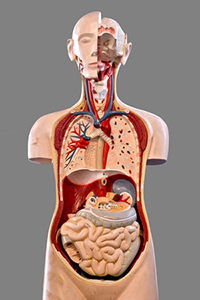
 Physical or "touchable" models like this digestive system are just one type of model used by scientists. |
When you think of a model, you most likely think of a touchable object--like a molecule made of sticks and balls or a plastic digestive system with labeled organs. A scientific model, however, is not only a physical object that can be touched, it is any description of an object or occurrence that shares characteristics with that object or occurrence. A model is a way to help explain something that happens in the world. Models can be material (like the digestive system model), mathematical (like an equation), or visual.
Scientists use several types of visual models to represent the flow of energy between trophic levels in an ecosystem. Compare three of these--food chains, food webs, and energy pyramids.
Food Chain
Food Web
Energy Pyramids
| A food chain is the simplest model of energy flow between trophic levels in an ecosystem. This is because they represent only one pathway. In general, producers are found at the bottom of the food chain, and the highest level consumer is found at the top. Arrows between organisms indicate the flow of energy. The producer in this food chain is a single-celled organism capable of photosynthesis. It is consumed by the small shrimp, which in turn is consumed by a fish. The energy flows to the highest predator that sits at the top of the food chain (the bird.) The single-celled organism at the bottom of this food chain is green; therefore, it contains the green pigment chlorophyll and completes photosynthesis to transform light energy (from the sun) into chemical energy (in the form of the sugar called glucose). What type of primary producer is it? Think about your answer and then click the Answer button to see if you are right. This organism is a photoautotroph. | 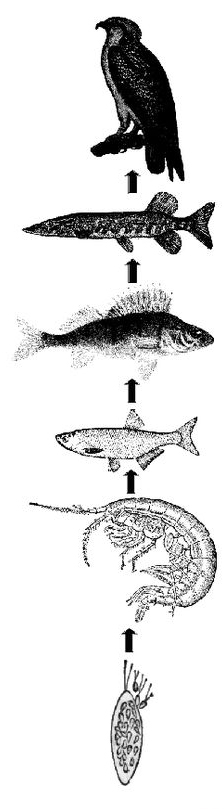 |
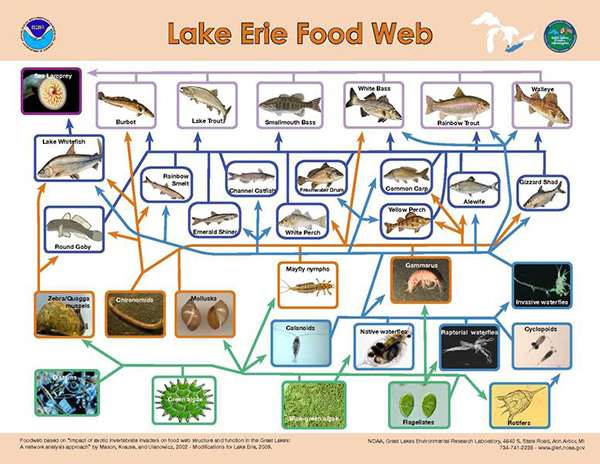
Another model of energy flow between trophic levels in an ecosystem is called a food web. Food webs are more realistic than food chains because energy flows between trophic levels in more than one way--and often in very complex ways. For example, the mayfly nymphs (insect larvae) are consumed by white perch (which are on one trophic level) and also by white bass (which are on another trophic level). Although food webs are more complex than food chains, they still are incomplete and serve as summaries of energy flow through an ecosystem.
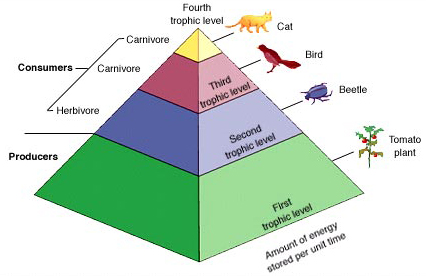
Sometimes ecologists use a model of ecosystem energy flow called an energy pyramid. Energy pyramids show available energy in each trophic level. Since producers put energy in a usable form, they are at the bottom of an energy pyramid since the "block" that represents available energy is very large.
Primary consumers absorb the stored energy in the producers. Only about 10% of the energy available from producers makes it into the next trophic level. This is because a lot of energy is lost, or in other words, it is given off to the environment as heat. The energy that does pass from the first to the second trophic level is represented by a smaller block. The pattern continues with the top of the pyramid containing the highest consumer possessing the least amount of energy.
Question
In an ecosystem, energy is passed on from one trophic level to the next. Each time, about 90% of the energy is lost. Use this to explain why typical food chains are limited to only four to six links.
