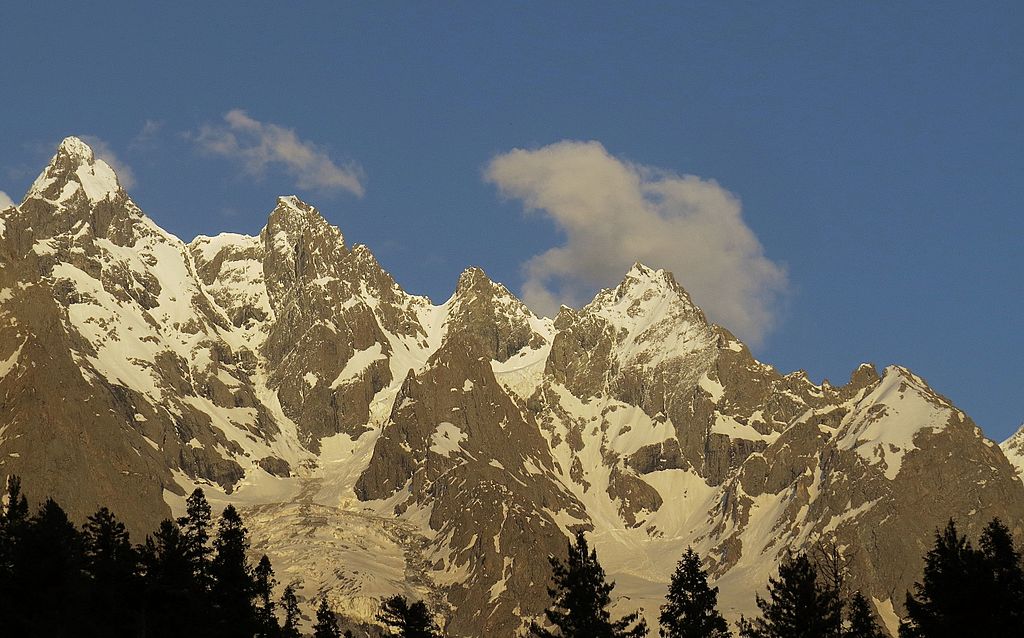
Along Pakistan's northern and western borders, one of the world's highest mountain ranges, the Hindu Kush, reaches majestically toward the sky. Several passes cut through the mountains, making transportation possible. The Khyber (KY ber) Pass allows movement between Peshawar (puh SHAH wuhr) in northwest Pakistan and Kabul (KAH Buhl), the capital of Afghanistan.
Just as in India, the towering mountains keep the cold air flowing out of Central Asia from penetrating the subcontinent during the winter. As a result, except at high elevations, temperatures in Pakistan are generally warm or hot. Temperatures in the city of Islamabad average 50°F (10°C) in January and 90°F (32°C) in July.
Much of western Pakistan is covered by the rugged Baluchistan (bah LOO chi STAN) Plateau. To the east lie barren stretches of the Thar Desert and brown, dusty plains.
Sandwiched between these two forbidding regions is the fertile valley created by the Indus River as it flows south out of the mountains to the Arabian Sea.
