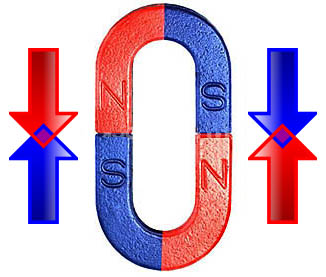
You have learned that when electrons move, “opposites attract” and “like repels like.” The same principle applies with magnets. When a north-seeking pole is placed next to another north-seeking pole, they repel each other. When a north-seeking pole is placed next to a south-seeking pole, they attract each other.
