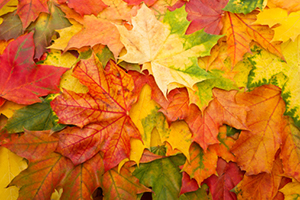
 Leaves change from green to yellow or red and then to brown as the winter solstice approaches. |
 Do you think autumn is the most beautiful time of the year? Many people do. Trees turn from green to bright colors like red, yellow and orange at the nights grow longer and the days grow shorter. Or do they? Not really!
As you already know, a plant's most important and abundant chemical is chlorophyll, the green pigment it needs for photosynthesis. Plants also have accessory pigments called carotenoids, as well as red and purple pigments called anthocyanins.
Senescence is a general term for aging. Leaf senescence occurs when days grow shorter and nights grow cooler. Trees, sensing that their time to do photosynthesis for the year is coming to an end, start to break down the chlorophyll, storing the valuable elements like nitrogen until the spring.
Senescence is an important part of a leaf's life cycle, as it is a leaf's final job - to tell the tree to get ready for winter, and to put its precious sugars and other elements into storage.
As the chlorophyll is broken down, the accessory pigments are revealed. They've been there all along, but were masked by the enormous amount of chlorophyll in the leaves. This change is an outward sign of leaf senescence.
So the next time someone mentions leaves turning color, tell them that leaves don't "turn", they "reveal" - and that it's called leaf senescence.
Do you think autumn is the most beautiful time of the year? Many people do. Trees turn from green to bright colors like red, yellow and orange at the nights grow longer and the days grow shorter. Or do they? Not really!
As you already know, a plant's most important and abundant chemical is chlorophyll, the green pigment it needs for photosynthesis. Plants also have accessory pigments called carotenoids, as well as red and purple pigments called anthocyanins.
Senescence is a general term for aging. Leaf senescence occurs when days grow shorter and nights grow cooler. Trees, sensing that their time to do photosynthesis for the year is coming to an end, start to break down the chlorophyll, storing the valuable elements like nitrogen until the spring.
Senescence is an important part of a leaf's life cycle, as it is a leaf's final job - to tell the tree to get ready for winter, and to put its precious sugars and other elements into storage.
As the chlorophyll is broken down, the accessory pigments are revealed. They've been there all along, but were masked by the enormous amount of chlorophyll in the leaves. This change is an outward sign of leaf senescence.
So the next time someone mentions leaves turning color, tell them that leaves don't "turn", they "reveal" - and that it's called leaf senescence.
Question
Do you think that leaf senescence is part of predictive dormancy, consequential dormancy, or both?
