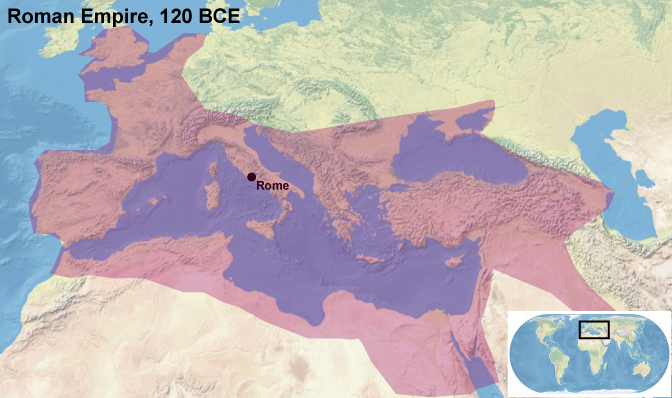
The Roman Empire emerged from the ancient city of Rome and lasted from 27 BCE until 476 CE. Rome was founded by the patrician families of the city and functioned at first as a republic, a state in which people (mainly landowners) chose representatives who then voted on the issues of the time. As Rome grew in size and power, though, the republic was replaced by a line of emperors, thereby creating the Roman Empire.
Review the information from the tabs below.
The Road to Empire
Augustus
The Roman Forum

The city of Rome was founded around 753 BCE. It rose to become a dominant city-state, and then a republic. For 500 years, from 27 BCE to 476 CE, Rome was an empire, and at its height, it was the largest empire in the world. At the peak of the Roman Empire in the early 2nd century CE, the Roman eagle was recognized from Asia to Britain.
What kind of government did Rome have?

The empire was a monarchy. The transition from a republic with partial democracy to a monarchy was resisted by leading Romans for many years, but in the end powerful leaders supported by armies loyal to them took power and established individual rule. Rome kept its Senate, where the wealthy met to create laws, but the emperor’s word had the final authority, and the Senate became mostly figurehead.
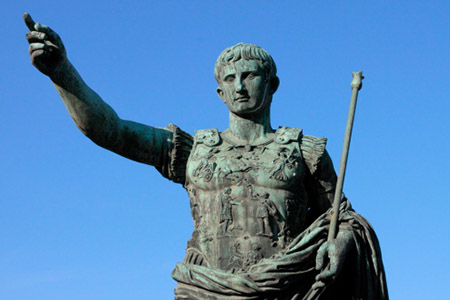
Augustus was the first Roman emperor, from 27 BCE–14 CE. He joined with two other wealthy Romans to overthrow general Julius Caesar, who was on track to take power, and then outlasted his partners to take power himself. Augustus used his armies to put down revolts against his power, and his rule ushered in a period of peace within the Roman empire called the Pax Augusta--the peace of Augustus.
What did Augustus’ rise to power mean for Rome?
It was the end of the Roman Republic and the beginning of the Roman empire.
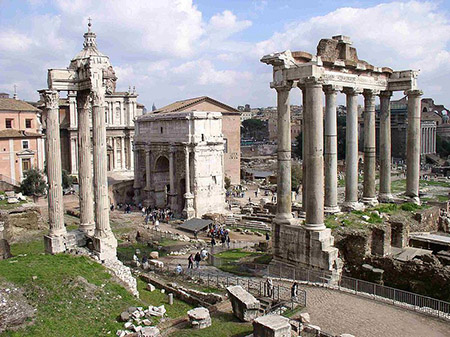
Augustus set about renovating the already-old city of Rome. One of his biggest projects was overhauling the Forum, which had been started in the 4th century BCE. The Forum was the center of Roman life. It was an area with political, commercial, and religious buildings, much like the Grecian agora. Over the centuries buildings had been added or allowed to fall into decay, creating a chaotic impression. Augustus rebuilt the Forum and refused to use any wood in the construction: Cement and stone would make this center of the empire an eternal one.
Why was it important for Augustus to rebuild the Forum bigger and better than ever before?
The finished project would be a reflection of the new emperor’s power.
Question
What changed in Rome's government when it became an empire?
