Not long after Alexander the Great attempted to invade the region now known as India, the Magadha king Chandragupta Maurya took control of the Indus River Valley and became the first of the Maurya Emperors. The Mauryan Empire lasted from 304 BCE until 220 BCE. Perhaps the most lasting legacy of the Maurya Empire is the practice of Buddhism, which was adopted by the Mauryan emperor Ashoka around 260 BCE.

Learn more about the Mauryan Empire in the slideshow below.
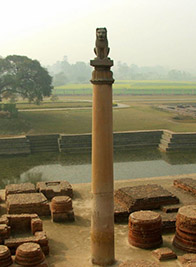
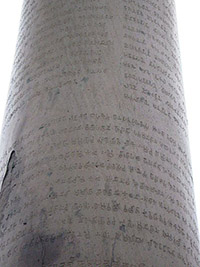
The image on the left is an “Ashoka pillar” in today’s city of Bihar, India. Ashoka erected these pillars across his empire during his reign in the 3rd century BCE. Each pillar had edicts, or decrees, from the king. The image on the right shows a close-up of the writing on a pillar. Ashoka was a powerful king who planned to expand his empire by conquering the state of Arisa in 269 BCE. The attempt cost the lives of over a quarter of a million people, and changed Ashoka’s life and rule forever.
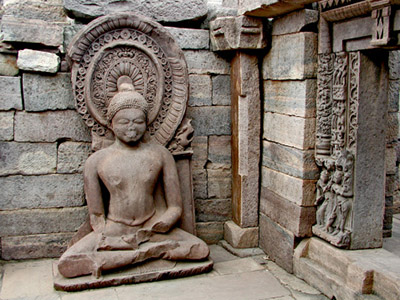
This image of the Buddha is from Sanchi, one of the monasteries Ashoka had built for Buddhist monks and pilgrims. After the horror of the Arisa campaign, Ashoka renounced violence and tried to rule an empire according to the Buddhist principle of Dharma, or righteousness. Ashoka presided over the first council of Buddhist priests, where Buddhist writings were collected into the first Buddhist scripture. In embracing Buddhist principles, Ashoka gave up the usual tools of empire-governing: force, war, and conquest.
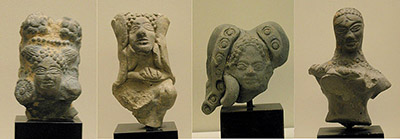
The Mauryan empire, like most classical empires, was divided into farming villages that supported great cities with their crops and the money that came from crop surpluses. What was unusual was a government policy that offered incentives of land and livestock to craftspeople to leave the cities and settle in villages where their skills were needed. Through this program, goldsmiths, silversmiths, tinsmiths, sculptors, blacksmiths, and workers in bone and ivory were more evenly distributed throughout the Mauryan empire than in other empires at the time. |
 |

Question
How did the adoption of Buddhism change Ashoka’s approach to his empire?
