Alexander the Great lived from 356-323 BCE. He was a powerful leader in Macedonia, a city-state in northern Greece. He united all of the Greek city-states into one empire and went on to conquer Egypt, Persia, and kingdoms in India before his untimely death at the age of 33. Alexander’s empire collapsed soon after his death, but his legacy lives on in Hellenistic civilization.
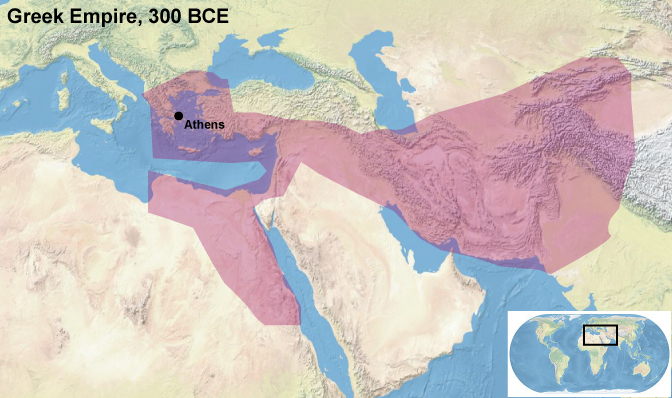
Learn more about Alexander's empire with the slide show below.
|
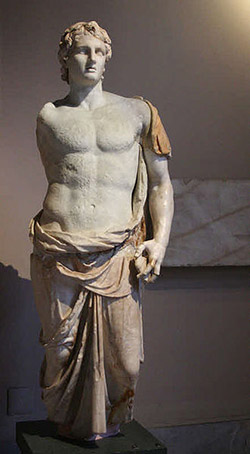
Alexander was a Macedonian prince. He received an unusually thorough education from his tutor, the famous philosopher and scientist Aristotle. Along with the principles of warfare, Alexander learned philosophy, science, art, law, and the art of government. Aristotle also instilled in his pupil a love of the poet Homer, whose works celebrated honor and glory achieved through personal success. How might Alexander’s education have influenced his rule as emperor?
It made him open to the cultures of the peoples he conquered. Alexander allowed conquered peoples in his empire to keep many of their customs and forms of government and society.
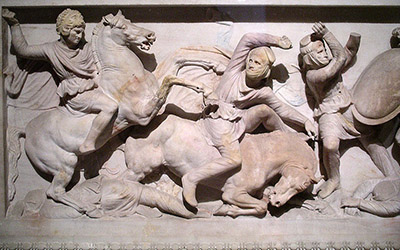
Alexander took the throne of Macedonia at age 20. He set out immediately to conquer the other city-states of Greece, and in just 12 years went on to establish an empire of over two million square miles across three continents. Alexander was a powerful and charismatic leader whose army traveled thousands of miles with him, never once losing a major battle. Their journey east ended only with Alexander’s death in the palace of Nebuchadnezzar II in Babylon, in modern-day Iraq, in 323 BCE. How might Alexander have conquered so much land in so little time?
He never stopped moving; once he left Greece he was continually on the march into new territories. He never stopped in any one place for long. He would stay long enough to be crowned king of the peoples he conquered, then set off for the next conquest.
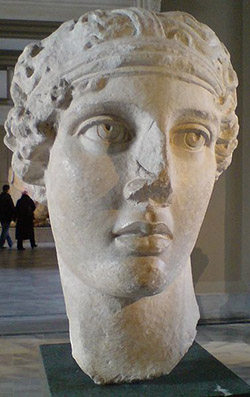
Alexander brought classical Greek culture to the areas he conquered. The mix of Greek and non-Greek cultures created something we call Hellenistic civilization: Greek-influenced culture in non-Greek lands. The statue above is an example: It is Hellenistic because it is a Greek style of sculpture made in modern-day Turkey, with non-Greek features (like the enlarged eyes). Alexander encouraged this mixing of cultures within his empire, and it went on long after his death. What was Hellenistic culture?
A mix of Greek and non-Greek cultures in the lands Alexander conquered. |
 |


Question
What was so unusual about Alexander the Great's history as an emperor?
