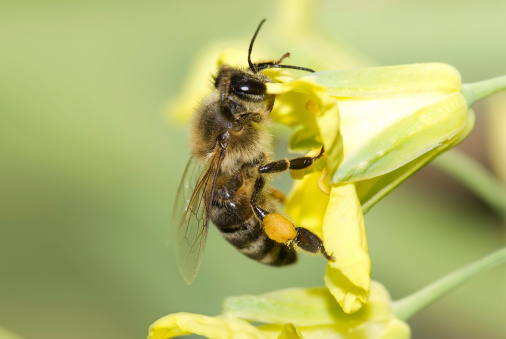
 Bees and other insects are just some of the animals that carry pollen grains between flowers during pollination. |
The life of a seed begins with pollination, which is the transfer of pollen grains from the anther to the pistil of a flower. In this photo, the bee is acting as the pollinator, transferring pollen grains between flowers. Pollination starts the process of fertilization, which is the bringing together of sperm and egg to form what eventually will be the embryo. After fertilization, the flower's ovary swells, forming a fruit. Fertilization in flowering plants is unique because there are two fertilization events that take place. This is called double fertilization. Read each row in the table to explore the steps of double fertilization. As you progress, think about the structures that participate in each fertilization event.
| Pollination occurs | Pollination is the step that starts double fertilization. Each pollen grain contains two nuclei. One is the tube nucleus; the other is called the generative nucleus. |
| Pollen tubes grow | After a pollen grain lands on a receptive stigma, it starts to grow into a pollen tube. This tube, which comes from the tube nucleus, grows down through the style and makes a "tunnel" that leads to the ovary. |
| Sperm travels through the pollen tube | The generative nucleus divides during its journey through the pollen tube, becoming two sperm cells. These cells enter the ovary. |
| Double fertilization occurs | Each sperm cell is part of a different fertilization event. One sperm cell meets with the egg and forms the embryo. The other sperm cell combines with two female cells called polar nuclei. This fertilization results in the endosperm, which is a special tissue used to nourish the embryo. |
| Fruit forms | Double fertilization sends chemical messages to the flower that its job is complete. The ovary swells, usually around the seed, forming the fruit. In some cases the fruit is large and fleshy, like a peach for example. In other cases, the seed is only surrounded by a few layers of cells. |
| Seed structures mature | As the fruit grows and ripens, the embryo and endosperm develop inside of what will become a mature seed. Seed development ends when the embryo and endosperm are enclosed and protected by a tough seed coat. At this point, the baby plant is ready to leave its parent. |
Test your knowledge of how fruit and seeds form by placeing the events below in the correct order.
|
Double fertilization occurs, producing an embryo and endosperm.
A pollen grain lands on a stigma.
A pollen tube forms.
The ovary swells, making a fruit.
The generative nucleus divides into two sperm.
|
|
