What cost more, a pair of shoes made in a factory or shoes made by one person in someone's home? Industrialization, which is defined by the introduction of power-driven machinery in factories, began in Britain in the mid-1700s. In the United States, it did not really start until the late 1700s. When America experienced a boom in population and a high demand for goods, industrialization really began to take hold.
The old system of creating everything at home became outdated and too expensive as factories began making goods, such as clothing, shoes, and farm tools. These new factories caused a population shift as more and more people migrated to the cities from farms to work in the newly opened mills. Women and children often went to work in the factories because owners could pay them less. Because these factories and their owners were not regulated, terrible accidents often occurred on the job.
Industrialization changed the face of the American landscape. In addition to urban population growth, canals and railroads were built to transport goods. The United States began moving from an agricultural society to an industrial nation.
Read the following information about industrialization in the U.S. and take notes.
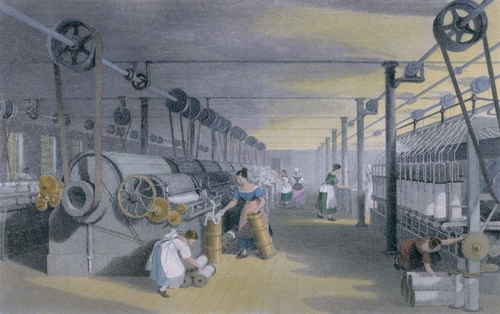
This artworks shows machines making cotton thread by performing mechanical versions of carding, drawing, and roving in a mill in Lancashire, England, around 1835
In the 1700s, people had been working in their homes or in workshops to make cloth and most other goods. Using hand tools, they produced furniture, farm equipment, household items, and clothing. This was known as outputting. In the mid-1700s, however, the way goods were made began to change. These changes appeared first in Great Britain. British inventors created machinery to perform some of the work involved in cloth making, such as spinning. The machines ran on waterpower, so British cloth makers built mills along rivers and installed the machines in these mills. People left their homes and farms to work in the mills and earn wages. The changes this system brought about were so great that this historic development is known as the Industrial Revolution.
The Industrial Revolution began to take root in the United States around 1800, appearing first in New England, Massachusetts, Rhode Island, Connecticut, Vermont, and New Hampshire. New England’s soil was poor, and farming was difficult. As a result, people were willing to leave their farms to find work elsewhere. Also, New England had many rushing rivers and streams. These provided the waterpower necessary to run the machinery in the new factories. New England’s geographic location also proved to be an advantage. It was close to other resources, including coal and iron from nearby Pennsylvania. New England also had many ports. Through these ports passed the cotton shipped from Southern states to New England factories, as well as the finished cloth bound for markets throughout the nation.
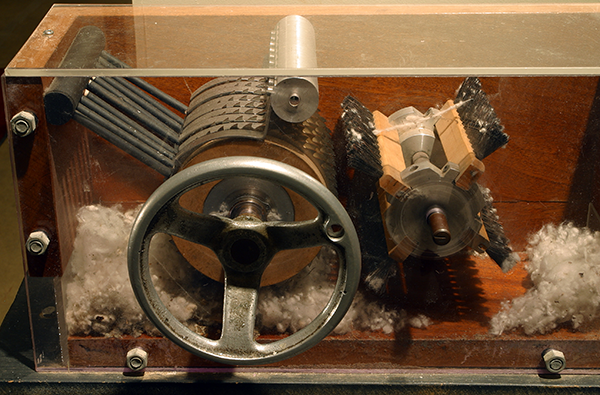
A cotton gin on display at the Eli Whitney Museum in Hamden, Connecticut
Workers, waterpower, location, and capital all played roles in New England’s Industrial Revolution. Yet without the invention of new machines and technology, the Industrial Revolution could not have taken place. Inventions such as the spinning jenny and the water frame, which spun thread, and the power loom, which wove the thread into cloth, made it possible to perform many steps in making cloth by machine, saving time and money. Because these new machines ran on waterpower, most mills were built near rivers. In 1785, for the first time, a steam engine provided power for a cotton mill. In 1793, Eli Whitney of Massachusetts invented the cotton gin, a simple machine that quickly and efficiently removed the seeds from the cotton fiber. The cotton gin enabled one worker to clean cotton as fast as 50 people working by hand.
Whitney also started the use of interchangeable parts. These were identical machine parts that could be quickly put together to make a complete product. Because all the parts were alike, they could be manufactured with less-skilled labor, and they made machine repair easier. Interchangeable parts opened the way for producing many kinds of goods on a mass scale and for reducing the price of the goods. With all the inventions, there was a fear of intellectual theft. In 1790, Congress passed a patent law to protect the rights of those who developed “useful and important inventions.” A patent gives an inventor the sole legal right to the invention and its profits for a certain period. One of the first patents went to Jacob Perkins for a machine to make nails.

The Slater Mill historic site in Pawtucket, Rhode Island
The British tried to keep their new industrial technology a secret. They even passed laws prohibiting their machinery as well as their skilled mechanics from leaving the country. However, a few enterprising workers managed to slip away to the United States. In Britain, Samuel Slater had worked in a factory that used machines invented by Richard Arkwright for spinning cotton threads. Slater memorized the design of Arkwright’s machines and slipped out of Britain in 1789. Once in the United States, Slater took over the management of a cotton mill in Pawtucket, Rhode Island. There, he duplicated Arkwright’s machines. Using these machines, the mill made cotton thread. Women working in their homes wove the thread into cloth. Slater’s mill marked an important step in the Industrial Revolution in America.
In 1814, Francis Cabot Lowell opened a textile plant in Waltham, Massachusetts. The plan he implemented went several steps beyond Slater’s mill. For the first time, all the stages of cloth making were performed under one roof. Lowell’s mill launched the factory system, a system bringing manufacturing steps together in one place to increase efficiency. The factory system was a significant development in the way goods were made—and another important part of the Industrial Revolution.

A cotton field
Although many New Englanders went to work in factories, most Americans still lived and worked on farms. In the 1820s more than 65 percent of Americans were farmers. In the Northeast, farms tended to be small, and the produce was usually marketed locally. In the South, cotton production increased dramatically. The demand for cotton had grown steadily with the development of the textile industries of New England and Europe. Southern plantation owners used enslaved workers to plant, tend, and pick the cotton. The cotton gin encouraged the planters to raise larger crops. Between 1790 and 1820, cotton production soared from 3,000 to more than 300,000 bales a year. In the West, agriculture also expanded. Southern farmers seeking new land moved west to plant cotton. Western farmers north of the Ohio River concentrated on raising pork and cash crops such as corn and wheat.

Under capitalism, individuals put their money into a business in hopes of making a profit.
Also necessary to strong industrial growth is an economic system that allows competition to flourish with a minimum of government interference. The economic system of the United States is called capitalism. Under capitalism, individuals put their capital, or money, into a business in hopes of making a profit. Free enterprise is another term used to describe the American economy. In a system of free enterprise, people are free to buy, sell, and produce whatever they want. They can also work wherever they wish. The major elements of free enterprise are competition, profit, private property and economic freedom. Business owners have the freedom to produce the products that they think will be the most profitable. Buyers also compete to find the best products at the lowest prices.
Most new industries were financed by small investors, merchants, shopkeepers, and farmers. These people invested some of their money in the hope of earning profits if the new businesses succeeded. Low taxes, few government regulations, and competition encouraged people to invest in new industries. Large businesses called corporations began to develop rapidly in the 1830s, when some legal obstacles to their formation were removed. The rise of these new corporations made it easier to sell stock, shares of ownership in a company, to finance improvement and development.
The charter of the First Bank of the United States had expired in 1811. In 1816, Congress chartered the Second Bank of the United States, also chartered for 20 years. The Bank had the power to make large loans to businesses. State banks and frontier people criticized the Bank on the grounds that it was a monopoly used by the rich and powerful for their own gain. Those who believed in strict interpretation of the Constitution also criticized it because they believed Congress did not have the power to charter such a bank.
| Why did America lag behind Great Britain in the movement to industrialize? | because of extensive land resources and a lack of labor and investments |
| Who opened the first industrial mill in the United States and is often attributed to bringing industrialization to America? | Samuel Slater |
| Why did industrialization require improved transportation networks? | to get raw materials to the factories to be manufactured |
