As you may remember from an earlier lesson, the Silk Road wasn't an actual road. It was a series of trade routes that connected the different empires of the ancient world, allowing travelers to sell their goods far and wide--not just in their local villages. The Silk Road did more for the ancient world than make its traders rich, however. The towns and villages that sprang up along the Silk Road provided a place for people from different civilizations to meet and mingle, which encouraged the sharing of knowledge and ideas, customs, and religious beliefs.
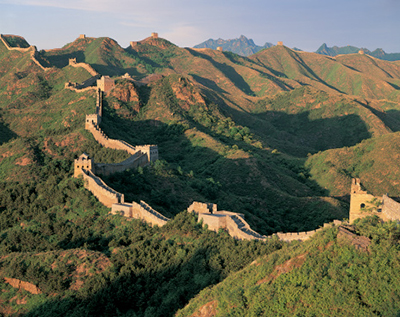
In China, the Silk Road was protected by the Great Wall, a line of tall, thick walls made of dirt and stone that continued for thousands of miles across China. This barrier provided protection from nomadic tribes in the north, who sometimes attempted to raid trading parties and steal goods or gold. The protection offered by the Great Wall encouraged trade with the Chinese, whose greatest export was silk. The trade routes to and from China came to be called “the Silk Road” because high demand for Chinese silk drove this long-distance trading.
This slideshow describes the impact of the Silk Road on the Han Dynasty, which ruled China from 206 BCE until 220 CE. Be sure to add notes to your Eastern World study sheet as you watch the slideshow.
|
(Click to enlarge)
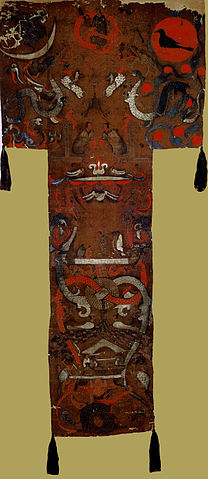
The Han Dynasty ruled China from 206 BCE to 220 CE. It is remembered as a golden age of classical Chinese civilization, with a strong trade economy fueling innovations in science and technology and the arts. Paper, the seismometer, the rotary fan, and waterwheels were all developed by the Han.
Trade was the engine of the Han economy, so it was important to protect the foreign traders who crossed dangerous stretches of land on the western fringes of the Chinese empire to reach Han markets. Trade caravans were easy prey for northern nomadic peoples; the Great Wall had originally been built by the Qin emperor to prevent these northerners from attacking China. Now the Han extended the Great Wall to prevent the nomads from attacking Chinese trade. The wall went farther west until it stretched to over 4,000 kilometers long.
Silk was China’s greatest export. The secrets of raising silkworms, harvesting silk from their cocoons, and spinning raw silk strands into gorgeous fabrics for writing, clothing, and furniture were fiercely guarded by the Han. This meant China had a monopoly on a very valuable product, so traders from the Western world risked great dangers on the Silk Road to acquire it.
The Silk Road trade brought new products to Han China, including western grapes, figs, walnuts, cucumbers, and furs; muslin fabric from India; and glass from Rome. Trade also brought new ideas and religions, like Buddhism, which traveled to China from India and slowly found acceptance there. |
 |



Question
How did the Silk Road help Han China develop into a classical civilization?
