Across the Himalayan Mountains west of China lies the South Asian region we now know as India. India's classical history is just as rich and dramatic as China's, though not nearly as long. Soon after Alexander the Great, from Greece, attempted to invade the region of present-day India, the Magadha king Chandragupta Maurya took over the Indus River Valley and became the first of the Maurya emperors. The Mauryan Empire lasted from 321 until 185 BCE.
The most visible and lasting legacy of the Mauryan Empire is the practice of Buddhism, which was adopted by the Mauryan emperor Ashoka around 260 BCE. Ashoka reigned from 274 to 232 BCE. By the time of Ashoka and the Mauryan Empire, India's system of social stratification--the caste system--was well in place. It had developed very early in India's history, after the Aryans, a group of invaders from the north, settled in the Indus Valley. The Aryans adopted the beliefs and customs of the farming Harrapan culture they displaced, and it is during this period of assimilation that the caste system seems to have emerged.
These tabs will help you understand the caste system--both its origins and how it became less flexible over time.
The Indo-Aryans Arrive
Levels of Social Caste
Caste Becomes Destiny
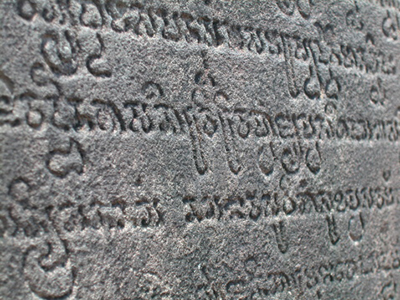
Historians think that the Indo-Aryan people were nomads who entered what is today India from the northwest around 1500 BCE. They assimilated with the people of the Indus Valley civilization and adopted farming. But the Indo-Aryan influence on the Indus people was powerful. The newcomers brought the written language Sanskrit and a new religion.
How did the Indo-Aryans change the Indus Valley civilization?

They brought Sanskrit writing and a new religion. This religion would introduce the caste system to India.
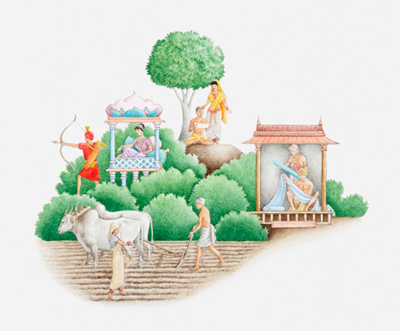
In a caste system, society is organized into hierarchical groups that people are born into based on their wealth, education, race, and/or profession. The Aryan caste system was organized from top to bottom in these categories: the Brahmana, or priests; the Kshatriya, or warriors; the Vaishya, or farmers; and the Shudra, or workers. Originally the caste system was flexible, and people could move between castes.
How was the Aryan caste system organized?
By profession: Priests, warriors/soldiers, farmers, and workers made up the categories.

By Saylor Foundation [CC-BY-3.0 (http://creativecommons.org/licenses/by/3.0)], via Wikimedia Commons
Eventually the caste system in Aryan India became rigid. No amount of power, wealth, beauty, or bravery in battle could result in moving up in the caste system, and no amount of disgrace could result in moving down to a lower caste.
Why might the caste system have become rigid?
People began to believe caste was inherited and could not be changed.
Question
How did the caste system begin? What was it based on?
