The Gupta Empire controlled India from 320 to 550 CE, a time usually considered the Golden Age of India. The Gupta expanded on the knowledge and systems of their Kushan predecessors, and their reign was a time of peace and prosperity. They made great advances in science, mathematics, and technology while adding to India's growing legacy of art, literature, and philosophy. The Kushan empire was a Hindu empire, although Buddhism was officially tolerated and practiced.
Use these flashcards to learn more about the Gupta Empire.
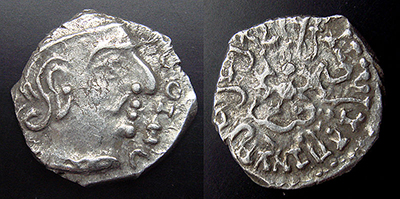
A traveler through the Gupta empire at its height described what he saw in about the year 400 CE, during the reign of Chandragupta II (pictured on this Gupta coin), as he traveled down the Ganges. The empire of 75 million people, according to this traveler, had a pleasant climate, the greatest cities and towns of India, no capital punishment, and many religions. In general the people were happy, rich, prosperous, benevolent, and charitable.
What likely made the Gupta Empire so rich and peaceful?
the wealth it received from the Silk Road trade, and its rulers’ commitment to justice as well as order

Gupta culture produced extraordinary art, from its coins to these great iron pillars, inscribed with decrees from the emperor. This pillar, in Delhi, is 35 feet tall. This kind of cast iron technology was revolutionary, combining pig iron and phosphorus. The Guptas were masters of metal. They even made steel weapons long before the rest of the world.
What was the likely purpose of a pillar like this one?
To show the power of the Gupta rulers, and to make their laws and decrees known to their people.
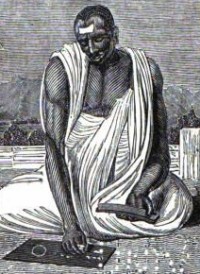
Brahmagupta, who lived from 597 to 668 CE, pioneered the use of zero as a number rather than a placeholder between numbers. This paved the way for the use of negative numbers. The astronomer and mathematician Aryabhata (476-550 CE) proved that the Earth orbited the sun. Gupta astronomers accurately calculated the circumference of the Earth.
How might this scientific activity have been part of a wider speculation about the place of humanity in the cosmos?
Gupta scientists wanted to know how the universe was structured, from the movement of planets to the system of numbers that helped them understand that structure. Once the universe was more known, the place and role of humans in the universe might be better understood.
Summary
 Correct:
 Incorrect:
Question
In what academic areas did India excel under the Gupta Empire?
