As you learned, at the end of a human cheek cell's S phase, there are 46 pairs of sister chromatids, for a total of 92 chromatids. These chromatids are stored in the nucleus of the cell. As a result of the extra chromatids, the cell is much bigger than when the process began. For each of the two daughter cheek cells to receive its proper number of chromosomes, the cell's nucleus must divide. The process of nuclear division is called mitosis.
During mitosis--the first half of the M phase, the nucleus divides into two cell nuclei that contain equal numbers of the duplicated chromosomes. This process ensures that each daughter cell receives the correct number of chromosomes. Once mitosis is completed, the cell undergoes cytokinesis. During cytokinesis, the remaining parts of the cell, called cytoplasm, divide and produce two distinct daughter cells.
Mitosis is the fastest phase in the cell cycle. It only takes an hour for the nucleus and cytoplasm of the parent cell to divide into two daughter cells.
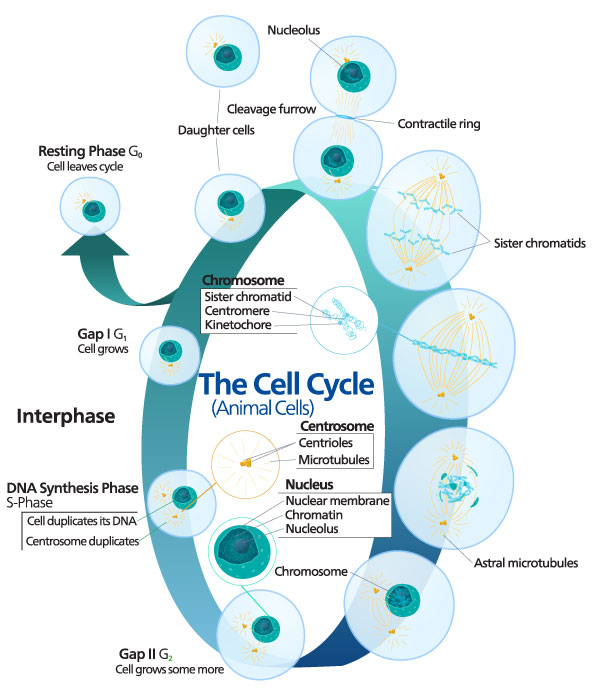
The image below illustrates in detail what happens during the cell cycle. Click the image to see a larger version. Notice what happens to the sister chromatids inside the nucleus of the cell during each phase.
Question
What is the difference between mitosis and cytokinesis?
During cytokinesis, the rest of the cell divides, forming two separate cells--each with its own nucleus.
